
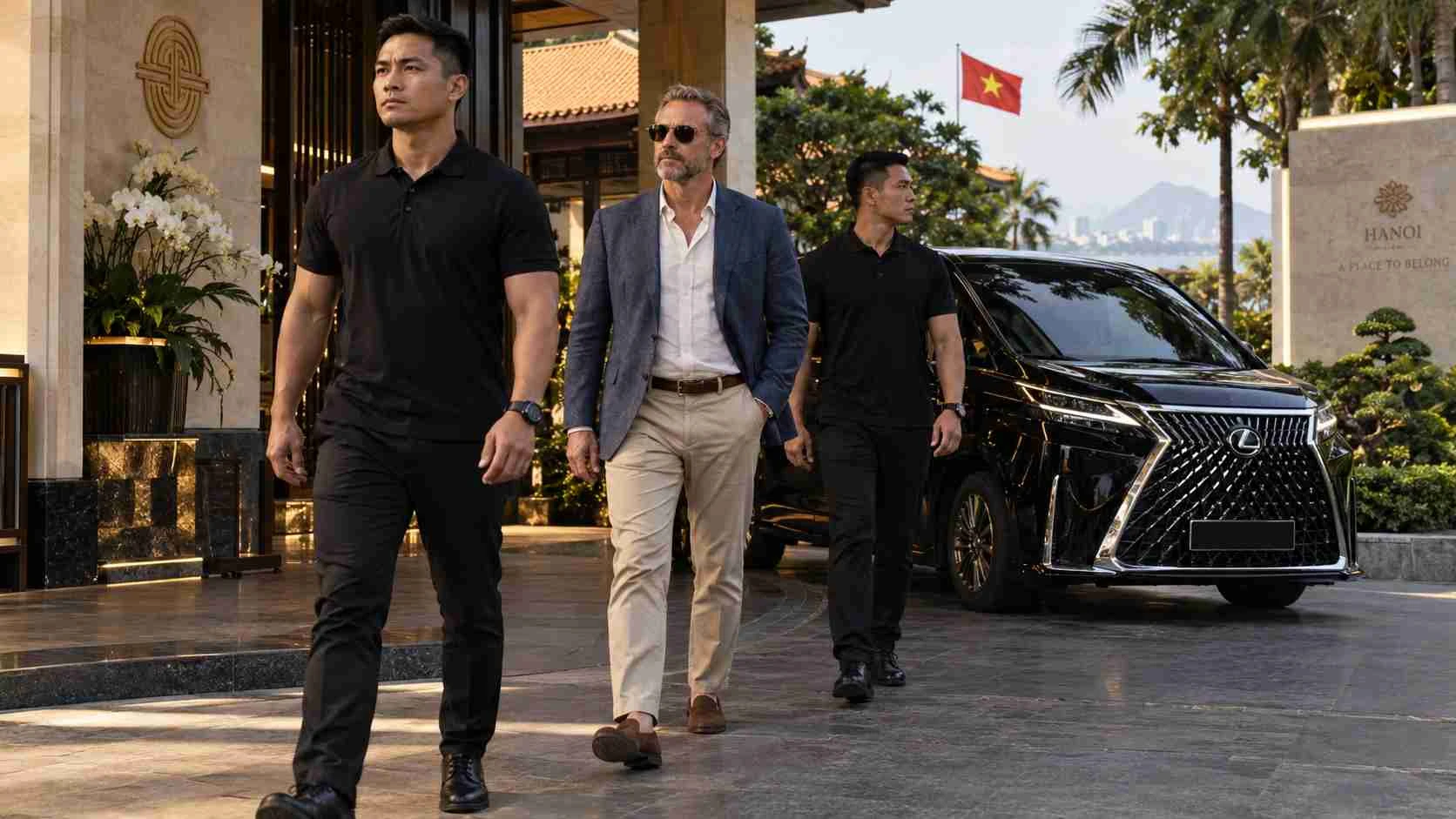
VIETNAM · MANUFACTURING AND MULTI-CITY EXECUTIVE PROTECTION
Bodyguard Services in Vietnam for Manufacturing and Business Leaders
R&H Global Protection coordinates discreet bodyguard services in Vietnam for manufacturing company owners, industrial executives, supplier teams and international investors. A confidential protection brief connects Ho Chi Minh City and Hanoi business gateways with Hanoi and northern manufacturing and any onward travel. Appropriately authorised local personnel are arranged for regulated duties; drivers, venues and property teams retain separate responsibilities.
Part of R&H Global Protection’s international bodyguard services and international executive security capability.
Vietnam Personal Protection at a Glance
Tan Son Nhat (SGN), Noi Bai (HAN) and Da Nang (DAD) airportsTen-week manufacturing expansion
Protect the same company principal while factories, suppliers and domestic flight schedules change. R&H allocates responsibilities against the agreed principal itinerary.
Supplier and engineering sites
Manufacturers retain control of industrial safety, visitor identification, confidential areas and required escorts. Appropriate authorisations and host permissions remain separate.
Vietnam Arrival and Receiving
Ho Chi Minh City and Hanoi business gateways should have an agreed driver, permitted meeting place and first destination before the principal arrives.
Bac Ninh, Hai Phong and Dong Nai
Technical facilities, scheduled inspections and industrial transport must respect factory safety and operator visitor rules. The team reviews realistic travel, staffing and handover requirements.
Direct answer · hiring private protection in Vietnam
Can You Hire a Private Bodyguard in Vietnam?
Yes. R&H Global Protection coordinates discreet bodyguard and executive protection in Vietnam for manufacturing company owners, industrial executives, supplier teams and international investors. Coverage may include Ho Chi Minh City corporate programmes, Hanoi and northern manufacturing and receiving at Tan Son Nhat (SGN), Noi Bai (HAN) and Da Nang (DAD) airports. The indicative officer planning range is USD 800–1,500 per day; the final written quote defines locally authorised personnel, duty hours, separate drivers and any multi-city or residential support. Factory security, plant HSE and supplier access are host-controlled. The travelling detail must be planned around domestic flights, long driver duty and properly authorised local service delivery.
R&H Global Protection · +972-55-9724475 · info@global-protection.net. The accepted scope confirms locally permitted duties, principal count, officer working hours, transport handoffs, relief and additional resources for Vietnam.
Bodyguard · Executive Protection · Close Protection in Vietnam
What Does a Bodyguard in Vietnam Cover?
A bodyguard in Vietnam protects the named principal during an agreed programme of manufacturing expansion, supplier inspections and investment programmes. The officer prepares receiving arrangements, works discreetly around public movements, keeps pace with the principal’s assistant and coordinates with the designated driver. The assignment is designed around real places such as Ho Chi Minh City corporate programmes and Hanoi and northern manufacturing, without turning ordinary business or private appointments into a conspicuous security operation.
Close protection does not automatically include chauffeur work, fixed residential guarding, event-wide crowd management, airport authority, research-campus access or industrial-site safety. When a Vietnam itinerary requires those separate tasks, R&H identifies the competent party and delineates the responsibilities. Factory security, plant HSE and supplier access are host-controlled. The travelling detail must be planned around domestic flights, long driver duty and properly authorised local service delivery. If protected people follow different routes simultaneously, additional staffing may be necessary.
Vietnam Protective Planning
Executive Protection in Vietnam for Manufacturing Company Owners
R&H Global Protection structures a Vietnam detail around the protected person, not a generic security package. These operating situations show how airport reception, confidentiality, hosted access and parallel movements change across manufacturing expansion, supplier inspections and investment programmes. Locally required permissions and professional boundaries are checked before the duties are accepted.
Clear responsibility.
Agree the principal profile, decision-making contact, arrival gateway and each handoff before the schedule begins. Protect the same company principal while factories, suppliers and domestic flight schedules change.
Ten-week manufacturing expansion
Protect the same company principal while factories, suppliers and domestic flight schedules change. R&H documents this responsibility for the actual Vietnam visit rather than relying on an assumption.
Supplier and engineering sites
Manufacturers retain control of industrial safety, visitor identification, confidential areas and required escorts. R&H documents this responsibility for the actual Vietnam visit rather than relying on an assumption.
Factory transfers and domestic flights
Separate airside operator rules, principal collection and vehicle duty for northern and southern branches. R&H documents this responsibility for the actual Vietnam visit rather than relying on an assumption.
Regional management continuity
A single international briefing can connect changing Vietnamese cities while locally regulated duties use eligible providers. R&H documents this responsibility for the actual Vietnam visit rather than relying on an assumption.
Vietnam Close Protection Services
Close Protection in Vietnam: Personal and Supporting Services
The ten capabilities below distinguish principal-focused protection from transportation, residence, venue and specialist support. A tailored proposal for Vietnam selects the services actually needed for manufacturing expansion, supplier inspections and investment programmes, specifying the duties and locally compliant providers rather than bundling unrelated functions into an officer rate.
Executive Protection in Vietnam
R&H can plan an unobtrusive principal-focused detail across Ho Chi Minh City corporate programmes and Hanoi and northern manufacturing. Assistant contacts, access windows and driver receiving are agreed with the executive before each substantial movement.
Private Bodyguard and VIP Protection in Vietnam
A private principal may need closer support through public approaches or event arrivals, followed by a lighter presence at confidential appointments. The level of visibility is adapted to Vietnam hospitality and meeting contexts.
Family Protection in Vietnam
Parents, partners and children can be supported during compatible shared itineraries. Independent family activities and unattended properties are reviewed separately, especially when the itinerary includes Bac Ninh, Hai Phong and Dong Nai.
Female Bodyguard Requests in Vietnam
R&H can review a request for a female close-protection professional or particular language skills, subject to qualified local candidates and a confirmed deployment plan. Neither profile nor nationality overrides security-licensing requirements.
Airport and Arrival Receiving for Vietnam
The first handoff may take place at Tan Son Nhat (SGN), Noi Bai (HAN) and Da Nang (DAD) airports. The responsible driver and officer confirm the permitted meeting point, luggage and receiving contact; restricted airport or private-terminal access remains with the operator.
Bodyguard and Security Driver in Vietnam
The personal officer and an independent professional driver coordinate an executive vehicle around Ho Chi Minh City and Hanoi business gateways. Road sectors, overtime terms, fuel or mileage and passenger count are defined as separate duties in the service scope.
Residential and Private Property Coordination in Vietnam
Family residences, private homes or hotel suites near Bac Ninh, Hai Phong and Dong Nai may need advance liaison with managers and staff. Fixed security posts and overnight property coverage require their own staffing plan.
Supplier and engineering sites
Manufacturers retain control of industrial safety, visitor identification, confidential areas and required escorts. These interfaces are confirmed before a visiting officer accompanies a principal into any venue, site or event, and the host remains responsible for its own operations.
Protective Advance Planning in Vietnam
Advance preparation identifies SGN, HAN and domestic airports, arrival timing, main appointments and the person who can approve revisions. R&H limits itinerary information to personnel who require it for the accepted assignment.
Long-Term Close Protection in Vietnam
An extended Vietnam detail benefits from learning the principal’s routine while preserving officer relief, appropriate local authorisations and reliable transport. Multi-week continuity should never be based on unsafe round-the-clock duty by one individual.
Vietnam Client Profiles
Who Hires Bodyguards and Executive Protection in Vietnam?
Protection in Vietnam serves different clients depending on public exposure, confidentiality, family responsibilities and the pace of the itinerary. The following profiles illustrate real planning needs; each assignment must name its principals and determine whether simultaneous activities justify extra officers.
Manufacturing Company Owners
Owners evaluating new suppliers need consistent personal protection across changing factory schedules.
Industrial Project Directors
Project managers may combine site inspections with confidential executive meetings.
Corporate Expansion Executives
Senior leaders moving between Hanoi and Ho Chi Minh City benefit from one travel brief.
Technology and Electronics Investors
Visitors discussing proprietary engineering programmes need privacy and host approval.
Supply-Chain Due-Diligence Teams
Auditors visiting multiple plants need timed transport and documented entry procedures.
International Board Delegations
Groups with different arrival flights need clear vehicle and receiving responsibilities.
Long-Term Corporate Residents
Multi-month principals may require recurring drivers, duty relief and family coordination.
Foreign Supplier Representatives
Visiting executives often need formal meeting escort planning while avoiding restricted plant access assumptions.
Israeli-led Protective Methodology
Protection Planning Adapted to Vietnam
R&H Global Protection begins with a confidential principal brief for manufacturing expansion, supplier inspections and investment programmes. The planning team reviews Ho Chi Minh City and Hanoi business gateways, confirms the assistants and drivers involved, and maps the real appointments across Ho Chi Minh City corporate programmes and Hanoi and northern manufacturing. Protect the same company principal while factories, suppliers and domestic flight schedules change. Any separate venue, medical, event or technical safety responsibility is made explicit.
Israeli-led planning maintains the client’s confidentiality, assignment priorities and continuity. In Vietnam, locally regulated protection is assigned only through resources eligible for the actual service. Vietnam treats security-service business activities as a regulated business sector, with security-and-order conditions under Decree 96/2016/ND-CP and applicable amendments. Verify the current provider eligibility, personnel, immigration and work-authorisation position for the exact security activity; an overseas adviser is not automatically authorised to act as a Vietnamese guard. When a new city, host, aircraft or regional road movement is added, the team rechecks access, transport, personnel permissions and staff relief before extending the written scope.
Operating principle
Quiet preparation. Clear responsibility. Flexible execution.- AdvanceConfirm Tan Son Nhat (SGN), Noi Bai (HAN) and Da Nang (DAD) airports, first accommodation and the host contact for Ho Chi Minh City corporate programmes before travel.
- DiscretionRestrict Vietnam flight, family, guest and business information to people with operational responsibility.
- Separate rolesThe officer protects the principal, while drivers and Hanoi and northern manufacturing hosts retain their own defined duties.
- AdaptabilityReview additional guests, changed SGN, HAN and domestic airports visits and revised collection times before the programme shifts.
- ReviewFor longer Vietnam deployments, reconfirm officer relief, applicable licensing, vehicles and locally controlled entry permissions.
Assignment continuity The working brief is updated when the client changes a flight, host, venue or onward destination. R&H reconfirms the permitted protection duties, available driver, appropriate staff relief and necessary permissions for Vietnam.
Vietnam Operating Context
Where the Protection Plan Changes in Vietnam
Vietnam protection combines specific geography, visiting-client priorities and separate responsibilities for each host. The locations below illustrate how a plan can change between business, private and arrival settings; naming a place does not imply an R&H office, a partnership or guaranteed admission.
Ho Chi Minh City corporate programmes
Southern office schedules mix investment meetings, industrial suppliers and city transport demands.
Hanoi and northern manufacturing
Institutional appointments and northern factory clusters require hosts who control site-entry permissions.
SGN, HAN and domestic airports
Flights between cities need confirmed terminal, baggage, driver and destination-side receiving contacts.
Bac Ninh, Hai Phong and Dong Nai
Technical facilities, scheduled inspections and industrial transport must respect factory safety and operator visitor rules.
Check Tan Son Nhat (SGN), Noi Bai (HAN) and Da Nang (DAD) airports, terminal or operator, passenger baggage and a nominated landside driver before the first movement.
Share the first host contact, permitted entry point and meeting start with the assistant; Southern office schedules mix investment meetings, industrial suppliers and city transport demands.
Keep the principal-focused detail aligned with business or family plans. Protect the same company principal while factories, suppliers and domestic flight schedules change.
Allow time for the next hosted appointment and verify the visitor procedure. Institutional appointments and northern factory clusters require hosts who control site-entry permissions.
Confirm evening vehicle collection and any change of duty or receiving team. A single international briefing can connect changing Vietnamese cities while locally regulated duties use eligible providers.
Planning note: Named sites are examples of the local operating environment, not endorsed partners, confirmed premises or guaranteed protected routes. The accepted daily itinerary controls the service.
Vietnam Assigned Team
Professional Standards for Your Vietnam Detail
R&H Global Protection matches the Vietnam protection team to the principal’s itinerary and locally permitted roles. The international planning function handles continuity; paid security activity requires appropriate local authority. Each officer, driver, property guard and venue host retains a distinct responsibility, so one person is not assigned simultaneous incompatible duties.
One client profile. Clear responsibility. Locally authorised delivery. Factory security, plant HSE and supplier access are host-controlled. The travelling detail must be planned around domestic flights, long driver duty and properly authorised local service delivery.
Personnel understand the context of manufacturing expansion, supplier inspections and investment programmes and keep a consistent, discreet client-facing profile. Protect the same company principal while factories, suppliers and domestic flight schedules change.
Officers observe venue credentials, operator authority and lawful personal-security duties. Manufacturers retain control of industrial safety, visitor identification, confidential areas and required escorts.
Meeting lists, residence details and principal preferences are shared only with agreed receiving contacts, drivers or relevant client staff.
Confirm the terminal, operator or arrival time and permitted ground handoff before booking a driver and officer.
The selected protective plan accounts for local conditions rather than imposing one standard route. Separate airside operator rules, principal collection and vehicle duty for northern and southern branches.
The team plans days off, vehicle continuity and support responsibilities without expecting one officer to cover all simultaneous or overnight duties.
Vietnam / Hiring Process
How to Arrange Close Protection in Vietnam
Send R&H a confidential, practical outline of your Vietnam programme. The six steps below turn the real principal needs, local venue permissions, officer credentials and transport arrangements into a written proposal before the assignment begins.
Define the principals and dates
Tell R&H who requires protection, the planned duration, core purpose (manufacturing expansion, supplier inspections and investment programmes) and any additional family or executive principals.
Confirm Vietnam airport or arrival point
Identify Tan Son Nhat (SGN), Noi Bai (HAN) and Da Nang (DAD) airports, flight details, any charter operator and the first accommodation or meeting address. Restricted airport access must be approved by the operator.
Map meetings and host permissions
List appointments around Ho Chi Minh City corporate programmes and Hanoi and northern manufacturing; provide venue contacts and access requirements instead of assuming that a security officer can enter.
Identify simultaneous movements
Explain whether colleagues, family members or guests split between different locations. One bodyguard cannot follow two separate itineraries at the same time.
Confirm vehicle and supporting staff
State which driver, car, private residence or event services are already provided, and which R&H should quote separately. A single international briefing can connect changing Vietnamese cities while locally regulated duties use eligible providers.
Verify local delivery and quotation
R&H reviews jurisdiction-appropriate security credentials, officer duty hours, armed requests, driver roles, logistical costs and any exclusions. The written scope must be accepted before mobilisation.
Vietnam Service Models
Choose the Right Protection Model in Vietnam
Each Vietnam programme is staffed against the actual protected people, access limitations and journey lengths. The options below are working arrangements, not automatic packages; driver and vehicle services, residences, events and specialist resources are individually scoped.
The team follows the principal’s actual Vietnam schedule. Transportation, private residences, venue permissions and any specialist support retain their own boundaries so the protection brief stays workable.
- Ten-week manufacturing expansionProtect the same company principal while factories, suppliers and domestic flight schedules change. A dedicated officer or relief team follows agreed working hours; accommodation, local authorisation and rest are confirmed before mobilisation.
- Executive with security driverA principal-focused officer and independent driver can connect Ho Chi Minh City and Hanoi business gateways with business or private appointments without combining unrelated licence or transport responsibilities.
- Manufacturing Company Owners and private meetingsKeep the principal’s calendar private while coordinating hosted venues around Ho Chi Minh City corporate programmes and Hanoi and northern manufacturing. Changes pass through the named assistant.
- Supplier and engineering sitesManufacturers retain control of industrial safety, visitor identification, confidential areas and required escorts. The local provider agrees permissible protection duties and contacts before entry.
- Family or delegation extensionsWhen two principals or groups move at the same time, quote the additional officers and drivers actually required instead of dividing one officer between incompatible routes.
- Bac Ninh, Hai Phong and Dong Nai extensionTechnical facilities, scheduled inspections and industrial transport must respect factory safety and operator visitor rules. A regional or overnight extension can change driver duty, accommodation and receiving-team requirements.
Vietnam / Transparent Pricing
How Much Does a Bodyguard in Vietnam Cost?
R&H Global Protection’s published indicative Vietnam range is USD 800–1,500 per bodyguard per day. The actual proposal depends on the agreed officer duty, local authorisation, route complexity and team size. Vehicles, drivers, flights, accommodation, boats, site support or separately staffed residential duties are itemised when required. This is not a guaranteed fixed package.
A quote covers the accepted Vietnam officer duty window; early travel, late events and relief are planned openly. A daily rate does not mean that one individual provides continuous 24-hour coverage.
Separate movements by executives, partners, children or delegates may require additional professional officers. Staffing is based on simultaneous protection needs and not the apparent size of an entourage.
Professional transport is sized for Tan Son Nhat (SGN), Noi Bai (HAN) and Da Nang (DAD) airports, passengers, luggage and the daily itinerary. Vehicle class, waiting, mileage, fuel and applicable transport fees are itemised where required.
Private properties, sites and hosts around Bac Ninh, Hai Phong and Dong Nai retain control of their own entry rules. Fixed residence guards, specialist support and any separate event security are distinct from mobile bodyguard protection.
Travel covering Hai Phong, Bac Ninh, Dong Nai and other industrial zones may add long ground sectors, overnight stays, driver relief or another licensed receiving team; the quotation defines each transition.
Extended protection programmes can involve accommodation, travel, scheduled officer rest and mobilisation costs. Payment stages, committed expenses and cancellation terms belong in the accepted written proposal.
Team Configurations for Vietnam Protection
An appropriately authorised individual bodyguard follows the accepted Vietnam principal itinerary; transport may be separate.
A qualified protective officer and dedicated driver share arrival instructions for Tan Son Nhat (SGN), Noi Bai (HAN) and Da Nang (DAD) airports and the confirmed business or family schedule.
Mobile protection for named family members, plus separately assigned property-security personnel if the residence must be staffed when they depart.
Extra professionals for simultaneous routes, longer drives or access-controlled meetings around Bac Ninh, Hai Phong and Dong Nai; pricing follows the actual scope.
per officer / per day. Vehicles, drivers, multi-officer details, residence posts, travel, accommodation, taxes and higher-complexity requirements can cost extra. Working hours and final prices are confirmed in writing.
Vietnam Coverage and Compliance
Personal Security in Vietnam and the Wider Itinerary
Coverage follows the agreed Vietnam itinerary, not an unrestricted promise of nationwide or site access. These operating areas explain where transport, venue permissions, property security and locally authorised personnel may change during the client’s schedule. The relevant government sources below describe the regulatory context, not a licence held by R&H.
Vietnam
Protection companies and personnel must have the permissions relevant to the actual Vietnam activity. Vietnam treats security-service business activities as a regulated business sector, with security-and-order conditions under Decree 96/2016/ND-CP and applicable amendments. Verify the current provider eligibility, personnel, immigration and work-authorisation position for the exact security activity; an overseas adviser is not automatically authorised to act as a Vietnamese guard.
In Vietnam, southern office schedules mix investment meetings, industrial suppliers and city transport demands. R&H specifies the principal receiving contact, venue restrictions and driver route where relevant.
The assignment review records the receiving host and authorised officer role. Institutional appointments and northern factory clusters require hosts who control site-entry permissions.
Where the principal travels in this part of Vietnam, flights between cities need confirmed terminal, baggage, driver and destination-side receiving contacts. Driver hours and the next duty are planned separately.
For this wider Vietnam stage, technical facilities, scheduled inspections and industrial transport must respect factory safety and operator visitor rules. Any extra team or overnight cost must be accepted in advance.
When the principal continues beyond Vietnam, R&H reconfirms the receiving driver and local security authorisation. An officer’s ability to travel does not automatically permit regulated duties in the next country or locality.
Official regulator and government links describe the legal framework; they do not certify R&H or a proposed local partner. The precise duties, current legal status and credentials must be verified before deployment.
Vietnam / Why R&H Global Protection
Why Choose R&H Global Protection in Vietnam?
An effective Vietnam executive detail should fit the client’s work or family schedule, not become the centre of attention. R&H’s planning emphasis is an accountable brief, practical local knowledge, clear driver and venue responsibilities, appropriate credentials, confidentiality and sustainable coverage over the accepted assignment.
Ten-week manufacturing expansion
Protect the same company principal while factories, suppliers and domestic flight schedules change. The programme stays centred on the principal and an agreed client representative.
Supplier and engineering sites
Manufacturers retain control of industrial safety, visitor identification, confidential areas and required escorts. Local partners or security functions are checked rather than described as automatic entitlements.
Confidential Vietnam communications
Business and family plans, guest names and private receiving information stay with the authorised client liaison and essential team members.
Airport and driver coordination
Confirm Tan Son Nhat (SGN), Noi Bai (HAN) and Da Nang (DAD) airports, the selected vehicle, any operator rules and the first appointment before the executive reaches the pickup point.
Factory transfers and domestic flights
Separate airside operator rules, principal collection and vehicle duty for northern and southern branches. A practical travel plan includes realistic transfer and departure arrangements.
Regional management continuity
A single international briefing can connect changing Vietnamese cities while locally regulated duties use eligible providers. R&H reviews changes against duty hours, licensing and the proposed protective resources.
“I spent around ten weeks in Vietnam while working on a manufacturing expansion programme that required regular travel between Ho Chi Minh City, Hanoi and several industrial locations. My schedule included factory inspections, supplier meetings, corporate dinners and frequent domestic flights. R&H Global Protection provided continuity throughout the programme and coordinated closely with my local management and transportation teams. Factory days required a different approach from executive meetings, and the officer adjusted naturally between the two. The schedule changed frequently as new supplier visits were added, but the security arrangements remained organised from start to finish. Having the same support across several parts of Vietnam was particularly valuable.”
International Protection Continuity
Connect Your Vietnam Assignment to Onward Travel
Within Vietnam, principals may travel to another city or continue abroad. R&H retains the principal’s confidentiality preferences and programme context, then reconfirms receiving drivers, accommodation, duty schedules, access permissions and the lawful local security team for the next stage.
Related destinations: Hanoi · Ho Chi Minh City · Tanzania · Indonesia · Morocco · Kenya · South Africa · Paris · London · Monaco · Dubai · Abu Dhabi · Singapore · Hong Kong · New York · Milan · Rome · Madrid · Geneva · Zurich
Explore International Bodyguard ServicesVietnam · Confidential Protection Enquiry
Hire a Bodyguard in Vietnam
To discuss protection in Vietnam, share the dates, principal and family count, arrival gateway, hotels or residences, meeting and event schedule, driver or executive vehicle requirements, and any known concerns. Mention intended visits involving Ho Chi Minh City corporate programmes or Hanoi and northern manufacturing and onward destinations. R&H Global Protection will review feasible, locally compliant delivery and quote the accepted scope. Send sensitive personal documents only through a suitable secure channel.
Opening WhatsApp drafts an enquiry; it does not confirm a reservation, accepted assignment or payment obligation.
Vietnam Bodyguard Questions
Frequently Asked Questions About Protection in Vietnam
Ten concise answers for clients comparing Vietnam bodyguard services: indicative prices, lawful local security, airport receiving, dedicated drivers, business visits, family requirements and longer-term planning. Each answer describes a practical service rather than guaranteeing restricted access or immediate availability.
How much do bodyguard services in Vietnam cost?
R&H Global Protection’s indicative planning range in Vietnam is USD 800–1,500 per officer per day. The final quote reflects how long protection is needed, the number of principals and travel between Ho Chi Minh City corporate programmes and SGN, HAN and domestic airports. Drivers, vehicles, flights, accommodation, separately staffed residences and additional authorised security are normally quoted apart from the officer fee.
Can I hire a professional bodyguard in Vietnam?
Yes. R&H Global Protection can assess executive and private protection in Vietnam for manufacturing company owners, industrial executives, supplier teams and international investors. Share the main locations, dates, number of protected people and preferred level of discretion. The company will review lawful staffing, transport and the intended duties before proposing a team. Enquiring does not guarantee officer availability or reserve personnel.
Are bodyguards in Vietnam armed or unarmed?
Unarmed protection is generally the starting point for privately arranged assignments in Vietnam. An armed component cannot be promised without checking local law, individual firearms authorisations and venue restrictions. R&H Global Protection assesses the actual requirement and uses appropriately authorised local resources where a lawful option exists. Prior military experience alone is not permission to carry a firearm.
What licences apply to private protection in Vietnam?
Vietnam treats security-service business activities as a regulated business sector, with security-and-order conditions under Decree 96/2016/ND-CP and applicable amendments. Verify the current provider eligibility, personnel, immigration and work-authorisation position for the exact security activity; an overseas adviser is not automatically authorised to act as a Vietnamese guard.
Can protection begin at the airport in Vietnam?
Yes. Airport receiving can be planned for Tan Son Nhat (SGN), Noi Bai (HAN) and Da Nang (DAD) airports, with the arrival flight, luggage, nominated driver and first destination confirmed before the principal lands. A close-protection officer can accompany the traveller through permitted public areas and onward ground transport. Airport operators retain control of restricted zones, private terminals and any required access permissions.
Can bodyguard services in Vietnam cover factories in several cities?
Yes, subject to each factory’s entry rules and locally lawful protection arrangements. R&H can coordinate one Vietnam executive programme across Ho Chi Minh City, Hanoi and industrial regions with advance drivers and domestic receiving. Plant access, visitor clearance and workplace safety stay under the operator; locally regulated guarding must be performed by eligible providers.
Can I combine a bodyguard and security driver in Vietnam?
Yes. R&H can scope a principal-focused officer with a separate professional driver and suitable vehicle for Ho Chi Minh City and Hanoi business gateways. The driver handles route timing, permitted waiting and vehicle logistics so the bodyguard remains attentive to the protected person. Vehicle class, working hours, mileage, overtime rules and additional journeys are agreed in writing and are not automatically included in the officer rate.
Can you protect private families and residences in Vietnam?
Yes. Family protection in Vietnam can cover agreed arrivals, outings, dining and private appointments, coordinated discreetly with household or hotel staff. Where children and adults travel separately, the team may need additional officers. An unattended villa, office or residence requires separately assigned property security; mobile close protection does not provide continuous guarding of an empty property.
Do you provide long-term or multi-location security in Vietnam?
Yes. Multi-week executive assignments can be planned in Vietnam, including travel toward Hai Phong, Bac Ninh, Dong Nai and other industrial zones. R&H reviews officer relief, local legal requirements, driver duties and every destination’s receiving arrangement. Additional days, flights, regional accommodation or simultaneous principal movements may affect the proposal; continuity of the client brief does not automatically make one officer authorised for every location.
How do I arrange close protection in Vietnam?
Send R&H Global Protection the proposed dates, principal count, arrival point and main meetings or family plans in Vietnam. Include relevant stops around Ho Chi Minh City corporate programmes and Hanoi and northern manufacturing, plus any driver, villa, project-site or onward travel needs. R&H will clarify legal delivery, staffing, expected hours, exclusions and pricing, then provide a written scope for approval.