
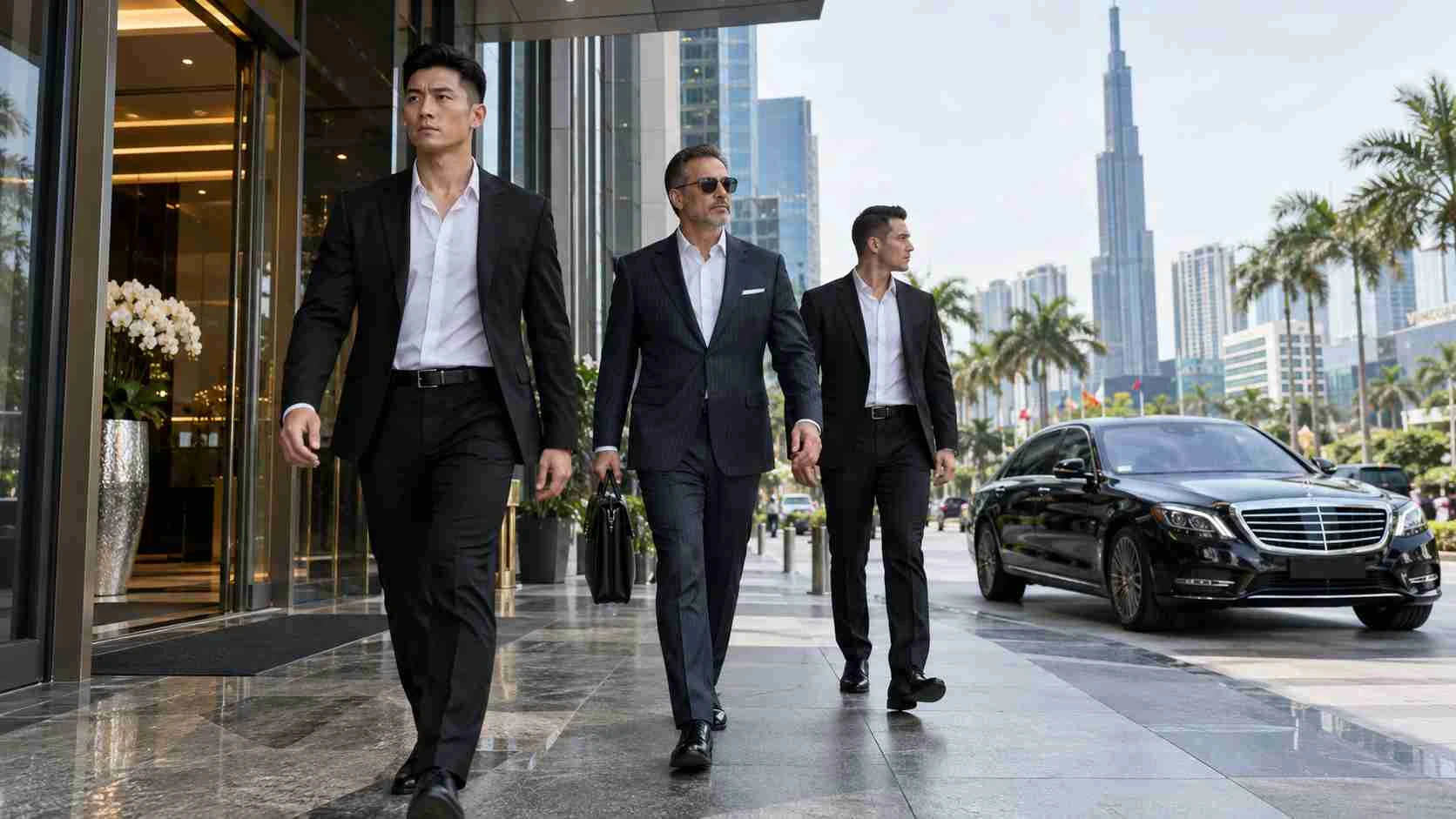
HO CHI MINH CITY · EXECUTIVE · FAMILY · PRIVATE PROTECTION
Bodyguard Services in Ho Chi Minh City for Executives & VIP Clients
R&H Global Protection coordinates bodyguard and executive protection in Ho Chi Minh City for executives, families, VIP visitors and private clients. The detail is built around the real itinerary—SGN arrivals, District 1 and District 3 commitments, manufacturing visits, investment meetings and regional industrial travel, and any onward stage toward Hanoi—while the appropriate Vietnam delivery structure is confirmed for regulated duties before deployment.
Part of R&H Global Protection’s bodyguard services in Vietnam and international protection capability.
Ho Chi Minh City Personal Protection at a Glance
SGNManufacturing Executive Protection
Discreet support for business owners and manufacturing leaders working between city meetings and production environments.
Investment & Corporate Programmes
Principal protection for investor meetings, advisers, private dinners and changing corporate schedules.
SGN Airport Movements
Tan Son Nhat receiving connected to the first protected destination and executive vehicle.
Factory & Industrial Area Travel
Planned continuation to Thu Duc, Bình Dương, Đồng Nai or other confirmed industrial areas with host and transport responsibilities defined.
Direct answer · hiring private protection in Ho Chi Minh City
Can You Hire a Private Bodyguard in Ho Chi Minh City?
Yes. R&H Global Protection can coordinate private bodyguard and executive protection in Ho Chi Minh City for a defined business, family, event, seasonal or long-term requirement. Share the dates, protected people, SGN arrival where relevant, broad programme, and whether a dedicated driver, property coverage or onward travel is needed. The provider, personnel and role required for lawful Vietnam delivery are confirmed before the assignment begins.
R&H Global Protection · +972-55-9724475 · info@global-protection.net. Dates, staffing, duty hours and lawful local delivery are confirmed for the assignment.
Bodyguard · Executive Protection · Close Protection in Ho Chi Minh City
What Does a Bodyguard in Ho Chi Minh City Cover?
A Ho Chi Minh City bodyguard accompanies the principal through the agreed business or private programme and prepares for the transitions that matter: airport receiving, hotel or residence departures, executive meetings, public arrivals, family movements and hosted appointments. The officer’s presentation and proximity should fit the setting, from a confidential meeting in District 1 to manufacturing visits, investment meetings and regional industrial travel where public visibility and access conditions may be very different.
The personal-protection role does not automatically include chauffeur driving, event-wide security, property guarding, yacht or boat crew functions, hotel security or unrestricted airport services. R&H Global Protection can coordinate these supporting responsibilities separately, including a dedicated driver and executive vehicle, additional officers for split family schedules and a separately staffed residence or property function.
Ho Chi Minh City Protection Planning
Executive Protection in Ho Chi Minh City for Manufacturing, Investment, Corporate and Long-Term Executive Programmes in Ho Chi Minh City
R&H structures executive protection in Ho Chi Minh City around the principal’s real exposure: confidential meetings, public or event visibility, private hospitality, family schedules and onward travel. The objective is discreet continuity with clearly assigned responsibilities, not unnecessary visibility or a larger team by default.
Private confidence.
Start with the protected people, their priorities and the responsibilities that must run at the same time. Agree the personal detail, supporting resources and lawful local delivery before treating the programme as confirmed.
Investment and manufacturing confidentiality
A Ho Chi Minh City business owner may move between investors, partners and production teams. The officer receives the schedule and access information needed for movement while commercial details remain with the authorised business contact.
City-to-factory transitions
A District 1 meeting is operationally different from a factory or industrial park visit. Journey time, site host, PPE, visitor access and photography rules are checked before the principal leaves the city phase.
Local driver and business-team coordination
Early starts and longer industrial movements work best when the driver, business team and officer share the next hard time while retaining distinct responsibilities for transport, site access and personal protection.
Two-month assignment consistency
A retained detail becomes more effective as the officer learns the client’s working rhythm, but relief and regional travel are still reviewed when the manufacturing programme changes.
Ho Chi Minh City Close Protection Services
Close Protection in Ho Chi Minh City: Personal and Supporting Services
The service mix below keeps the bodyguard role principal-focused while showing where drivers, residences, events and regional movement need their own resources. Each responsibility is confirmed in the written brief so one officer is not quietly expected to cover several incompatible duties.
Executive Protection in Ho Chi Minh City
Discreet executive protection for investment meetings, manufacturing programmes, factory visits, partner dinners and regional industrial travel. The officer works from the principal’s confirmed programme, keeps schedule details need-to-know and coordinates with the authorised assistant, driver and host contacts without making protection the focus of every arrival.
Private Bodyguard and VIP Protection in Ho Chi Minh City
Low-profile personal protection for executives, VIP visitors, founders, public figures and private clients moving through District 1, District 3 and other confirmed locations. Proximity changes with the environment while responsibility for the named principal remains clear.
Family and UHNW Protection in Ho Chi Minh City
Family protection can support parents, children, carers, guests and household staff within an agreed programme. Where family members separate, staffing is increased rather than implying that one officer can meaningfully cover simultaneous movements.
Female Bodyguard Requests in Ho Chi Minh City
Female protection professionals can be requested for executive, family or privacy-sensitive assignments. Availability, languages, professional fit and the local delivery requirements are checked before commitment.
SGN Airport Bodyguard Reception
Airport protection begins at the agreed meeting point once the flight, passenger group, luggage, receiving vehicle and first protected destination are known. Restricted-area, immigration, lounge or airside services remain separate unless specifically arranged.
Bodyguard, Security Driver and Executive Vehicle in Ho Chi Minh City
A dedicated security driver can keep the vehicle available while the bodyguard remains with the principal through offices, hotels, venues and pedestrian phases. Vehicle class, waiting, passenger requirements and driver hours are quoted separately from the bodyguard role.
Residential and Private-Property Security in Ho Chi Minh City
Separately staffed residential protection can be added for a long-stay base, apartment, villa or private residence. The mobile officer accompanying the principal should not simultaneously be counted as the person maintaining a fixed property post.
Manufacturing and Investment Programme Protection
Manufacturing programmes can extend from District 1 meetings to factories and industrial areas outside the centre. The team confirms driver hours, site host, visitor procedures and the final responsibility point before each longer movement.
Protective Assessment and Advance Planning in Ho Chi Minh City
Advance planning can cover arrival points, host contacts, property access, public exposure, driver rejoin locations and the transition into regional travel. Sensitive tactical details remain private and are never published as a fixed route.
Long-Term Close Protection in Ho Chi Minh City
Retained assignments begin with officer matching, introductions, working patterns, relief, privacy preferences and an authorised management contact. The plan is reviewed as the principal’s business exposure, household routine or regional travel changes.
Ho Chi Minh City Client Profiles
Who Hires Bodyguards and Executive Protection in Ho Chi Minh City?
Ho Chi Minh City assignments often combine investment discussions with manufacturing or factory access. Business owners, project leaders and long-term executives need protection that can stay discreet in city meetings and become more structured for industrial travel outside the centre.
Manufacturing Executives
Manufacturing Executives can move from city offices to controlled worksites or industrial areas where visitor rules, PPE, photography restrictions and host escorts may differ. Those interfaces should be confirmed before departure.
International Business Owners
International Business Owners in Ho Chi Minh City require a protection plan built around their actual schedule, privacy needs, transport and local hosts rather than a generic fixed route.
Investors
Investors benefit from confidential coordination between advisers, drivers and meeting hosts, particularly when appointments are added with little notice or extend beyond District 1 into unfamiliar parts of Vietnam.
Industrial Project Leaders
Industrial Project Leaders can move from city offices to controlled worksites or industrial areas where visitor rules, PPE, photography restrictions and host escorts may differ. Those interfaces should be confirmed before departure.
Corporate Directors
Corporate Directors usually need predictable movement between District 1, District 3, hotels and private engagements while assistants retain control of sensitive diary changes. The officer should fit naturally into the business environment.
Family Offices
Family Offices often coordinate principals, advisers, household staff, vehicles and residences under one management contact. Each simultaneous duty should still have its own staffing rather than being blurred into one officer’s role.
Private Families
Private Families need protection that is comfortable around children, household staff and private time. The officer should become familiar with the routine without making normal family life feel organised around security.
Long-Term Vietnam-Based Executives
Long-Term Vietnam-Based Executives usually need predictable movement between District 1, District 3, hotels and private engagements while assistants retain control of sensitive diary changes. The officer should fit naturally into the business environment.
Israeli-Led Protective Methodology
Protection Planning Adapted to Ho Chi Minh City
Ho Chi Minh City executive protection must bridge a central business routine with manufacturing and industrial travel. R&H plans each factory or regional stage around the site host, vehicle, journey time and access rules while keeping the city meeting programme discreet and flexible.
In Ho Chi Minh City, the method is adapted to city meetings, factory visits, early starts, industrial-region travel and changing partner schedules. The team prepares the next transition, coordinates the people who actually own access or transport, and keeps the principal’s information compartmented. Local authorisation remains a separate requirement: international experience does not automatically permit regulated work in Vietnam.
Operating principle
Quiet preparation. Clear responsibility. Flexible execution.- AdvanceBuild the next movement from the real hard time, host and arrival point rather than relying on a fixed published route.
- DiscretionShare principal information only with the people who need it and keep private addresses, family routines and concerns off public channels.
- Separation of rolesKeep personal protection, driving, property security and venue-wide functions distinct even when they support one client programme.
- AdaptabilityUpdate the plan when city meetings, factory visits, early starts, industrial-region travel and changing partner schedules change the operating picture, while keeping the principal experience calm and consistent.
- ReviewFor retained assignments, review staffing, relief, transport and local delivery whenever the family or business routine changes materially.
Ho Chi Minh City Local Operating Context
Where the Ho Chi Minh City Protection Plan Changes
Ho Chi Minh City is not one operating environment. Airport arrival, business districts, public or event phases, private properties and regional extensions create different access and movement conditions. The detail should recognise those differences without publishing rigid tactical routes.
SGN and the first hard time
The arrival plan should connect flight, baggage, passenger count and vehicle loading to the first real commitment in District 1 or District 3. A generous but undefined airport buffer is less useful than knowing the first host, entrance and responsibility point.
District 1 and District 3
These areas can involve different building, hotel, street or vehicle-access conditions. The officer and driver should know the correct entrance, host contact and rejoin plan before the principal leaves the previous location.
Thu Duc City and manufacturing visits
This phase can change crowd density, access rules and the amount of public visibility. Venue or property security remains responsible for its own controlled space while the travelling detail focuses on the named principal and the next movement.
Bình Dương / Đồng Nai continuity
Longer or less predictable sectors affect driver hours, luggage, relief and the final release. Treat the extension as its own operational phase instead of allowing a city detail to drift into open-ended standby.
Confirm arrival, baggage, receiving vehicle and first hard time.
Advance the actual entrance, host and vehicle rejoin in District 1.
Adjust for the public, event or property environment in Thu Duc City.
Keep family, dining, residence and hospitality movements discreet and need-to-know.
Close at the agreed hotel, property, SGN or receiving team for Hanoi.
Planning note: Area, hotel, venue and neighbourhood references describe possible service settings and operating context. They do not represent R&H offices, affiliations, endorsements or proof of previous client engagements.
Ho Chi Minh City Assigned Team
Professional Standards for Your Ho Chi Minh City Detail
Officer selection matters as much as the number of people deployed. R&H reviews professional fit, communication, local delivery requirements and the way personal protection interacts with drivers, residences, properties, hosts and long working days before personnel are committed.
The assigned team should protect the client without changing the tone of the trip. In Ho Chi Minh City, that means professional presentation, good judgement around family or business settings and a clear understanding of which tasks belong to the bodyguard and which belong to local hosts, drivers or property personnel.
The assigned team is selected around the actual Ho Chi Minh City programme, communication style and local operating environment rather than a generic international profile.
Before travel beyond the normal Ho Chi Minh City business routine, the team confirms host contacts, site procedures, journey time and the point at which local project security assumes its own responsibilities.
The officer should fit Ho Chi Minh City boardrooms, hotels, formal meetings and private settings without unnecessary tactical presentation or attention-seeking behaviour.
Provider, personnel and regulated duties are checked for Vietnam. International experience informs selection but does not replace local licensing or authorisation required for the actual assignment.
The complete principal diary is controlled by the authorised client contact. Hotels, offices, venues and local partners receive only the information needed for their access or coordination role.
Early starts, late dinners, regional travel and retained assignments require realistic relief. A long booking does not mean one person is continuously active for twenty-four hours.
Hiring a Bodyguard in Ho Chi Minh City
How to Arrange Close Protection in Ho Chi Minh City
Start with the people and the real Ho Chi Minh City routine. A useful first brief identifies dates, arrival, the broad operating areas, simultaneous movements and any driver or property requirement without placing exact private addresses, passport data or sensitive threat information in an open message.
Define the Ho Chi Minh City requirement
Share the dates or approximate duration, number of protected people and whether the priority is executive, family, event, residential or retained protection. Identify the broad Ho Chi Minh City base and the client contact authorised to approve changes.
Confirm SGN or the actual arrival
State the flight, terminal or aviation operator, passenger group, luggage and first protected destination. If the assignment begins somewhere other than the airport, define the exact handover point instead of assuming automatic access.
Map the fixed commitments
List the meetings, hosts, manufacturing, investment and corporate meetings, private appointments and locations with hard times. A useful brief identifies where access or public exposure changes without publishing sensitive tactical routes.
Identify parallel family or executive movements
Explain whether spouses, children, colleagues, carers or staff will separate from the principal. Overlapping schedules may require additional officers or vehicles even when the client uses one overall management contact.
Declare transport, property and regional needs
State whether a dedicated driver, executive vehicle, residence or property coverage is required and whether the programme continues toward Hanoi or Bangkok. These responsibilities are scoped separately.
Confirm lawful delivery and written quotation
R&H Global Protection reviews the proposed team, local delivery structure, working period, supporting resources and committed logistics. The written proposal becomes the reference for staffing, payment, mobilisation and the final responsibility points.
Ho Chi Minh City Service Models
Choose the Right Protection Model in Ho Chi Minh City
Choose the working pattern around the people who need protection, the duration and the responsibilities that must run at the same time. Each proposal identifies personal coverage, additional support and a realistic working pattern rather than presenting every assignment as the same package.
Scale the Ho Chi Minh City detail to the actual programme. Separate principal protection, driving, residence duties and host security so the client understands who is responsible for each part of the day.
- Ho Chi Minh City executive detailA defined personal officer for the principal’s meetings, hotel movements, agreed private commitments and arrival/departure points within the booked duty period.
- Personal officer plus dedicated driverSeparate protective and driving responsibilities so the vehicle can reposition while the officer remains with the principal through meetings, events or pedestrian phases.
- Family or delegation with parallel needsAdditional personal officers where protected people require simultaneous coverage in different locations or follow different leisure, business or school-style routines.
- Retained private-client programmeA continuing arrangement with an agreed officer profile, introductions, planned relief, privacy preferences and scheduled reviews as the client’s routine develops.
- Residence plus mobile protectionA separately staffed property function when the residence must remain covered while the personal officer is away with the principal.
- Ho Chi Minh City and onward travelContinuity of client preferences into the next destination, with driver hours, receiving contacts, personnel and jurisdictional requirements checked for the new stage rather than assumed.
Ho Chi Minh City Bodyguard Cost · Written Quotations
How Much Does a Bodyguard in Ho Chi Minh City Cost?
R&H Global Protection’s indicative Ho Chi Minh City planning range is USD 800–1,500 per bodyguard per day. Final pricing reflects the actual working period, protected people, local delivery, dedicated transport and any residence, event, seasonal or regional requirements.
SGN receiving, meetings, private commitments, evening hospitality and the agreed finish define the booked officer day. A daily planning rate is not automatic twenty-four-hour coverage or unlimited standby.
Independent family, executive or delegation movements can require additional officers even when everybody is staying under one overall programme.
Manufacturing visits, investment meetings and regional industrial travel can require extra coordination with organisers, properties, corporate hosts or venue teams before the principal arrives.
Vehicle category, passenger count, luggage, waiting, driver hours and any longer regional repositioning are quoted separately from the principal-facing bodyguard role.
A villa, chalet, residence, hotel-floor or property requirement is treated as a separate staffed function when it needs to remain covered while the principal moves.
Continuation toward Hanoi or Bangkok, accommodation where required, flights, taxes and other committed logistics are shown separately in the written scope.
Team Configurations for Ho Chi Minh City Protection
These configurations describe different responsibilities, not interchangeable fixed-price packages. The written proposal identifies the actual personnel, working periods, vehicles and supporting resources included.
Single principal / defined duty
One officer can suit a contained programme when one principal follows one sequence and the working hours are clear.
Officer + dedicated driver
This model keeps protection with the client while the driver manages vehicle readiness, waiting and repositioning.
Principal + family split team
Additional officers support family members whose programme continues separately from the principal’s meetings or events.
Ho Chi Minh City retained detail
A long-term structure can add continuity, relief, household integration and planned regional travel without treating every day as identical.
USD 800–1,500 per officer / day · indicative planning range. The officer rate is separate from vehicles, professional drivers, extra personal coverage, accommodation where required, flights, taxes, separately staffed property functions and any additional locally authorised resources.
A contained Ho Chi Minh City executive day is operationally different from a programme involving manufacturing visits, investment meetings and regional industrial travel, split family schedules or continuation toward Hanoi. The written scope makes those differences visible before mobilisation.
Request an Itemised Ho Chi Minh City ProposalThe planning range is not an unlimited twenty-four-hour package. Final scope, mobilisation and payment terms are confirmed in writing.
Ho Chi Minh City Geographic Coverage & Compliance
Personal Security in Ho Chi Minh City and Your Onward Itinerary
The coverage plan connects the city or destination with its airport, principal operating areas and the next stage of travel. Legal delivery is checked separately from travel logistics so a convenient route is never mistaken for automatic authority to provide regulated security.
Ho Chi Minh City
Vietnam regulates security-service businesses through national conditions including Decree 96/2016 and related public-security oversight. The delivering local company, personnel and exact permitted duties must be confirmed for the Ho Chi Minh City assignment before deployment.
Executive, hotel, private-client and planned meeting coverage around District 1, subject to the actual itinerary and local access.
Bodyguard and driver coordination around District 3 where corporate, hospitality or residential movements require a different arrival/rejoin plan.
Named-principal protection around Thu Duc City and manufacturing, investment and corporate meetings, with venue-wide security and accreditation remaining with the host or organiser.
Longer property, industrial, resort or residential stages around Bình Dương are scheduled with realistic driver hours and separate property responsibilities where required.
Programmes extending through Đồng Nai or toward Hanoi are rechecked for transport, receiving ownership and the legal delivery appropriate to the next stage.
Official references provide general regulatory, aviation and destination context. They do not certify a proposed operator’s credentials, guarantee access to a venue or replace assignment-specific verification.
Why R&H Global Protection
Why Choose R&H Global Protection in Ho Chi Minh City?
R&H Global Protection is designed for clients who need one protection brief to work across manufacturing, investment, corporate and long-term executive programmes in Ho Chi Minh City while preserving discretion, lawful local delivery and clear responsibility between the personal officer, driver, property staff and hosts.
Manufacturing-Programme Fluency
R&H builds the Ho Chi Minh City detail around manufacturing, investment, corporate and long-term executive programmes in Ho Chi Minh City, adapting proximity and preparation to the setting instead of applying one security posture to every part of the day.
Factory and Industrial Movement Planning
Ho Chi Minh City movements are planned around realistic travel time, driver positioning and the next hard commitment. Regional travel is treated as a distinct stage when the duty moves beyond the normal city routine.
SGN-to-Principal Continuity
SGN receiving is connected to the first protected destination, vehicle plan and next commitment so the airport movement is part of the detail rather than an isolated transfer.
Long-Term Executive Routine
Retained programmes use officer matching, introductions, realistic relief and scheduled reviews so protection remains consistent without becoming rigid as the client’s routine changes.
Local Business-Team Coordination
R&H combines international planning with a delivery structure appropriate for Vietnam. Provider, personnel and any regulated or armed function are confirmed before the assignment begins.
Regional Industrial Travel Preparation
R&H can coordinate city executive protection with project or industrial travel while keeping host/site security, transport and principal-facing protection as clearly defined responsibilities.
“I spent approximately two months in Ho Chi Minh City while working on a manufacturing and investment programme. My schedule involved meetings in the city, factory visits, dinners with partners and regular travel to industrial areas outside the centre. R&H Global Protection worked closely with my local driver and business team and adapted well to a programme that changed frequently. The officer remained discreet during meetings but was always prepared for longer movements and site visits. Some days started very early and ended late, but the level of service remained consistent throughout the assignment. By the end of the two months, the security arrangements had become a seamless part of my routine.”
R&H leadership and operating approach · Published company experience · Editorial standards and accountability
International Protection Continuity
Connect Your Ho Chi Minh City Assignment to Onward Travel
Ho Chi Minh City manufacturing and investment assignments often continue to Hanoi or other Asian business centres. R&H can retain the client’s core brief while every onward stage is rebuilt around the local provider, vehicles, site contacts and legal delivery.
Relevant onward pages: Hanoi · Bangkok · Singapore · Kuala Lumpur · Jakarta · Dubai · Paris · Monaco · Madrid · New York · London
Explore International Bodyguard ServicesHo Chi Minh City · Confidential Protection Enquiry
Hire a Bodyguard in Ho Chi Minh City
For a Ho Chi Minh City protection enquiry, send the dates or approximate duration, protected-person count, SGN arrival or other meeting point, broad schedule, and whether you need a dedicated driver, property coverage or onward travel. R&H Global Protection will review the client brief and the appropriate Vietnam delivery structure. Exact private addresses, passports and detailed security concerns should follow only through the agreed private channel.
WhatsApp opens a draft for you to review and send. Opening a draft does not book protection. Prefer a web form? Use our contact page.
Ho Chi Minh City Bodyguard Questions
Frequently Asked Questions About Protection in Ho Chi Minh City
Direct answers about hiring, pricing, SGN reception, local delivery, drivers, family protection, manufacturing visits, investment meetings and regional industrial travel, property coverage and long-term assignments.
How much does a bodyguard in Ho Chi Minh City cost?
R&H Global Protection’s indicative Ho Chi Minh City planning range is USD 800–1,500 per bodyguard per day. The written quotation confirms duty hours, team size, transport and any residence, event, regional, accommodation or deployment costs.
Can I hire a private bodyguard in Ho Chi Minh City?
Yes. Share the dates, protected people, SGN arrival if relevant, broad programme and any driver or residence requirement. R&H then confirms the suitable personnel and the lawful local delivery structure for the agreed duties.
What local security requirements apply in Ho Chi Minh City?
Vietnam regulates security-service businesses through national conditions including Decree 96/2016 and related public-security oversight. The delivering local company, personnel and exact permitted duties must be confirmed for the Ho Chi Minh City assignment before deployment.
Can protection begin at SGN?
Yes, at an agreed meeting point. Confirm the flight, passenger group, luggage and first destination. Airside, immigration, lounge, FBO or other restricted-area services are separate and only included when specifically arranged.
Can I request a female or English-speaking bodyguard in Ho Chi Minh City?
Yes. State the preferred profile, language and duties early. Matching depends on suitable personnel, dates and the local requirements applicable to the assignment.
Can a Ho Chi Minh City bodyguard work with a security driver?
Yes. A dedicated driver can keep the vehicle available while the personal officer accompanies the principal. Vehicle class, waiting, passenger needs and driver hours are stated separately from the officer’s protection responsibilities.
Can the protection detail accompany me to factories and industrial areas outside the city centre?
Yes. Factory and industrial-area travel can be included when the destination, driver hours, site host, visitor procedures and final responsibility point are confirmed in advance.
Can you protect my family or team while I attend meetings in Ho Chi Minh City?
Yes, with additional resources where schedules overlap. One officer cannot simultaneously accompany the principal and cover family members or colleagues following an independent programme elsewhere in Ho Chi Minh City.
Can residential, project-base or property security be added in Ho Chi Minh City?
Yes, when separately scoped. A residence, apartment, project base or other private property can have its own coverage while the mobile protection officer travels with the principal.
How does long-term close protection in Ho Chi Minh City work?
A retained arrangement sets officer profiles, introductions, working patterns, relief, privacy preferences, management contacts and review points. The structure is updated when business exposure, household routines or regional travel materially changes.