
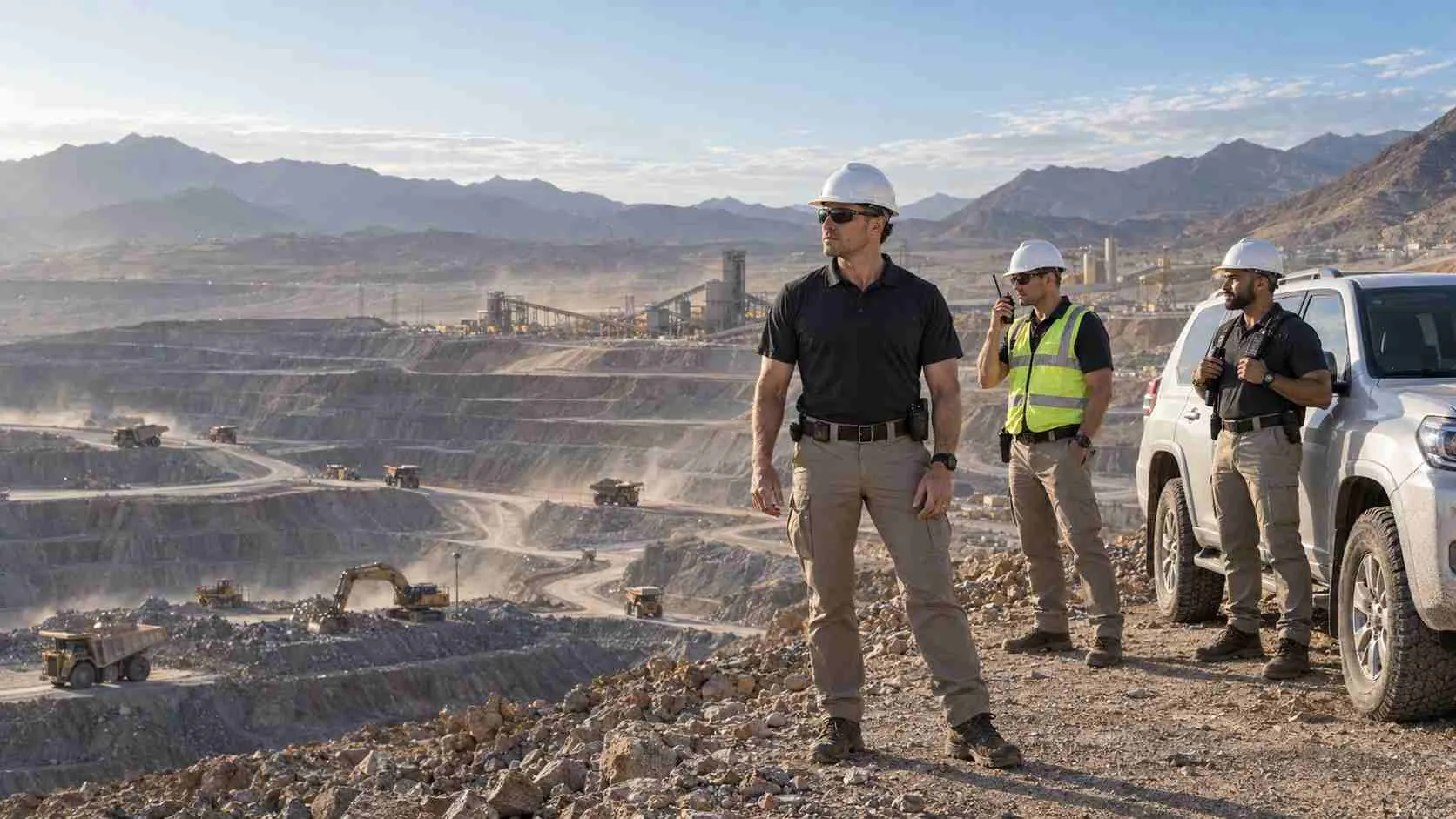
Mine Site Protection
Protective security for entrances, operational areas, compounds, infrastructure and other controlled parts of a mining project, aligned with the site’s operating procedures and lawful security model.
R&H Global Protection · Mining Security · Worldwide
R&H Global Protection provides mining security services for mining companies, mineral exploration teams, executives and remote projects that need structured protective security around people, mine sites, assets and operational movement. A programme can combine mine site security, mining risk management, executive protection, exploration security, secure transportation, journey management and locally compliant protective resources according to the actual project.
Mining Security Overview
A professional mining security company should connect site protection, people, assets, movement and management rather than treating every requirement as a separate guard post.
Protective security for entrances, operational areas, compounds, infrastructure and other controlled parts of a mining project, aligned with the site’s operating procedures and lawful security model.
Security planning for employees, contractors, technical visitors, management teams and other people whose work or movement creates identifiable exposure.
Measures designed around equipment, machinery, storage, critical infrastructure and other assets where loss, interference or unauthorized access could affect the project.
Protective planning for isolated locations, long logistics chains, limited external support and changing field conditions where disruption can quickly affect people and operations.
Direct Answer
Mining security services combine site protection, personnel security, risk management, asset protection and secure movement planning to reduce security exposure across mining and exploration operations. The right scope depends on the project stage, operating environment, people, assets, routes, current controls and the legal framework governing private security.
A mining security provider may be asked to coordinate mine site security, protective personnel, access and perimeter measures, executive protection, mining exploration security, transport, journey management, security assessments, crisis preparation and local licensed resources. R&H treats those elements as one security architecture so responsibilities, escalation and management remain clear.
The same programme may also need to account for contractor turnover, visitors, accommodation, storage, valuable equipment, project-road movements, changing construction areas and the handover between corporate policy and site-level execution. That wider view matters on long-term projects. Effective mining industry security therefore depends on management discipline as much as physical presence: someone must own the standards, exceptions, reporting and review process when the operating environment changes.
Mining security works best when the controls around the mine are connected with the people who move through it, the routes that support it and the management system that reviews changing risk.
Executives, employees, contractors, geologists, visitors and project leadership are considered according to role, exposure and movement.
Access points, perimeter, camps, offices, storage, infrastructure and restricted working areas are reviewed as one operating environment.
Airport transfers, project roads, personnel movements, security drivers and journey-management requirements are planned around the real itinerary.
Reporting, supervision, escalation, local-provider coordination and review cycles turn individual measures into a security programme.
Mining Operational Risk
Mining security should be designed around the actual loss, access, people, movement and disruption risks affecting the project. The objective is not simply to add guards, but to identify credible exposure and assign proportionate controls without publishing sensitive defensive details.
Mining theft prevention and mining loss prevention can involve fuel, machinery, inventory, equipment, product and high-value minerals. Precious metals security may require especially clear custody, access and dispatch controls. Repeated loss patterns may also justify incident or mining investigations by appropriately authorized specialists.
An insider threat may arise through excessive access, collusion, contractor turnover, credential misuse, information exposure or weak reporting. Security planning should connect screening, access privileges, supervision, separation of duties and escalation to the realities of the workforce rather than treating every worker or contractor as the same risk.
Illegal mining, trespass and unauthorized access can expose people, assets and operations to additional risk. Mine access control and mine perimeter security should define legitimate entry, restricted areas, visitor and contractor processes, escalation and the lawful role of private or public security resources.
Mining projects can face protest, road disruption, access disputes or other community-related tension. Protective security should support lawful access, incident reporting and continuity while remaining separate from community-relations work and following responsible-security principles, proportionality and clear rules of conduct.
Core Capability
A mining security solution can be narrow—such as an assessment or executive detail—or integrated across a project. Each service should have a defined purpose, owner and lawful delivery model.
Mine site security can combine protective personnel, site procedures, access control, perimeter awareness, reporting and coordination around operational facilities. The structure should reflect the actual site, operating phase, workforce and threat picture rather than using a standard guard package for every project.
Mining security guards, mine security guards and other protective personnel may support fixed posts, controlled access, patrol or site-security functions where permitted. Staffing, supervision, licensing, permitted duties and any use-of-force authority must be defined according to local law and the project scope.
Mining executive protection supports directors, senior project leadership, investors, visiting specialists and other principals whose profile, itinerary or decisions create a personal-security requirement. A detail can integrate close protection, security drivers, advance planning and locally compliant support where needed.
Mining exploration security is built for smaller teams working away from mature infrastructure. Protection for geologists, survey teams and exploration personnel may include remote-site assessment, camp-security planning, journey management, movement coordination and local protective resources according to the field programme.
Mining camp security focuses on the living and support environment around personnel. Planning may cover controlled access, visitors, contractor movement, perimeter awareness, accommodation areas, storage and incident escalation while preserving a workable environment for people who live and work at the project.
Mining asset protection addresses equipment, machinery, infrastructure, storage, inventory and other property exposed to theft, interference or unauthorized use. The strongest model combines people, procedures, physical controls, monitoring and clear ownership rather than depending on one protective layer.
Mining transport security can support personnel, equipment or valuable-material movements through route-risk review, escort coordination and protective movement planning. The service is described at a management level; tactical convoy formations, fixed procedures and other sensitive defensive information should remain within the restricted operating plan.
Journey management for mining companies connects who is travelling, the route, vehicle, timing, communications and escalation plan. Security drivers can support executives, technical staff and project personnel where appropriate, with the vehicle and driver integrated into the wider protection plan rather than treated as a standard driving service.
A mining security risk assessment or mine security audit reviews credible threats, vulnerabilities, people, assets, routes, current controls, incident information supplied by the client and management arrangements. The result should prioritize practical improvements, ownership and implementation instead of producing an abstract list of risks.
Mining crisis management can include security-focused contingency planning, escalation structures, incident coordination, evacuation planning and support to management during disruptive events. The plan should clearly separate private-security responsibilities from medical, rescue, fire, mine-safety and public-authority functions.
Client Profiles
Security requirements differ according to project ownership, operating phase and the people commissioning the work. The common requirement is decision-ready protection rather than a generic security product.
Operating companies that need a coherent mine security programme across personnel, facilities, access, assets, movement and incident management.
Field teams and exploration businesses working from temporary bases, remote camps or changing project locations where infrastructure and external support may be limited.
Directors, executives, project leaders and other decision-makers who require personal protection, secure movement or additional support during visits and ongoing operations.
Developers, EPC contractors and specialist project partners managing construction, temporary infrastructure, workforce growth and rapidly changing access requirements.
Board members, investors, lenders, advisers and technical visitors whose site itinerary, visibility or unfamiliarity with the operating environment may require additional protection.
Geologists, survey personnel and other technical teams whose work takes them outside established facilities or into less supported areas.
Employees and contractors living or working in isolated project environments where accommodation, movement, communications and escalation arrangements need to connect.
In-house security, risk, travel and operations leaders who need an external assessment, specialist protective capability, local-provider integration or additional management support.
Mining Risk Management
Mining security risk management should convert a complex project into a prioritized security picture that management can act on, fund, assign and review.
A mining security strategy starts with the operating context, credible threats, exposed people and assets, existing controls and the consequences of disruption. The assessment should turn those findings into a practical mining security management plan with clear priorities, owners, mitigation measures, staffing and technology decisions, incident-management responsibilities, escalation points and review triggers.
Operational Lifecycle
A mining security plan should change as the project changes. Exploration, construction, production and dispatch create different people flows, assets, perimeters and management challenges.
Exploration security often starts with small teams, temporary camps, changing operating bases, long journeys and limited infrastructure. The plan should stay flexible enough to follow the field programme while maintaining clear communications, movement and incident arrangements.
As a project moves into development and construction, contractor numbers, temporary facilities, material flows and access points can expand rapidly. Security governance must keep pace so responsibility does not become fragmented between the owner, contractors and multiple service providers.
During active production, security planning typically becomes more structured around workforce movement, controlled access, critical infrastructure, valuable equipment, storage and continuity. Long-term staffing and supervision should be designed for sustainable rotations and consistent reporting.
Storage and dispatch can create a different exposure profile from the operating site itself. Security planning may address custody, authorized access, vehicle movement, documentation, handovers and coordination for valuable material without publishing restricted transport tactics on a public page.
Team Standard
Professional mining security personnel need more than physical presence. Long-term projects depend on conduct, supervision, reporting, handovers and a delivery model that stays inside local legal boundaries.
R&H structures personnel and management around the agreed role. International delivery is subject to local law, licensing, immigration, specialist availability and the exact responsibilities defined for the project.
Engagement Process
A useful proposal begins with the project, protected people, operational exposure and legal requirements. Sensitive defensive information can be handled later through an appropriate restricted process.
Start with the project stage, broad operating environment, approximate duration, known concerns and what has changed. Initial scoping should not require the client to send detailed vulnerability maps, guard-post locations, passwords, codes or other sensitive defensive information.
Establish who needs protection, which assets or facilities are most important, what functions would be materially affected by disruption and where existing controls already work well. This keeps the security design proportional to the project.
Review the broad flow of employees, contractors, visitors, executives, vehicles, accommodation, site access and necessary travel. Movement exposure is often connected to site security and should not be planned as a completely separate problem.
Identify which functions can be delivered by R&H, which require locally licensed security providers, where authorities may have a role and which responsibilities remain with the client. This is particularly important for guarding, regulated security work and any armed component.
Determine the appropriate combination of personnel, management, physical measures, existing technology, communications, reporting and escalation. Technology can support the programme, but it should not be presented as a substitute for clear ownership and trained decision-making.
The written proposal should define scope, personnel, working periods, management, transport or specialist resources, logistics, exclusions, mobilisation requirements, pricing basis and review points. Material changes to the project should trigger a scope review rather than informal expansion.
Delivery Models
The right model depends on whether the client needs independent advice, ongoing security management, protective personnel, executive support or an integrated long-term programme.
R&H separates advisory, management and protective roles so the client can choose the resources that solve the actual problem, define accountability clearly and identify where appropriately licensed local providers are required.
Project-Specific Pricing
There is no responsible universal global day rate for a mining security programme. A realistic quote has to reflect the actual operating model and resources.
Mining security services cost depends on the country and lawful delivery model, remoteness, number of sites, people to be protected, coverage hours, rotation, supervision, executive-protection or transport components, vehicles, accommodation, flights, locally licensed security resources, communications, technology, specialist assessments, project duration and required mobilisation time. R&H reviews these factors before issuing a written mining security services quote that states the scope, pricing basis and exclusions.
Remote & Exploration Security
Remote mining security has to work with limited infrastructure, long travel times, changing field programmes and fewer immediate support options.
Remote mine security and exploration security services can address isolated sites, temporary camps, equipment protection, field-team movement, communications, contingency planning and protection for exploration personnel. The model should change when the operating base, access route, workforce or project stage changes.
Why R&H Global Protection
R&H approaches mining security as a managed protective-security requirement: understand the exposure, define the roles, use the right people and keep the delivery model clear. For buyers, the practical advantage is a proposal that can be reviewed against the project rather than a vague promise of “complete security.”
R&H's wider protective-security model draws on personnel backgrounds that include Israeli Special Forces and Shin Bet experience, combined where required with appropriately licensed local security providers. For mining projects, that background must still be translated into the actual site, workforce, movement, regulatory and operating requirements rather than presented as a substitute for local mine-specific capability.
Read about R&H Global ProtectionR&H structures the requirement around the real project, people, operating pattern and identified exposure rather than beginning with a predetermined number of guards.
A defined management contact supports clearer communication, changes, escalation and coordination across R&H resources and suitably licensed local partners.
Relevant assignments can draw on R&H personnel with professional protective backgrounds, including former Israeli special-forces and Shin Bet experience where that background fits the role and lawful delivery model.
Where mine guarding, armed security or other regulated functions require local licensing, the model can integrate appropriately licensed local providers rather than assuming foreign personnel can perform every role.
The proposal separates site security, executive protection, drivers, technology, local authorities, emergency providers and client management so responsibilities do not become ambiguous.
A project can begin with assessment or a defined protective requirement and expand into longer-term support when the operating phase, workforce or risk picture changes.
Each proposal should clearly state scope, personnel, hours, responsibilities, exclusions, logistics, management and pricing basis—so the client can see exactly what is included before mobilisation.
Responsible Security
Mining security arrangements can affect workers, contractors, communities, private security personnel and the relationship between a company and public authorities. Governance matters alongside protection.
Responsible security planning should consider proportionality, lawful conduct, personnel screening, training, accountability, incident reporting, grievance considerations, rules of conduct, community interaction and management oversight. Where use of force could arise, responsibilities, legal authority, escalation and review should be addressed explicitly rather than left to informal practice.
For a mining company, governance should also reach contractor security and third-party providers. The client should know who employs each security officer, which licence or authority supports the role, how personnel are screened and supervised, what conduct standards apply, how complaints or allegations are escalated and who reviews incidents. This is particularly important when several private providers or public-security interfaces exist around one project.
The Voluntary Principles on Security and Human Rights were developed to help companies maintain operational security while respecting human rights, with origins in the extractive and energy sectors. IFC Performance Standard 4 addresses community health, safety and security, while IFC’s security-forces handbook provides project-level guidance on assessing and managing risks associated with private and public security. Referencing these frameworks does not imply R&H membership, certification or endorsement.
Responsible governance is also operationally useful. Clear expectations for screening, training, supervision, reporting and investigation help the client identify poor performance before it becomes a larger security, legal or reputational problem. For long-term projects, these standards should be incorporated into contracts, onboarding, management reviews and incident-learning processes so they remain active rather than existing only in a policy document.
Confidential Project Scoping
Tell us the project stage, approximate duration, number of sites or people, broad operating environment and whether you need assessment, site security, executive protection, transport or an integrated programme. We will use that information to define the appropriate next step and proposal scope.
Useful details for the first discussion
Keep the first enquiry high-level. Sensitive security information can be handled after the appropriate communication channel and project context are established.
Direct contact: +972-55-9724475 · R&H Global Protection
Questions, Answered Clearly
These answers explain the most common commercial questions about mine site security, remote operations, protective personnel, risk assessment and locally compliant delivery.
Mining security services protect people, mine sites, assets and operational movements. Depending on the project, they can combine site security, access control, executive protection, journey management, asset protection, risk assessments and locally licensed security resources.
Mine site security can include protective personnel, controlled access, perimeter protection, contractor and visitor procedures, camp or compound security, asset protection and incident reporting. The exact model depends on site layout, project stage, risk, local law and existing controls.
Pricing is project-specific. Main factors include country and licensing, remoteness, number of sites, team size, coverage hours, rotations, vehicles, logistics, local providers, technology, duration and mobilisation. R&H defines the scope, pricing basis and exclusions in a written proposal.
Yes. R&H can structure security for remote mining and exploration projects, including isolated sites, camps, field-team movement, journey management, equipment exposure, communications and contingency planning. The delivery model depends on local law, access, logistics and available support.
Yes. Support can cover mining executives, project leaders, investors, geologists, survey teams and other field personnel. Depending on the assignment, the plan may combine close protection, security drivers, secure transportation, local security resources, camp measures and risk assessment.
Yes, subject to local law and licensing. In some jurisdictions, mine-site guards must be supplied by an appropriately licensed local provider, while R&H can provide management, advisory, protective or coordination functions. Roles and responsibilities are defined before mobilisation.
Yes. Mining transport security can include security drivers, journey management, route-risk review, personnel transfers and coordination with close protection or licensed local resources. Armed or specialist escort is considered only where lawful and appropriately licensed.
Yes. A mining security risk assessment can review threats, exposed people and assets, access controls, existing measures, transport, incident history, escalation and governance. The output can support a practical security plan, priorities and staffing decisions.
Yes. Mining security can include crisis preparation, escalation structures, incident coordination, contingency planning and evacuation-planning support. Private security does not replace medical evacuation, mine rescue, public emergency services or government authorities.
Armed security depends on local law, licensing and government requirements. Where it is legally required and available, the armed role may need to be delivered by licensed local security providers or competent authorities. R&H does not assume foreign personnel can carry weapons in every jurisdiction.