
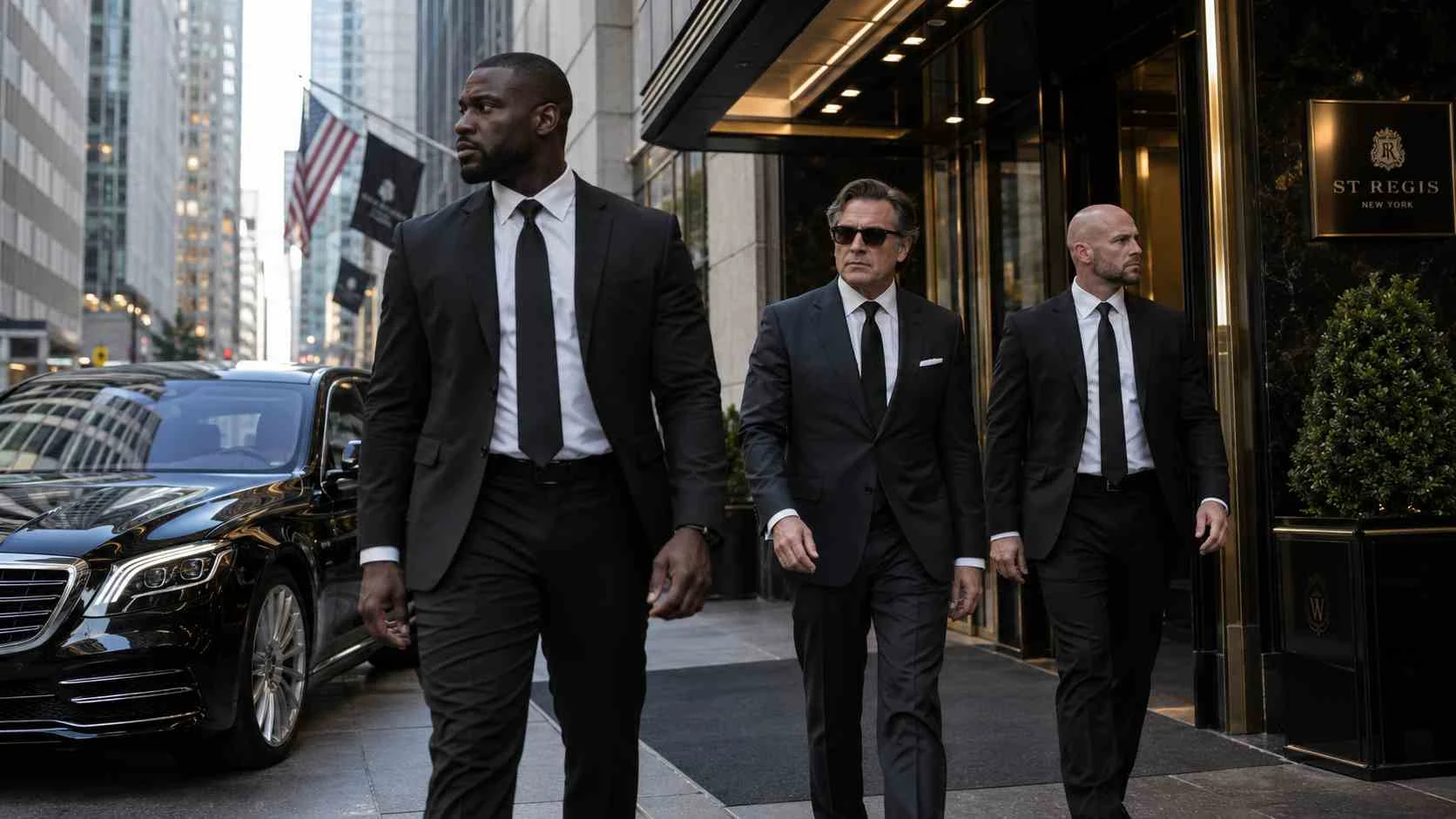
NEW YORK · EXECUTIVE PROTECTION · PRIVATE FAMILIES · VIP & CELEBRITY CLIENTS
Bodyguard Services in New York for Executives, Families & VIP Clients
R&H Global Protection coordinates bodyguard and executive protection in New York for C-suite leaders, family offices, private families, VIPs and public figures. The plan is built around the principal’s real New York program—JFK, LGA or EWR arrivals, Midtown and Financial District meetings, private-family routines, media or fashion commitments and any New Jersey continuation—with the delivering personnel and jurisdictional requirements checked for each stage.
Part of our bodyguard services in the United States and international protection capability.
New York Personal Protection at a Glance
JFK · LaGuardia (LGA) · Newark (EWR)Executive and family-office protection
Discreet personal security for executives, founders, investors and family-office principals moving between Manhattan meetings, hotels, advisers and private hospitality.
Private families and UHNW clients
Low-profile coverage for adults, children and household routines, with separate officers considered when protected people follow independent schedules.
Airports and security drivers
JFK, LGA and EWR reception can be coordinated with a dedicated security driver and executive vehicle while the personal officer remains focused on the principal.
Events, retainers and onward travel
Public appearances, New York Fashion Week, long-term arrangements and interstate travel are planned around the actual client schedule, duties and jurisdictional requirements.
Direct answer · hiring private protection in New York
Can You Hire a Private Bodyguard in New York?
Yes. R&H Global Protection can coordinate a private bodyguard in New York for a defined executive, family, VIP, celebrity or retained protection requirement. Share the dates, protected people, Manhattan base, JFK/LGA/EWR arrival, major appointments and whether a dedicated security driver, public-appearance support or residence team is needed. New York delivery credentials are checked for the agreed duties, while Newark, New Jersey and other interstate stages receive their own review.
R&H Global Protection · +972-55-9724475 · info@global-protection.net. Dates, staffing, duty hours, transport and applicable New York or interstate delivery requirements are confirmed for the assignment.
Private Bodyguard · Executive Protection · Close Protection in New York
What Does a Bodyguard in New York Cover?
A New York bodyguard stays with the named principal through the agreed business, private or public-facing schedule and helps coordinate the transitions between airport, vehicle, building, hotel, residence and event. The protective posture can change during one day: confidential Midtown meetings, a public appearance and private family time may all need different proximity and preparation.
Personal accompaniment is separate from chauffeur driving, building security, event-wide security and a staffed residence post. R&H Global Protection can coordinate those resources when required, but the proposal states the role, hours and jurisdiction for each. Newark or other New Jersey duties are not treated as if a New York credential automatically covers them.
New York Protection Planning
Executive Protection in New York for Business, Public Visibility & Family Life
Executive protection in New York can combine confidential business meetings with public visibility, private family time and high-profile events. R&H builds the detail around the principal’s actual exposure, schedule and privacy needs, then coordinates the officer, driver, hosts and supporting resources through one working brief.
Identify the principal’s concerns, the meetings that require accompaniment and any independent family plans. Officers, driving support and advance preparation are then allocated to the real program rather than a generic city package.
Finance, roadshows and confidential meetings
A roadshow can involve several hosts without requiring identical personal coverage at every appointment. Work with the assistant to identify public exposure, disclosed concerns and permitted accompaniment. Keep confidential meeting content separate from the limited information needed for transport and reception.
Family offices and household routines
A retained family program may include children, residence-based staff and independent adult appointments. Define who is protected, how household communication works and when additional officers are needed. A tower’s security team does not provide mobile personal coverage away from its premises.
Media and fashion-related engagements
Public figures or fashion-week guests can have appearances, fittings, meetings and private hospitality within one program. Discuss the actual organizer and management contacts. Credentials and venue permissions remain separate from the personal detail; security is not a promise of backstage or invitation-only access.
Airports, New Jersey and onward travel
JFK, LGA and EWR are not interchangeable receiving instructions, and an interstate stage adds a separate compliance question. The proposal should identify who delivers each portion of the assignment. Do not assume that a New York registration or firearm permission authorises all proposed work elsewhere.
New York Protection Services
Close Protection in New York: Personal and Supporting Services
Build your New York protection arrangement from distinct personal and supporting services. The options below connect the client’s priorities with the right officer, preparation and additional resources; the agreed proposal identifies what is included.
Executive bodyguard in New York
Discreet executive protection for senior leaders, founders, investors and family-office principals around Midtown, the Financial District, hotels and private meetings. The brief connects the principal’s exposure, assistant instructions, driver responsibilities and any useful advance preparation without turning ordinary business travel into an overt security operation.
Family and child protection in New York
Private-family protection can support parents and children around residences, hotels, appointments, shopping and daily movements. Separate schedules may require additional officers. The security role works alongside parents and carers and remains distinct from childcare or a fixed residential-security post.
JFK, LaGuardia and Newark airport protection
Protection can begin at JFK, LaGuardia or Newark from an agreed meeting point. Confirm the airport, flight, passengers, luggage and first destination. EWR or other New Jersey duties are reviewed separately for the work performed there; airside or specialist terminal access is not automatically included.
Bodyguard and security driver in New York
A dedicated security driver and appropriate executive vehicle can support the close protection officer through airport receiving, Manhattan meetings, private appointments and evening hospitality. Vehicle class, passenger capacity, waiting, duty hours and interstate travel are defined in the written proposal.
Celebrity, VIP and public-figure protection
Discreet personal protection for recognizable clients attending appearances, rehearsals, media commitments, private appointments or hospitality. The officer’s presentation and communication are agreed around the principal; the service does not imply control over lawful photography, press access or host-controlled areas.
New York Fashion Week, conferences and delegations
Personal protection can support named principals around New York Fashion Week, corporate conferences, major events and UN General Assembly-period visits. Invitations, accreditation, backstage access and venue-wide security remain controlled by the relevant host, organizer or authority.
Female protection officer requests
Female close protection officers can be requested for family, executive or privacy-sensitive assignments. Share the preferred duties, language and presentation requirements early; the suitability, availability and local role of the proposed officer are confirmed before commitment.
Residential security coordination
Longer New York stays can combine mobile protection with separately staffed apartment, townhouse or residence security. The household contact, access arrangements, visitors and duty hours are defined independently so the traveling bodyguard is not treated as a fixed property post.
Protective planning and management liaison
R&H reviews disclosed concerns, public commitments, hosts, transport and communication before deployment. The agreed planning scope can include arrival preparation, venue liaison, contingency contacts and reporting, with specialist capabilities commissioned separately when the assignment requires them.
Long-term and multi-state protection
Long-term executive or family protection can include officer matching, introductions, relief and a consistent management contact. New Jersey or another U.S. destination is reviewed for its own provider, personnel, driving and any weapons-related requirements before continuity is confirmed.
Client Profiles
Who Hires Bodyguards and Executive Protection in New York?
New York clients can include executives, UHNW families, family offices, founders, celebrities, public figures, corporate delegations and long-term residents. Staffing is built around privacy, public exposure, simultaneous duties and the principal’s actual schedule.
C-suite executives and board members
Senior leaders with Midtown or Financial District meetings, investor roadshows and evening hospitality who need discreet continuity and tight information control.
Family-office principals
Private clients whose advisers, household, drivers and independent family schedules require one authorized management channel.
UHNW families in New York
Adults and children moving between residences, schools, shopping, appointments and private hospitality where simultaneous movements may need separate officers.
Founders and investors
High-visibility entrepreneurs balancing confidential business activity with public appearances, dinners and personal time.
Celebrities and public figures
Recognisable clients attending rehearsals, media obligations, events or private appointments where the detail must manage visibility without implying control over public space.
Fashion and brand guests
Principals attending New York Fashion Week, fittings or brand events under organizer-controlled invitations, accreditation and backstage access.
UNGA and conference visitors
Named delegates or executives whose private personal protection sits alongside, but does not replace, official, venue or organizer security arrangements.
Tri-state and onward travellers
Clients whose EWR, New Jersey or wider U.S. itinerary needs separate provider, credential, vehicle and working-period checks beyond the New York stage.
Israeli-led methodology · Assignment-specific local delivery
Protection Planning Adapted to New York
New York planning starts with the principal’s exposure and the difference between private and public time. A closed investor meeting, a family movement on the Upper East Side and a photographed event arrival do not need the same protective posture. R&H Global Protection therefore defines the sensitive moments, authorized client contact and simultaneous responsibilities before recommending resources.
The operating brief connects the personal officer to the assistant, driver, building or event host and any residence manager without turning all of them into one undifferentiated security team. JFK, LGA and EWR are treated as specific receiving instructions; the booked gateway, passenger group and first protected destination determine the handoff and working period.
Jurisdiction matters when the itinerary leaves New York. Newark or other New Jersey work is reviewed separately, as are armed-status questions and wider U.S. stages. For retained assignments, the plan is revisited when public visibility, household routines, relief or interstate travel changes rather than assuming the first-day structure remains sufficient.
New York Local Context
New York Protection Across Manhattan, Major Events & Interstate Travel
Local detail matters where it changes access, timing, privacy or the relationship between the principal, officer and vehicle. These New York settings show where preparation or staffing can change.
Midtown and Financial District executive schedules
Executive protection can connect offices, investor meetings, private dining and hotel movements without distributing the full business diary to every supplier. Confirm the host, reception process and vehicle rejoin so the officer can remain focused on the principal.
Upper East Side, Tribeca and private-family life
Private-family programs may involve adults, children, carers and household staff following different schedules. Establish the approved household contact and privacy expectations, then add separate officers or residential coverage where simultaneous duties require them.
New York Fashion Week, media and public appearances
High-visibility schedules can combine shows, fittings, interviews, rehearsals, dinners and private time. Personal protection follows the named principal while accreditation, backstage access and general event security remain controlled by the host or organizer.
JFK, LGA, EWR and tri-state continuation
The booked airport and the actual duties performed determine the receiving and transport plan. Newark or other New Jersey stages require a separate jurisdictional review; continuity of the client brief does not mean a New York credential automatically covers work in another state.
Finance, roadshows and confidential meetings
Family offices and household routines
JFK · LaGuardia (LGA) · Newark (EWR)
Fashion-week appointments, conferences and media appearances.
New Jersey and other separately agreed U.S. destinations.
The final plan uses your confirmed properties, hosts and program. Additional destinations and specialist requirements are reviewed before they are included in the New York assignment.
The Assigned Team
Professional Standards for Your New York Detail
A New York protection team should be comfortable in executive offices, private residences and public-facing environments while understanding that city, airport and interstate stages can involve different delivery requirements. R&H Global Protection reviews professional fit, communication and jurisdictional scope before personnel are confirmed.
R&H Global Protection is led by former Israeli Special Forces and Shin Bet professionals. In New York, that planning background is applied to executive confidentiality, high public visibility, household privacy and the practical credential checks required for the actual New York or interstate duty.
The officer should work naturally around C-suite leaders, advisers and family offices, understanding when close presence is useful and when discretion around meetings matters more.
The employer, individual registration or applicable exemption and relevant training should match the security duties being supplied. Armed work has additional requirements and is not assumed.
Celebrity, media and Fashion Week assignments require calm management of visibility, organizers and crowds without promising backstage privileges or control over lawful public activity.
A dedicated driver can manage vehicle readiness while the officer receives and accompanies the principal. EWR also raises New Jersey delivery questions that are reviewed separately.
Residence addresses, children’s routines, medical or personal details and confidential meetings should move through the authorized client contact and only to personnel who need them.
Late events, airport departures and New Jersey continuations change the duty day. Relief, driver hours and handovers should be planned explicitly for retained or multi-day programs.
Hiring a Bodyguard in New York
How to Arrange Close Protection in New York
A New York protection proposal should distinguish Manhattan duties from airport and interstate stages before personnel are selected. Start with dates, protected people, New York base, JFK/LGA/EWR arrival and the public or private commitments that create simultaneous responsibilities.
Define the principal and New York base
Share the dates, number of protected people and whether the requirement is executive, family, celebrity, public-figure or retained household protection.
Specify JFK, LGA or EWR
Give the actual airport, flight, passenger group, luggage and first protected destination. Newark should be identified clearly because New Jersey duties are reviewed separately.
Separate private and public commitments
Outline Midtown or Financial District meetings, family movements, media appearances, Fashion Week or other hosted events so the team can size personal coverage around real exposure.
Review New York and interstate credentials
Confirm the delivering employer, personnel status and any armed or interstate considerations required for the actual duties before the assignment is accepted.
Add the driver and residence functions
Specify whether a dedicated driver, executive vehicle or independently staffed residence is required. Each function keeps its own working hours and responsibility.
Approve terms and the private planning channel
Confirm the duty window, personnel, expenses, payment and cancellation terms, then use the agreed confidential channel for exact addresses, private schedules and material security information.
An investor roadshow followed by an evening appearance and a Newark departure creates more than a set of Manhattan pickups. Define the principal’s coverage, the driver’s working period and the delivering roles in each jurisdiction. A partner’s independent appointments or a residence post require their own staffing decisions.
New York Service Models
Choose the Right Protection Model in New York
Select the model around your New York priorities: the people needing protection, the duration and the responsibilities that must run at the same time. Each proposal identifies personal coverage, additional support and a realistic working pattern.
- Manhattan executive visit A defined personal officer for the principal’s offices, meetings and agreed private commitments.
- Personal officer plus security driver Separate accompaniment and vehicle duties around the booked airports, buildings and hospitality.
- Family or delegation with parallel needs Additional personal officers where protected people require simultaneous coverage in different locations.
- Retained family-office program A retained family-office program begins with officer selection and an introduction to the authorized representative. Agree privacy preferences, hours, relief and reporting, then review the arrangement as business visibility or family routines change. Residential posts and interstate travel remain separately defined duties with their own cost and credential checks.
- Residence team with mobile protection A separately staffed property function when the principal’s personal officer is away from the home.
- New York and onward U.S. program Continuity of client preferences with distinct provider, personnel and jurisdictional checks for later stages.
New York Bodyguard Cost · Written Quotations
How Much Does a Bodyguard in New York Cost?
R&H Global Protection’s indicative New York planning range is USD 800–1,500 per bodyguard per day. Final pricing reflects the officer duty, public visibility, New York or New Jersey delivery, dedicated transport and any household, event or interstate requirements.
JFK/LGA/EWR receiving, Manhattan appointments, evening events and the final responsibility point define the officer day; extended standby is not assumed.
Media, Fashion Week, investor-roadshow or other public commitments can require extra preparation or additional personal coverage.
Independent family, delegation or executive movements can require multiple officers even when the client uses one management contact.
Vehicle type, passenger count, luggage, waiting and driver hours are priced separately so the personal officer can remain with the principal away from the car.
A fixed residential post, relief pattern or long-term household resource has its own personnel and hours rather than being absorbed into the mobile officer rate.
EWR or other New Jersey work, wider U.S. travel, accommodation, repositioning, taxes and committed expenses are shown according to the accepted itinerary.
Team Configurations for New York Protection
These configurations describe different responsibilities, not interchangeable price packages. The proposal identifies the actual people, working periods and supporting resources included.
The USD 800–1,500 range covers one bodyguard’s agreed New York duty. Dedicated transport, extra officers, residential posts, public-event preparation, interstate stages, travel and accommodation are separately itemised when required.
Confirm the New York service window, dates and any longer travel or event duties before committing. Extra personal coverage and driver waiting are different cost items and should remain visible in the proposal.
Request a New York proposal that clearly separates the personal officer from the driver, residence and event functions and states where New York duties end and any New Jersey or interstate stage begins.
For retained work, agree relief, household coverage and interstate travel rules in advance. Personnel and vehicles are not reserved by an enquiry alone.
Request Your New York Bodyguard QuoteLocal and Regional Coverage
Personal Security in New York and Your Onward Itinerary
The New York service area follows the confirmed client program. New Jersey and other U.S. destinations are treated as separate operating stages for staffing, transport and any applicable registration or armed-status requirements.
New York
Protection in New York connects the accepted appointments, private needs and arrival arrangements with the appropriate supporting resources. The local detail remains focused on the principal’s accepted program. Additional national travel needs its own personnel, transport and receiving arrangements.
The actual appointments and private requirements accepted in the proposal.
The booked gateway, personal receiving duty and separately defined transport.
Personal accompaniment and any independent property-security requirement.
Named principals and organizer permissions, not automatic whole-event security.
Fresh receiving contacts, resources and working-period review for subsequent stages.
Official sources describe the regulatory and event context; they do not certify R&H or a proposed operator. Assignment-specific provider, personnel, host-access and jurisdiction requirements are confirmed before deployment.
Why R&H Global Protection
Why Choose R&H Global Protection in New York?
R&H Global Protection is designed for New York clients who need discreet international-standard planning but also clear local responsibility for Manhattan, airport and interstate stages. The emphasis is on principal-focused protection, confidentiality and realistic delivery rather than generic VIP language.
Manhattan executive-protection focus
Midtown and Financial District schedules are planned around principal exposure, building procedures, assistants and driver rejoin points rather than a conspicuous one-size-fits-all detail.
Celebrity and public-figure capability
Public appearances, fashion programs and media-facing commitments are treated as principal-protection tasks that must work within legitimate organizer and venue rules.
Family-office and household discretion
Long-term private clients can combine mobile protection, drivers and separately staffed residence functions while keeping family information compartmented.
JFK, LGA and EWR planning
Each airport is treated as a real receiving instruction, with the passenger group, first destination, vehicle and jurisdiction identified before duty begins.
Interstate compliance discipline
New Jersey and wider U.S. stages are reviewed separately for providers, credentials, armed status and transport rather than assumed covered by the New York arrangement.
Israeli-led international continuity
Former Israeli Special Forces and Shin Bet experience informs prevention and client management, while the next U.S. or international destination is rebuilt around its own legal and operational requirements.
“I wanted protection in New York without turning every arrival into an event. The officer was comfortable around colleagues and never made the security presence the center of attention. We worked mainly between Midtown meetings, our temporary office and evening engagements. Over the six weeks, what I valued most was consistency: agreed arrangements were followed, questions went through my assistant where appropriate, and my private time remained private. It gave me one less responsibility during a busy assignment.”
Published company experience · R&H leadership and operating approach · Editorial standards and accountability
International Protection Continuity
Connect Your New York Assignment to U.S. and International Travel
A New York protection program can continue to Miami, Los Angeles, Las Vegas, Canada, Europe, the Middle East and other destinations. R&H can carry forward the client brief, privacy preferences and management relationship while the receiving personnel, vehicles, working hours and local authorizations are confirmed for each new stage.
Worldwide destinations:
Miami, Monaco, Paris, Madrid, Zurich, Milan, Dubai, Singapore.
United States overview and onward travel:
United States protection overview, Los Angeles, Las Vegas.
Canadian destinations:
Toronto, Montreal.
New York · Confidential Protection Enquiry
Hire a Bodyguard in New York
For a New York protection enquiry, send the dates or approximate duration, protected-person count, Manhattan base, JFK/LGA/EWR arrival and the broad mix of executive, family or public-facing commitments. Add whether you need a dedicated security driver, residence coverage or New Jersey continuation. R&H Global Protection will review the delivery requirements for each stage; exact addresses, passports and detailed threat material should stay out of the first message.
WhatsApp opens a draft for you to review and send. Opening it does not book protection or reserve personnel. Prefer a web form? Use our contact page.
New York Bodyguard Questions
Frequently Asked Questions About Protection in New York
Direct answers about hiring a bodyguard in New York, R&H pricing, airport reception, security drivers, family and celebrity protection, local delivery requirements, female officers, armed requests and long-term assignments.
How much does a bodyguard in New York cost?
R&H Global Protection’s indicative New York planning range is USD 800–1,500 per bodyguard per day. The written quote confirms duty hours, team size, transport and any public-event, residence, interstate, travel or deployment costs.
Can I hire a private bodyguard in New York?
Yes. Share the dates, protected people, New York base, JFK/LGA/EWR arrival and broad schedule. R&H Global Protection then confirms the delivery personnel and any security driver, residence or public-appearance resources required.
What does executive protection in Manhattan include?
It can include principal accompaniment, advance liaison, airport and vehicle coordination, business meetings and private commitments. Building security and event-wide security remain separate responsibilities.
Does an EWR arrival need a New Jersey review?
Yes. Newark is in New Jersey, so the work performed there and any onward New Jersey duty should be reviewed separately from the New York stage, including the delivering personnel and transport arrangement.
Can I arrange a dedicated security driver in New York?
Yes. A dedicated driver can keep the vehicle ready for JFK, LGA, EWR and city appointments while the personal officer remains with the principal away from the car.
Can you provide long-term family protection in New York?
Yes. A retained program can set officer profiles, household introductions, privacy rules, relief and review points. Independent family schedules and residence coverage are staffed separately where required.
Can you support New York Fashion Week or media appearances?
Yes, for the named principal and their confirmed program. Invitations, accreditation, backstage access and general venue security remain under the organizer or host.
Are New York bodyguards automatically armed?
No. Armed work is a separate legal and credential question. The employer, officer status, firearm permissions, duties and jurisdictions must be checked before an armed option can be included.
Can I request a female or multilingual bodyguard in New York?
Yes. State the preferred profile, language and duties early. Matching depends on suitable personnel, availability and the credentials applicable to the actual role.
Can New York protection continue to other U.S. states?
Yes, but each next stage is reviewed for provider, personnel, transport, work eligibility and any armed-status requirements. One New York credential is not treated as universal authority across the United States.