
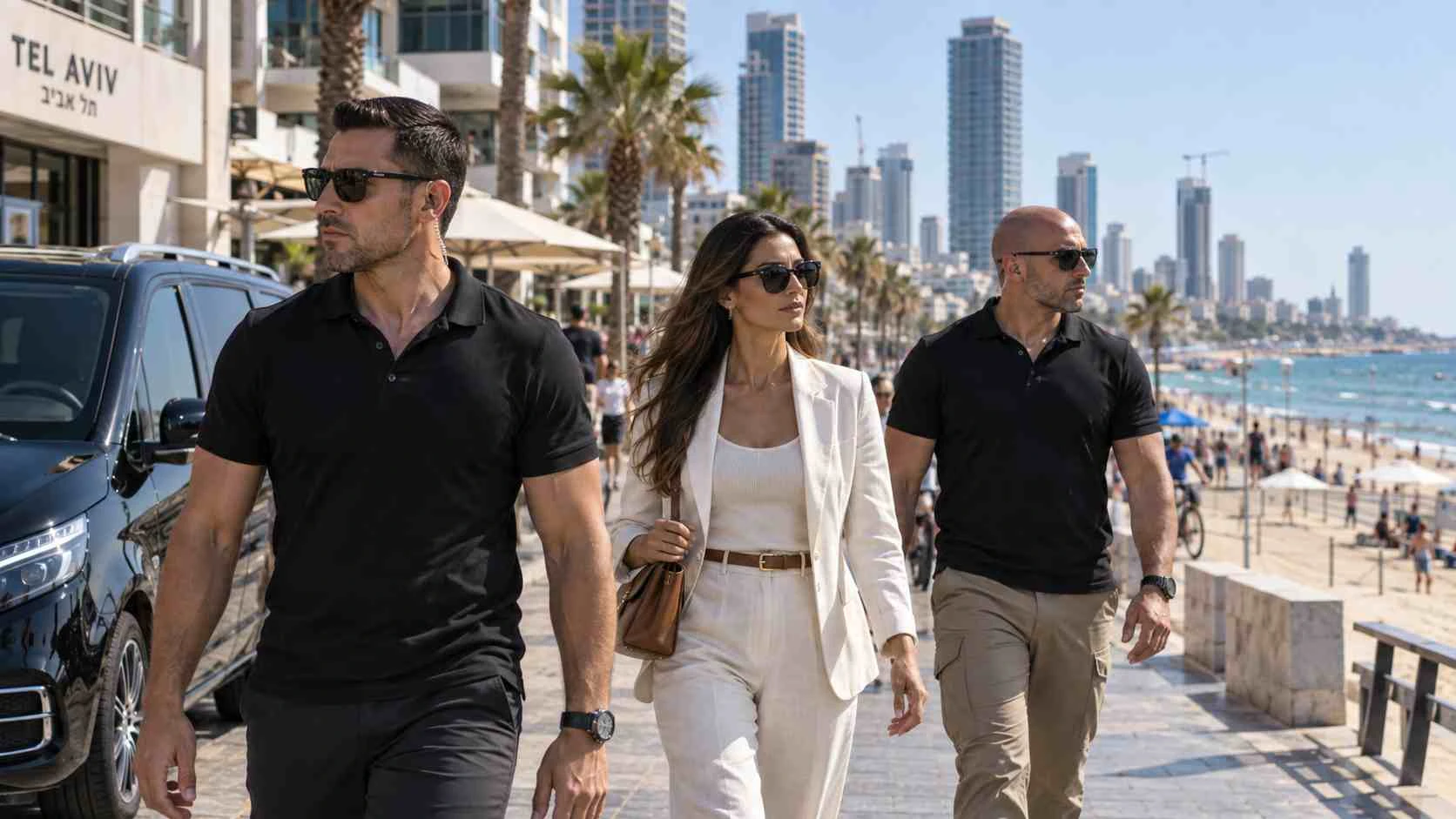
TEL AVIV · EXECUTIVE PROTECTION · PRIVATE CLIENTS · SECURE TRAVEL
Bodyguard Services in Tel Aviv for Executives, Families & VIP Clients
R&H Global Protection provides discreet bodyguard and executive protection in Tel Aviv for technology-founder and investor clients, private families and retained principals. Programmes can connect Ben Gurion Airport (TLV) with Rothschild Boulevard, Sarona and Ramat Gan business towers, while planning for Cybertech Global at Expo Tel Aviv or other high-demand periods. Vehicle and officer handoffs are built around real corridors such as Ayalon Highway and Menachem Begin Road, with locally regulated roles confirmed before deployment.
Part of R&H Global Protection’s bodyguard services in Israel and international protection capability.
Tel Aviv Protection Snapshot
Ben Gurion Airport (TLV)Principal-Focused Protection
Protection follows the client through Rothschild Boulevard, Sarona, hotels and private appointments. The officer stays with the principal rather than becoming a driver, venue guard or household post.
Hotels and Hosted Venues
Receiving can involve properties such as The David Kempinski Tel Aviv or The Norman Tel Aviv. Hotel and host teams keep control of their premises; the CPO manages the protected guest.
Road and Event Pressure
Ayalon Highway and Menachem Begin Road can behave very differently during Cybertech Global at Expo Tel Aviv. Driver position and release timing are planned before the principal is ready to move.
Retained Continuity
Longer Tel Aviv assignments use consistent personnel, realistic relief and review as the routine changes between Ramat Gan business towers, Neve Tzedek and the next declared stage.
Direct answer · hiring a bodyguard in Tel Aviv
Can You Hire a Private Bodyguard in Tel Aviv?
Yes. R&H Global Protection coordinates retained personal protection in Tel Aviv. Send the expected duration, TLV arrival if relevant, operating base, fixed commitments around Rothschild Boulevard or Sarona, and any driver, family, residence or event requirement.
R&H Global Protection · +972-55-9724475 · info@global-protection.net. For Tel Aviv, send the multi-week schedule, TLV, Rothschild / Ramat Gan meeting pattern, events and any family or Herzliya movement.
Bodyguard · Executive Protection · Close Protection in Tel Aviv
What a Bodyguard in Tel Aviv Covers
The Tel Aviv bodyguard’s core duty is continuous personal protection of the named principal from the agreed start point through meetings, hotel arrivals, private time and road movement. That can include TLV, Rothschild Boulevard, Sarona and event-related transitions.
The Tel Aviv officer does not become the Ayalon driver, apartment guard or Expo Tel Aviv security team. Split family movement and fixed posts receive their own resources.
Tel Aviv Protection Planning
Executive Protection for Founders, Investors and Technology Leaders
A technology-founder and investor programme in Tel Aviv can move from The David Kempinski Tel Aviv or The Norman Tel Aviv into Rothschild Boulevard, then change posture again around Cybertech Global at Expo Tel Aviv. Hotel receiving, host access, public transitions and vehicle release are treated as separate operating moments.
A meeting day around Rothschild Boulevard does not operate like private time around Ramat Gan business towers or a high-demand period such as Cybertech Global at Expo Tel Aviv. Officer distance, driver standby and host interfaces are adjusted accordingly.
Road Corridor Reality
Ayalon Highway and Menachem Begin Road affect when the vehicle can realistically rejoin the principal. The driver brief follows the true exit, not only the scheduled address.
Hotel and Residence Handoffs
At The David Kempinski Tel Aviv, Royal Beach Tel Aviv or a private residence, the handoff should be clear at the lobby, driveway or parking area without implying any hotel affiliation.
Event-Specific Posture
Cybertech Global at Expo Tel Aviv can increase crowd density, accreditation controls and late departures. The CPO protects the client while organisers keep responsibility for the wider site.
Longer Assignment Review
Repeated routes through Neve Tzedek and Rokach Boulevard become more efficient over time, but relief, public exposure and new venues are reviewed rather than assumed to stay constant.
Tel Aviv Protection Services
Personal Protection, Drivers and Family Support
Tel Aviv support must keep pace with founder schedules, tower exits, Ayalon repositioning and late event changes. Transport, apartment and event roles are kept modular around the personal officer.
Founder / Technology Executive Protection
Principal-focused protection for the technology-founder and investor client moving through Rothschild Boulevard, Sarona and confirmed executive appointments.
Investor and Boardroom Close Protection
Low-profile coverage around The David Kempinski Tel Aviv, The Norman Tel Aviv and private hospitality, with the officer reducing visibility where the environment allows.
Family Protection in Neve Tzedek / Coast
Family coverage around Ramat Gan business towers and private routines, with extra officers added if parents, children or staff move at the same time.
Female CPO Request
A female CPO can be requested for Tel Aviv family, founder or privacy-sensitive assignments, subject to suitable availability and the required Israeli role status.
Ben Gurion Airport Receiving
Receiving at Ben Gurion Airport (TLV) links the live flight, luggage, vehicle and first protected stop so the city programme starts as one movement chain.
Security Driver for Ayalon / Begin Road
A dedicated driver manages waiting and repositioning on Ayalon Highway, Menachem Begin Road and later city movements while the CPO remains with the principal.
Apartment / Residence Integration
Residential coverage is separated when a property near Ramat Gan business towers needs its own access or fixed-post responsibility while the mobile detail is away.
Cybertech and Expo Tel Aviv Protection
For Cybertech Global at Expo Tel Aviv, the officer remains accountable for the named client; accreditation, screening and general venue security stay with the organiser.
Advance Planning for Tower and Hotel Exits
Advance work checks entrances, exits, host contacts and vehicle rejoin points around Rothschild Boulevard, Rokach Boulevard and the day’s highest-pressure stops.
Three-Week / Retained Tel Aviv Programme
A retained Tel Aviv programme uses continuity to learn repeated routes and client preferences, then adds planned relief and review so familiarity never replaces discipline.
Client Profiles
Who Uses Retained Protection in Tel Aviv?
The buying situations in Tel Aviv are not interchangeable. A technology-founder and investor principal using Rothschild Boulevard has different movement pressure from a family based near Ramat Gan business towers or a guest attending Cybertech Global at Expo Tel Aviv.
Technology Founders
Senior clients with recurring appointments around Rothschild Boulevard who need the protection layer to remain discreet around assistants and hosts.
Venture Capital and Investors
Principals moving between Sarona, private meetings and hotels such as The Norman Tel Aviv who require precise vehicle and lobby handoffs.
Public-Company Executives
Public-company leaders and investors may cross Tel Aviv and Ramat Gan several times a day; the detail is structured around confidentiality and fast exits rather than formal convoy presentation.
Family Offices
Families using Ramat Gan business towers, residences and premium hotels who need a calm service that adapts to children and normal daily routines.
Private Families
Clients exposed to crowd and traffic pressure around Cybertech Global at Expo Tel Aviv who need tighter arrival and departure planning.
Cybertech / Event Speakers
Tel Aviv family offices may connect Neve Tzedek residences, Rothschild meetings, drivers, TLV and Herzliya schedules through one controlled contact.
Ramat Gan Finance Executives
Cybertech speakers and technology executives may separate for investor meetings, panels and dinners; staffing follows the principal schedule, not only the event badge.
Retained Principals
Longer-assignment clients who benefit from officer continuity, relief and familiarity with recurring roads such as Menachem Begin Road and Rokach Boulevard.
Israeli-led methodology · Assignment-specific delivery
Planning for a Fast-Moving Tel Aviv Schedule
Planning starts with the real route: TLV receiving, the operating base, Rothschild Boulevard, Sarona and the final release. Ayalon Highway and Menachem Begin Road are working constraints, not decorative local references.
Hotels such as The David Kempinski Tel Aviv and Royal Beach Tel Aviv are receiving and handoff environments. Their concierge, valet or security teams remain responsible for hotel operations; the CPO remains responsible for the client.
After event days such as Cybertech Global at Expo Tel Aviv, the team reviews driver duty, crowd exposure, late finishes, family splits and the next stage. The retained plan is updated rather than simply repeating day one.
Local Operating Context
Operational Geography: Rothschild, Sarona, Ramat Gan and the Coast
The strongest local distinction comes from how neighbourhoods, hotels, roads and events connect. In Tel Aviv, one duty period may move between The David Kempinski Tel Aviv, Rothschild Boulevard, Menachem Begin Road and Cybertech Global at Expo Tel Aviv.
TLV / Ayalon Highway
Ben Gurion receiving should connect the flight to the Ayalon / Begin Road approach and the first Tel Aviv hotel or office; the airport is outside the city, so the transfer is part of the protected day.
Rothschild Boulevard / Executive Core
Meeting days can use properties such as The David Kempinski Tel Aviv or The Norman Tel Aviv. Building exits and driver staging matter more than the headline address.
Cybertech Global at Expo Tel Aviv
Cybertech at Expo Tel Aviv can create dense Rokach Boulevard movement while investor meetings continue elsewhere. The officer and driver need a clear separation between event and city tasks.
Ramat Gan business towers / Private Programme
Private time may connect to Hilton Tel Aviv or a residence. The posture is quieter, but household, valet and vehicle handoffs still need clear ownership.
Primary airport / city or waterfront movement.
Executive meetings, hotel handoffs and hosted access.
Example luxury-hotel receiving environment; no affiliation is implied.
Peak-demand planning for crowd, accreditation and release timing.
Family, residence and lower-profile movement.
Planning note: Ayalon Highway, Menachem Begin Road, Rokach Boulevard, The David Kempinski Tel Aviv, The Norman Tel Aviv, Royal Beach Tel Aviv and Cybertech Global at Expo Tel Aviv are geographic and operational examples only. They do not imply an R&H office, hotel relationship, organiser affiliation, guaranteed access or authority over any premises. Additional Tel Aviv planning references include HaYarkon Street, Hilton Tel Aviv and the Tel Aviv Port / coastal corridor, alongside Ayalon Highway, Menachem Begin Road and Rokach Boulevard.
The Assigned Team
Standards for a Founder / Investor Detail
The assigned team should fit a technology-founder and investor programme in Tel Aviv: polished around The David Kempinski Tel Aviv, confident with Cybertech Global at Expo Tel Aviv, and practical about road movement on Ayalon Highway and Menachem Begin Road.
R&H matches the principal-facing officer to the actual Tel Aviv environment rather than to a generic security résumé. Driver, host, residence and event responsibilities are reviewed together before confirmation.
Choose personnel who can move naturally between Rothschild Boulevard, The David Kempinski Tel Aviv and private engagements without making security the centre of attention.
For Tel Aviv, security-service and any armed roles are checked against the applicable Israeli licensing structure before personnel are confirmed.
The Tel Aviv brief keeps founder movements, investor names, apartment details and driver positions within the smallest working group needed to move the programme.
Keep vehicle responsibility with the driver so waiting on Ayalon Highway or repositioning near Sarona does not pull the CPO away from the client.
Protect hotel, residence and family information on a need-to-know basis; named properties such as The Norman Tel Aviv are locations, not client relationships.
TLV receiving, fluid investor meetings and late Tel Aviv events are counted as one working day; relief should reflect the actual finish rather than a nominal office schedule.
Hiring a Bodyguard in Tel Aviv
Arranging Long-Term Protection in Tel Aviv
Start with the protected people, expected duration, arrival point and actual Tel Aviv programme rather than a generic request for security. Early clarity about fixed appointments, transport, family splits and residence needs makes the retained proposal more accurate.
Send the real programme
Provide the expected Tel Aviv duration, protected people and the main technology-founder and investor pattern rather than only the first appointment.
Anchor the arrival and base
Confirm TLV, the hotel or residence and whether the first important movement is toward Rothschild Boulevard, Sarona or another fixed stop.
Mark event and split-schedule days
Identify Cybertech Global at Expo Tel Aviv, family movements and any dates where two protected routes may happen at the same time.
Separate the supporting roles
Keep the CPO with the founder, the driver with the vehicle, Expo Tel Aviv with its venue security and any apartment / family layer separately staffed.
Review local delivery
Confirm the Israeli provider / personnel status and any separate armed role before the Tel Aviv retainer is mobilised.
Approve the operating plan
Lock duty periods, Ayalon Highway / city transport, relief, commercial terms and the final responsibility point before mobilisation.
Tel Aviv Service Models
Models for Business, Family and Event Movement
The right model depends on whether the principal is in Rothschild Boulevard, moving privately around Ramat Gan business towers, attending Cybertech Global at Expo Tel Aviv or splitting from family. Each model assigns those responsibilities differently.
- Tel Aviv executive dayOne principal with TLV, Rothschild Boulevard meetings and a dedicated driver if the road schedule requires it.
- Principal + dedicated driverThe officer stays with the client while the driver owns Ayalon Highway, parking, waiting and the next pickup.
- Family split modelAdditional personal coverage when private routines around Ramat Gan business towers continue while the principal is elsewhere.
- Major event modelPersonal protection around Cybertech Global at Expo Tel Aviv with organiser-controlled accreditation and venue security kept separate.
- Residence + mobile layerA fixed apartment / residence role remains responsible for the property while the founder-facing CPO follows the Tel Aviv schedule.
- Retained continuity modelConsistent personnel, planned relief and regular review for a multi-week or multi-month Tel Aviv assignment.
Tel Aviv Bodyguard Cost · Written Quotations
Bodyguard Cost in Tel Aviv
R&H Global Protection’s indicative Tel Aviv planning range is $700–$1,500 per officer/day. The final quotation is built from duty hours, team size, transport, event pressure, residential roles and the actual operating pattern.
The Tel Aviv duty clock includes TLV, tower meetings, event changes, evening hospitality and the final release to the hotel or residence.
Add officers when business and family create simultaneous routes between Rothschild Boulevard and Ramat Gan business towers.
Advance time may be needed for Cybertech Global at Expo Tel Aviv, controlled entrances or hosted appointments with fixed access windows.
Transport cost follows the real vehicle workload on Ayalon Highway, Menachem Begin Road, parking, waiting and late repositioning.
A multi-week Tel Aviv programme may need officer relief, a consistent driver and a separate apartment / family layer as the founder’s schedule expands.
Herzliya or Jerusalem continuation keeps the client brief but rebuilds vehicle timing and any locally regulated security layer for the next environment.
Team Configurations for Tel Aviv Protection
The four configurations below are responsibility examples, not packages. A Tel Aviv assignment can be shaped by TLV, Rothschild Boulevard, Cybertech Global at Expo Tel Aviv, hotel handoffs and split principals; the written scope defines the actual resources.
$700–$1,500 is the indicative Tel Aviv officer-day. Driver / vehicle, extra officers, residence coverage and any separately licensed armed role are outside that base range.
Peak-demand note: Cybertech Global at Expo Tel Aviv can intensify Rokach Boulevard, hotel and event-entrance movement while investor schedules continue elsewhere. Earlier confirmation may be required, and transport or staffing can price above ordinary periods.
The Tel Aviv proposal separates the founder-facing officer, driver, family / apartment layer and any regulated armed resource so the client sees the actual operating model.
Before confirmation, review payment, mobilisation and cancellation terms together with the final responsibility point. An enquiry does not hold personnel or create access rights at The David Kempinski Tel Aviv, Rothschild Boulevard or any restricted venue.
Request Tel Aviv Bodyguard QuoteLocal and Regional Coverage
TLV Receiving, Hotel Handoffs and Herzliya Continuity
Coverage follows the principal’s real Tel Aviv pattern: TLV, Ayalon Highway, Rothschild Boulevard, hotel receiving and private movement around Ramat Gan business towers. The geography is operational context, not a claim of office locations or guaranteed access.
Tel Aviv
A typical protected day may connect The David Kempinski Tel Aviv, Rothschild Boulevard, Menachem Begin Road and Ramat Gan business towers. During Cybertech Global at Expo Tel Aviv, driver staging may change materially even if the meeting list does not.
Airport receiving and the first protected road movement.
Meetings, towers, hosts and hotel-to-office handoffs.
Example hotel environments; no client or hotel relationship is implied.
Peak-demand crowd, access and vehicle-release planning.
Family, residence and lower-profile schedules.
The Israel Ministry of Justice licensing source supports the guard-services context, and the Israel Airports Authority supports Ben Gurion receiving. Neither source endorses R&H or grants firearm authority.
Why R&H Global Protection
Why Choose R&H Global Protection in Tel Aviv?
R&H Global Protection is useful in Tel Aviv when the detail must bridge Rothschild Boulevard, hotel receiving, Ayalon Highway, private time and Cybertech Global at Expo Tel Aviv without turning the client’s day into a security exercise.
Fast Schedule Adaptation
The programme is built around the real pressure created by Cybertech Global at Expo Tel Aviv rather than applying an ordinary weekday plan to a peak-demand day.
Ayalon / Tower Exit Planning
Driver staging is planned around Ayalon Highway and Menachem Begin Road, so the principal is not waiting while the vehicle is somewhere impractical.
Investor-Meeting Discretion
At The David Kempinski Tel Aviv, Rothschild Boulevard and hosted venues, R&H keeps the personal officer distinct from concierge, building and organiser security.
Family and Apartment Integration
Family schedules around Ramat Gan business towers can receive their own officer or residence layer when they diverge from the principal’s business programme.
Multi-Week Personnel Continuity
Across a three-week Tel Aviv programme, the same core team can learn tower exits, investor routines and evening patterns while relief prevents schedule familiarity from becoming fatigue.
Clear Israeli Role Separation
The Tel Aviv scope distinguishes the CPO, driver, apartment / family layer and any separately licensed armed resource so the founder knows exactly who owns each role.
“I spent three weeks in Tel Aviv meeting investors, technology companies and potential partners while also attending several industry events. My schedule was extremely fluid and often changed during the day. R&H Global Protection handled that environment very well. The officer remained discreet during meetings but was always ready for the next movement, whether we were travelling between offices, restaurants, hotels or evening events. I particularly appreciated that the service did not feel overly formal or restrictive. The security fitted naturally into the fast pace of the trip. After several weeks together, I could focus entirely on the business programme because I knew the movements and security considerations were already being handled.”
R&H leadership and operating approach · Editorial standards and accountability
International Protection Continuity
International Protection Continuity
After Tel Aviv, the founder’s preferences can continue to Jerusalem, Dubai, London or another city, but transport and locally regulated roles are reconfirmed for that destination.
Relevant protection destinations:
Jerusalem, Dubai, London, Paris, New York, Miami, Athens, Monaco.MadridSingapore
Tel Aviv · Confidential Protection Enquiry
Request Tel Aviv Protection
For a retained Tel Aviv requirement, send the expected duration, protected people, TLV arrival if relevant, hotel or residence, recurring locations such as Rothschild Boulevard, and any event, driver or family layer. R&H will return a written operating scope rather than a generic package.
The WhatsApp button prepares a Tel Aviv-specific draft that you can edit before sending. The web contact page remains available if the client prefers not to open a messaging app.
Tel Aviv Bodyguard Questions
Tel Aviv Bodyguard FAQs
These answers focus on Tel Aviv founder and family questions: pricing, TLV, Ayalon movement, Cybertech / events, apartment support and licensed Israeli roles.
How is Tel Aviv bodyguard pricing calculated?
R&H Global Protection uses $700–$1,500 per officer/day as the indicative Tel Aviv planning range. The final quote reflects duty hours, transport, extra personnel, events and any separate residence requirement.
Can I hire a Tel Aviv bodyguard for a short visit?
At present R&H prioritises long-term and retained assignments. A short standalone request is therefore not the normal deployment model for this location.
What does executive protection in Tel Aviv cover?
The officer stays with the principal through TLV, Rothschild, Sarona, Ramat Gan, hotels, events and private engagements. Driving and fixed-property responsibilities remain separate.
Can protection begin at Ben Gurion Airport (TLV)?
Yes. Ben Gurion receiving is connected to the vehicle and first Tel Aviv stop, with Ayalon / Begin Road movement treated as part of the protected duty.
Why is a dedicated driver useful in Tel Aviv?
Frequent tower exits, hotel driveways and schedule changes make vehicle repositioning important. A separate driver keeps the officer free to remain with the principal.
Can R&H protect a founder’s family in Tel Aviv?
Yes. Family routines can be integrated, but separate movements may require additional officers rather than asking one detail to cover two routes.
Can protection support technology events and nightlife?
Yes. The posture can remain discreet in meetings and tighten around public events, restaurants and late movement while venues retain their own security responsibilities.
Is retained Tel Aviv protection available for several weeks?
Yes. Multi-week coverage can use consistent personnel, planned relief and review as the founder’s investor, event and private schedule evolves.
Can a Tel Aviv bodyguard be armed automatically?
No. Security-service licensing and firearm authority are separate in Israel. Any armed role must be assigned through the applicable licensed structure and firearm permissions.
Can the same brief continue to Herzliya or Jerusalem?
Yes. The principal brief can continue, but vehicle timing, local access and any new regulated role are rebuilt for the next environment.