
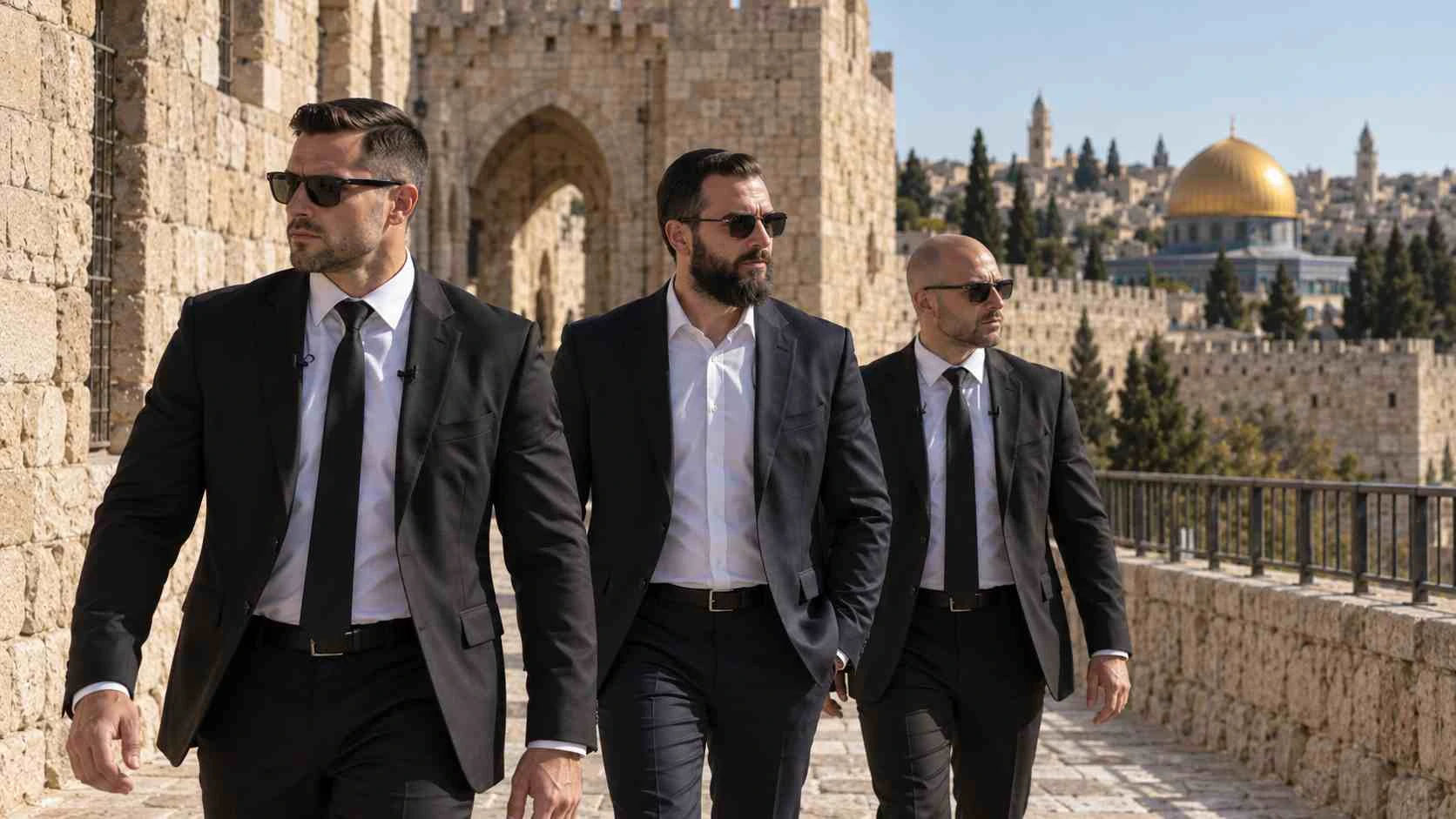
JERUSALEM · EXECUTIVE PROTECTION · PRIVATE CLIENTS · SECURE TRAVEL
Bodyguard Services in Jerusalem for Executives, Families & VIPs
R&H Global Protection provides discreet bodyguard and executive protection in Jerusalem for family, religious-site and formal-visit clients, private families and retained principals. Programmes can connect Ben Gurion Airport (TLV) with Mamilla, Old City and Government Quarter / Givat Ram, while planning for ICC Jerusalem conference days or other high-demand periods. Vehicle and officer handoffs are built around real corridors such as Route 1 and King David Street, with locally regulated roles confirmed before deployment.
Part of R&H Global Protection’s bodyguard services in Israel and international protection capability.
Jerusalem Protection Snapshot
Ben Gurion Airport (TLV)Principal-Focused Protection
Protection follows the client through Mamilla, Old City, hotels and private appointments. The officer stays with the principal rather than becoming a driver, venue guard or household post.
Hotels and Hosted Venues
Receiving can involve properties such as King David Hotel or Mamilla Hotel. Hotel and host teams keep control of their premises; the CPO manages the protected guest.
Road and Event Pressure
Route 1 and King David Street can behave very differently during ICC Jerusalem conference days. Driver position and release timing are planned before the principal is ready to move.
Retained Continuity
Longer Jerusalem assignments use consistent personnel, realistic relief and review as the routine changes between Government Quarter / Givat Ram, Rehavia / Talbiya and the next declared stage.
Direct answer · hiring a bodyguard in Jerusalem
Can You Hire a Private Bodyguard in Jerusalem?
Yes. R&H Global Protection coordinates retained personal protection in Jerusalem. Send the expected duration, TLV arrival if relevant, operating base, fixed commitments around Mamilla or Old City, and any driver, family, residence or event requirement.
R&H Global Protection · +972-55-9724475 · info@global-protection.net. For Jerusalem, send the family or executive duration, TLV, hotel base, Old City walking phases and any formal or residence requirements.
Bodyguard · Executive Protection · Close Protection in Jerusalem
What a Bodyguard in Jerusalem Covers
The Jerusalem bodyguard’s core duty is continuous personal protection of the named principal from the agreed start point through meetings, hotel arrivals, private time and road movement. That can include TLV, Mamilla, Old City and event-related transitions.
Jerusalem walking protection, Route 1 driving, hotel security and a fixed residence post are different responsibilities. The CPO stays with the family or principal through the agreed city movement.
Jerusalem Protection Planning
Family, Executive and Access-Sensitive Protection
A family, religious-site and formal-visit programme in Jerusalem can move from King David Hotel or Mamilla Hotel into Mamilla, then change posture again around ICC Jerusalem conference days. Hotel receiving, host access, public transitions and vehicle release are treated as separate operating moments.
A meeting day around Mamilla does not operate like private time around Government Quarter / Givat Ram or a high-demand period such as ICC Jerusalem conference days. Officer distance, driver standby and host interfaces are adjusted accordingly.
Road Corridor Reality
Route 1 and King David Street affect when the vehicle can realistically rejoin the principal. The driver brief follows the true exit, not only the scheduled address.
Hotel and Residence Handoffs
At King David Hotel, Waldorf Astoria Jerusalem or a private residence, the handoff should be clear at the lobby, driveway or parking area without implying any hotel affiliation.
Event-Specific Posture
ICC Jerusalem conference days can increase crowd density, accreditation controls and late departures. The CPO protects the client while organisers keep responsibility for the wider site.
Longer Assignment Review
Repeated routes through Rehavia / Talbiya and Jaffa Road become more efficient over time, but relief, public exposure and new venues are reviewed rather than assumed to stay constant.
Jerusalem Protection Services
Personal Protection, Drivers and Residence Support
Jerusalem support is shaped by walking phases, formal hosts, hotel departures and Route 1 timing. Drivers, guides, residence staff and venue teams are coordinated without replacing the family-facing CPO.
Family / Principal Protection
Principal-focused protection for the family, religious-site and formal-visit client moving through Mamilla, Old City and confirmed executive appointments.
Old City Walking-Phase Protection
Low-profile coverage around King David Hotel, Mamilla Hotel and private hospitality, with the officer reducing visibility where the environment allows.
Private Family Protection in Rehavia / Talbiya
Family coverage around Government Quarter / Givat Ram and private routines, with extra officers added if parents, children or staff move at the same time.
Female CPO Request
A female CPO can be requested for Jerusalem family or privacy-sensitive programmes where that profile best fits the household and lawful Israeli delivery.
Ben Gurion to Jerusalem Receiving
Receiving at Ben Gurion Airport (TLV) links the live flight, luggage, vehicle and first protected stop so the city programme starts as one movement chain.
Security Driver for Route 1 / King David Street
A dedicated driver manages waiting and repositioning on Route 1, King David Street and later city movements while the CPO remains with the principal.
Residence Integration for Family Stays
Residential coverage is separated when a property near Government Quarter / Givat Ram needs its own access or fixed-post responsibility while the mobile detail is away.
ICC / Major City Event Protection
For ICC Jerusalem conference days, the officer remains accountable for the named client; accreditation, screening and general venue security stay with the organiser.
Advance Planning for Old City Access
Advance work checks entrances, exits, host contacts and vehicle rejoin points around Mamilla, Jaffa Road and the day’s highest-pressure stops.
Retained Jerusalem Family / Executive Programme
A retained Jerusalem programme uses continuity to learn repeated routes and client preferences, then adds planned relief and review so familiarity never replaces discipline.
Client Profiles
Client Profiles for Private, Religious and Formal Visits
The buying situations in Jerusalem are not interchangeable. A family, religious-site and formal-visit principal using Mamilla has different movement pressure from a family based near Government Quarter / Givat Ram or a guest attending ICC Jerusalem conference days.
International Families
Senior clients with recurring appointments around Mamilla who need the protection layer to remain discreet around assistants and hosts.
Religious and Heritage Visitors
Principals moving between Old City, private meetings and hotels such as Mamilla Hotel who require precise vehicle and lobby handoffs.
Formal / Official Visitors
Formal visitors can move between Givat Ram, Mount Scopus and hotel meetings; host screening and visitor rules stay with the institution while the officer stays with the principal.
Healthcare and Academic Leaders
Families using Government Quarter / Givat Ram, residences and premium hotels who need a calm service that adapts to children and normal daily routines.
Delegation Principals
Clients exposed to crowd and traffic pressure around ICC Jerusalem conference days who need tighter arrival and departure planning.
VIP Hotel Guests
Jerusalem family offices may coordinate Mamilla hotels, private residences, drivers, religious visits and formal appointments through one reporting line.
Family Offices
ICC Jerusalem guests and formal delegations can have parallel conference, family and religious-site movements that require distinct personal coverage.
Retained Residents and Executives
Longer-assignment clients who benefit from officer continuity, relief and familiarity with recurring roads such as King David Street and Jaffa Road.
Israeli-led methodology · Assignment-specific delivery
How an Access-Led Jerusalem Plan Is Built
Planning starts with the real route: TLV receiving, the operating base, Mamilla, Old City and the final release. Route 1 and King David Street are working constraints, not decorative local references.
Hotels such as King David Hotel and Waldorf Astoria Jerusalem are receiving and handoff environments. Their concierge, valet or security teams remain responsible for hotel operations; the CPO remains responsible for the client.
After event days such as ICC Jerusalem conference days, the team reviews driver duty, crowd exposure, late finishes, family splits and the next stage. The retained plan is updated rather than simply repeating day one.
Local Operating Context
Operational Geography: Mamilla, Old City, Givat Ram and Rehavia
The strongest local distinction comes from how neighbourhoods, hotels, roads and events connect. In Jerusalem, one duty period may move between King David Hotel, Mamilla, King David Street and ICC Jerusalem conference days.
TLV / Route 1
Ben Gurion receiving should connect the flight to Route 1, the hotel base and the first Jerusalem access point; a late flight can materially change the city arrival and driver duty.
Mamilla / Executive Core
Meeting days can use properties such as King David Hotel or Mamilla Hotel. Building exits and driver staging matter more than the headline address.
ICC Jerusalem conference days
ICC Jerusalem conference days and citywide events can shift Jaffa Road, hotel and Old City movement. The detail should confirm pedestrian and vehicle rejoin points before the programme begins.
Government Quarter / Givat Ram / Private Programme
Private time may connect to The David Citadel Hotel or a residence. The posture is quieter, but household, valet and vehicle handoffs still need clear ownership.
Primary airport / city or waterfront movement.
Executive meetings, hotel handoffs and hosted access.
Example luxury-hotel receiving environment; no affiliation is implied.
Peak-demand planning for crowd, accreditation and release timing.
Family, residence and lower-profile movement.
Planning note: Route 1, King David Street, Jaffa Road, King David Hotel, Mamilla Hotel, Waldorf Astoria Jerusalem and ICC Jerusalem conference days are geographic and operational examples only. They do not imply an R&H office, hotel relationship, organiser affiliation, guaranteed access or authority over any premises. Additional Jerusalem planning references include Hebron Road, The David Citadel Hotel and Jerusalem Marathon periods, alongside Route 1, King David Street and Jaffa Road.
The Assigned Team
Standards for a Family / Formal Detail
The assigned team should fit a family, religious-site and formal-visit programme in Jerusalem: polished around King David Hotel, confident with ICC Jerusalem conference days, and practical about road movement on Route 1 and King David Street.
R&H matches the principal-facing officer to the actual Jerusalem environment rather than to a generic security résumé. Driver, host, residence and event responsibilities are reviewed together before confirmation.
Choose personnel who can move naturally between Mamilla, King David Hotel and private engagements without making security the centre of attention.
For Jerusalem, regulated guard and any firearm-related functions are checked separately under the Israeli framework before the family or executive detail starts.
For Jerusalem, hotel, guide, driver and family communications are separated so sensitive routines and religious-site plans are not distributed beyond the people who need them.
Keep vehicle responsibility with the driver so waiting on Route 1 or repositioning near Old City does not pull the CPO away from the client.
Protect hotel, residence and family information on a need-to-know basis; named properties such as Mamilla Hotel are locations, not client relationships.
Route 1, Old City walking phases, late family dinners and hotel returns all count toward the Jerusalem duty; relief is based on the actual family day.
Hiring a Bodyguard in Jerusalem
Arranging Retained Protection in Jerusalem
Start with the protected people, expected duration, arrival point and actual Jerusalem programme rather than a generic request for security. Early clarity about fixed appointments, transport, family splits and residence needs makes the retained proposal more accurate.
Send the real programme
Provide the expected Jerusalem duration, protected people and the main family, religious-site and formal-visit pattern rather than only the first appointment.
Anchor the arrival and base
Confirm TLV, the hotel or residence and whether the first important movement is toward Mamilla, Old City or another fixed stop.
Mark event and split-schedule days
Identify ICC Jerusalem conference days, family movements and any dates where two protected routes may happen at the same time.
Separate the supporting roles
Keep the CPO with the family or principal, the driver with the vehicle, site / host security with the host and any residence post at the property.
Review local delivery
Confirm the Israeli licensed delivery for the Jerusalem duties, including any separately requested armed or residence function.
Approve the operating plan
Lock duty periods, Route 1 / city transport, relief, commercial terms and the final responsibility point before mobilisation.
Jerusalem Service Models
Protection Models for Walking, Family and Hosted Days
The right model depends on whether the principal is in Mamilla, moving privately around Government Quarter / Givat Ram, attending ICC Jerusalem conference days or splitting from family. Each model assigns those responsibilities differently.
- Jerusalem executive dayOne principal with TLV, Mamilla meetings and a dedicated driver if the road schedule requires it.
- Principal + dedicated driverThe officer stays with the client while the driver owns Route 1, parking, waiting and the next pickup.
- Family split modelAdditional personal coverage when private routines around Government Quarter / Givat Ram continue while the principal is elsewhere.
- Major event modelPersonal protection around ICC Jerusalem conference days with organiser-controlled accreditation and venue security kept separate.
- Residence + mobile layerA residence officer remains at the Jerusalem property while the personal officer accompanies the family through city movements and walking phases.
- Retained continuity modelConsistent personnel, planned relief and regular review for a multi-week or multi-month Jerusalem assignment.
Jerusalem Bodyguard Cost · Written Quotations
Bodyguard Cost in Jerusalem
R&H Global Protection’s indicative Jerusalem planning range is $700–$1,500 per officer/day. The final quotation is built from duty hours, team size, transport, event pressure, residential roles and the actual operating pattern.
The Jerusalem duty clock includes TLV, Route 1, walking phases, private visits and the final family or hotel return.
Add officers when business and family create simultaneous routes between Mamilla and Government Quarter / Givat Ram.
Advance time may be needed for ICC Jerusalem conference days, controlled entrances or hosted appointments with fixed access windows.
Transport cost follows the real vehicle workload on Route 1, King David Street, parking, waiting and late repositioning.
A longer Jerusalem family programme may need relief plus distinct driver and residence responsibilities as the household routine becomes established.
Tel Aviv continuation keeps the family brief but changes vehicle positioning, city access and any locally regulated duties for the next stage.
Team Configurations for Jerusalem Protection
The four configurations below are responsibility examples, not packages. A Jerusalem assignment can be shaped by TLV, Mamilla, ICC Jerusalem conference days, hotel handoffs and split principals; the written scope defines the actual resources.
$700–$1,500 is the indicative Jerusalem officer-day. Route 1 driver duty, extra family officers, residence posts and any separately licensed armed role are scoped independently.
Peak-demand note: ICC Jerusalem conferences and marathon/event periods can alter Route 1 approaches, Jaffa Road access, hotel arrivals and vehicle rejoin points. Earlier confirmation may be required, and transport or staffing can price above ordinary periods.
The Jerusalem proposal separates the family-facing officer, Route 1 driver, residence support and any regulated armed layer so the household can review each responsibility.
Before confirmation, review payment, mobilisation and cancellation terms together with the final responsibility point. An enquiry does not hold personnel or create access rights at King David Hotel, Mamilla or any restricted venue.
Request Jerusalem Bodyguard QuoteLocal and Regional Coverage
TLV Transfer, Hotel Access and City Movement
Coverage follows the principal’s real Jerusalem pattern: TLV, Route 1, Mamilla, hotel receiving and private movement around Government Quarter / Givat Ram. The geography is operational context, not a claim of office locations or guaranteed access.
Jerusalem
A typical protected day may connect King David Hotel, Mamilla, King David Street and Government Quarter / Givat Ram. During ICC Jerusalem conference days, driver staging may change materially even if the meeting list does not.
Airport receiving and the first protected road movement.
Meetings, towers, hosts and hotel-to-office handoffs.
Example hotel environments; no client or hotel relationship is implied.
Peak-demand crowd, access and vehicle-release planning.
Family, residence and lower-profile schedules.
The Israel Ministry of Justice licensing source supports the guard-services context, and the Israel Airports Authority supports Ben Gurion receiving. Neither source changes the access rules of religious, hotel or institutional sites.
Why R&H Global Protection
Why Choose R&H Global Protection in Jerusalem?
R&H Global Protection is useful in Jerusalem when the detail must bridge Mamilla, hotel receiving, Route 1, private time and ICC Jerusalem conference days without turning the client’s day into a security exercise.
Old City Access Planning
The programme is built around the real pressure created by ICC Jerusalem conference days rather than applying an ordinary weekday plan to a peak-demand day.
Route 1 / Hotel Receiving
Driver staging is planned around Route 1 and King David Street, so the principal is not waiting while the vehicle is somewhere impractical.
Family-Friendly Protection Style
At King David Hotel, Mamilla and hosted venues, R&H keeps the personal officer distinct from concierge, building and organiser security.
Formal Host Boundary Management
Family schedules around Government Quarter / Givat Ram can receive their own officer or residence layer when they diverge from the principal’s business programme.
Residence and Driver Integration
Across a longer Jerusalem family programme, continuity helps with hotel, guide and walking routines while relief keeps the service patient and sustainable for children and adults.
Israeli Licensing Clarity
The Jerusalem scope separates family protection, driving, residence duties and any licensed armed function so the household can review the model before the first movement.
“Our family travelled to Jerusalem for almost two weeks and wanted professional protection that would allow us to visit important religious and historical sites without making the experience uncomfortable for our children. R&H Global Protection provided exactly that balance. The officer accompanied us through the Old City, private visits, restaurants and family activities while remaining calm and discreet at all times. Certain days involved crowded areas and several changes to the route, but everything was handled smoothly. The team also coordinated well with our driver and hotel, which made departures and returns much easier. We always felt looked after without feeling restricted, and that was particularly important to us as a family.”
R&H leadership and operating approach · Editorial standards and accountability
International Protection Continuity
International Protection Continuity
After Jerusalem, the family or executive brief can continue to Tel Aviv or an international destination while receiving, vehicles and local security roles are rebuilt for the next stage.
Relevant protection destinations:
Tel Aviv, Dubai, London, Paris, New York, Rome, Athens, Monaco.MadridSingapore
Jerusalem · Confidential Protection Enquiry
Request Jerusalem Protection
For a retained Jerusalem requirement, send the expected duration, protected people, TLV arrival if relevant, hotel or residence, recurring locations such as Mamilla, and any event, driver or family layer. R&H will return a written operating scope rather than a generic package.
The WhatsApp button prepares a Jerusalem-specific draft that you can edit before sending. The web contact page remains available if the client prefers not to open a messaging app.
Jerusalem Bodyguard Questions
Jerusalem Bodyguard FAQs
These answers focus on Jerusalem family and executive questions: pricing, Ben Gurion / Route 1, Old City movement, drivers, residence coverage and Israeli licensing.
How is Jerusalem bodyguard pricing calculated?
R&H Global Protection uses $700–$1,500 per officer/day as the indicative Jerusalem planning range. The final quote reflects duty hours, transport, extra personnel, events and any separate residence requirement.
Does R&H offer short Jerusalem protection visits?
R&H’s current model is centred on retained protection. Short isolated bookings are not offered as the standard service; send the full duration and scope for assessment.
What does a Jerusalem bodyguard actually cover?
The officer can accompany the principal or family through TLV receiving, Mamilla, formal appointments, Old City visits, restaurants and protected movements. Driving and fixed-property duties are separate.
Can protection begin at Ben Gurion Airport (TLV)?
Yes. Ben Gurion receiving is connected to Route 1, the receiving vehicle and the first Jerusalem hotel, residence or formal access point.
Can the driver stay close during Old City visits?
Not always. Some Jerusalem phases are pedestrian or access-controlled, so the plan should define the walking segment and the vehicle rejoin point in advance.
Can you protect a family with children in Jerusalem?
Yes. The officer can work around children, guides, family activities and private visits, with extra personnel added if the household splits.
How are religious-site visits handled?
The detail plans crowds, walking, host or guide information and vehicle access while respecting site rules and keeping the security posture proportionate.
Is long-term family protection available in Jerusalem?
Yes. Retained family coverage can use consistent personnel, planned relief and separate residence support where the property needs its own security responsibility.
Are armed bodyguards standard in Jerusalem?
No. Armed security requires separate Israeli licensing and firearm permissions and is not automatically included in an ordinary personal-protection booking.
Can the Jerusalem detail continue to Tel Aviv?
Yes. The client brief can continue, but Tel Aviv vehicle positioning and city movement are rebuilt for that different operating environment.