
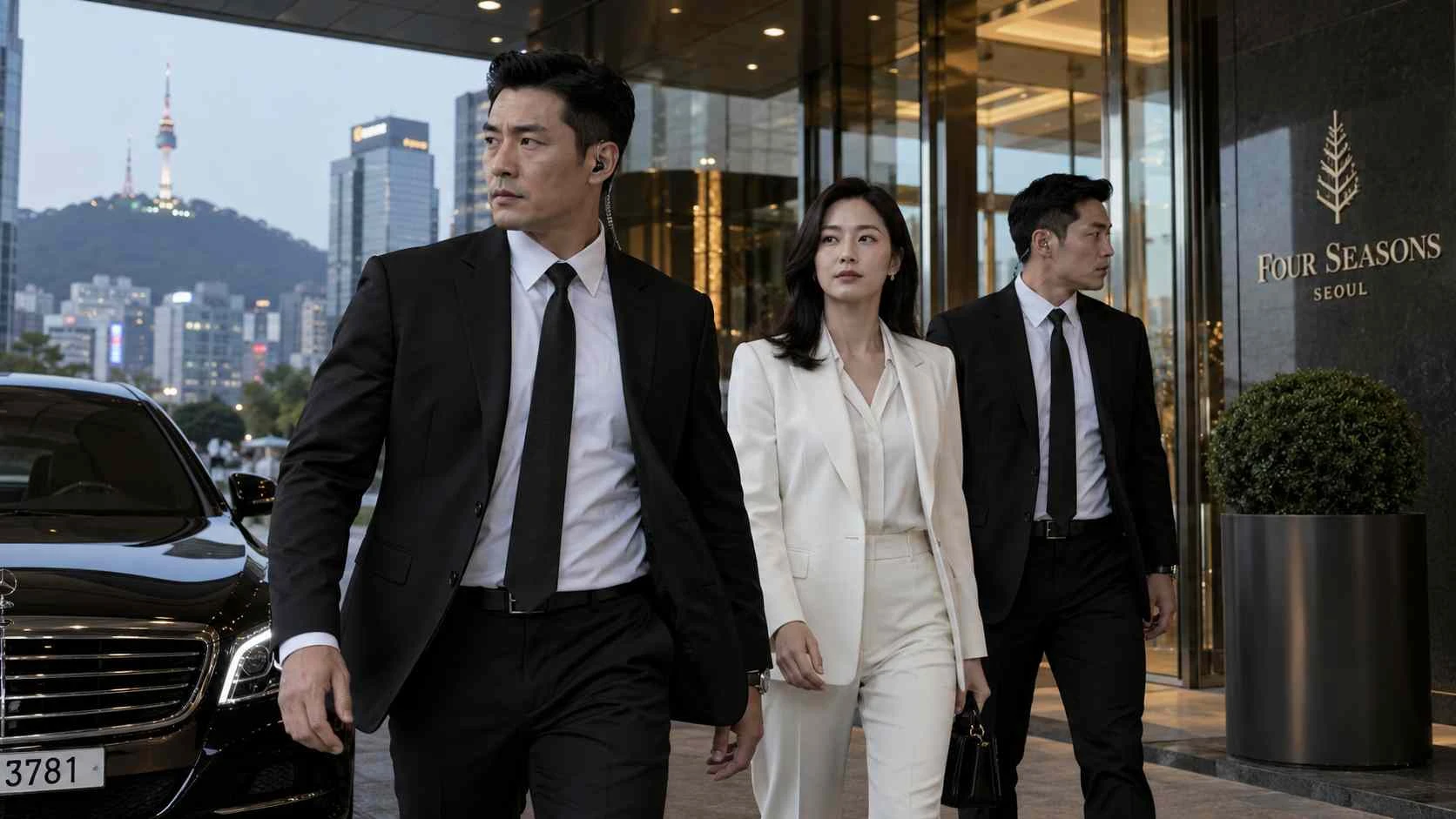
SEOUL · EXECUTIVE PROTECTION · PRIVATE CLIENTS · SECURE TRAVEL
Bodyguard Services in Seoul for Executives, Families & VIP Travel
R&H Global Protection provides discreet bodyguard and executive protection in Seoul for technology leaders, executives, private families and delegations. Long-term programmes can connect ICN or GMP arrivals, Gangnam and COEX schedules, Yeouido finance meetings, central Seoul appointments and KTX continuation, with South Korean delivery roles confirmed before deployment.
Part of R&H Global Protection’s bodyguard services in South Korea and international protection capability.
Seoul Personal Protection at a Glance
Incheon (ICN) · Gimpo (GMP)Executive and private clients
Discreet protection shaped around technology, finance and corporate schedules across Gangnam, Yeouido and central Seoul, with the officer focused on the principal rather than taking over the client’s meetings or host environment.
Hosted and formal appointments
Appointments around Gangnam and COEX, Yeouido finance district and other hosted locations are handled with a clear boundary: the receiving organisation controls premises while the CPO manages personal accompaniment.
Family and residence support
Private coverage can follow family and private-client programmes linking hotels, residences, shopping and evening hospitality, with residence duties separated when a property needs its own fixed security responsibility.
Regional continuity
Onward travel toward KTX, domestic-air and wider South Korea continuation with a named receiving plan keeps the client brief but triggers a fresh check of transport, working hours, receiving and locally regulated roles.
Direct answer · hiring a bodyguard in Seoul
Can You Hire a Private Bodyguard in Seoul?
Yes. R&H Global Protection coordinates private bodyguard, executive protection and VIP protection in Seoul for executives, families and corporate leaders. We currently focus on long-term and retained assignments. The brief should identify ICN or GMP, Gangnam/COEX or Yeouido commitments, protected people, driver needs and any KTX or wider Korea continuation.
R&H Global Protection · +972-55-9724475 · info@global-protection.net. For a retained Seoul quotation, send the expected duration, protected people, broad programme and any driver, vehicle, family or residence requirement.
Bodyguard · Executive Protection · Close Protection in Seoul
What Does a Bodyguard in Seoul Cover?
With R&H Global Protection, the Seoul bodyguard role is personal accompaniment and close protection of the named principal during the agreed duty period. Coverage can include ICN or GMP receiving, Gangnam or COEX schedules, Yeouido meetings, central Seoul commitments, media appearances and protected movement between them.
The personal officer does not automatically provide chauffeur driving, fixed residence guarding, venue-wide security or continuation beyond the accepted Seoul stage. KTX, domestic-air, additional family and property responsibilities are separately reviewed and assigned.
Seoul Protection Planning
Executive Protection in Seoul for Business and Private Life
Executive protection in Seoul is shaped by technology, finance and corporate schedules across Gangnam, Yeouido and central Seoul as well as private time. R&H builds the detail around exposure, confidentiality, host procedures and the movement interfaces created by Incheon (ICN) · Gimpo (GMP), Gangnam and COEX, Yeouido finance district and Jongno and central Seoul.
Respect the environment.
ICN road time, tower access and KTX release can stretch the protected day well beyond the visible meeting schedule. Start with the principal’s real commitments, then decide where personal accompaniment is essential, where a driver takes over and which hosts control access.
Exposure and privacy
Consider visibility, disclosed concerns and the confidentiality of technology, finance and corporate schedules across Gangnam, Yeouido and central Seoul. The officer receives only the information needed for protection without circulating unnecessary commercial or family detail.
Host and venue boundaries
Entrances, screening and premises security around Gangnam and COEX, Yeouido finance district and hosted locations remain with the relevant organisation. The bodyguard works through those procedures rather than claiming authority over them.
Driving, household and event roles
Keep the CPO available for the principal while a driver manages vehicle work and separate resources cover any residence or event-wide duty. This matters when family and private-client programmes linking hotels, residences, shopping and evening hospitality overlap with the executive programme.
Regional and international stages
Continuation toward KTX, domestic-air and wider South Korea continuation with a named receiving plan is rebuilt around the next journey, duty period and local requirements. Client preferences can continue, but the original Seoul staffing and permissions are not assumed to transfer unchanged.
Seoul Protection Services
Close Protection in Seoul: Personal and Supporting Services
In Seoul, supporting resources are chosen around the actual friction points: Gangnam and COEX, Yeouido finance district, Incheon (ICN) · Gimpo (GMP) and any split family or regional movement. The CPO remains principal-focused; transport, residence, event and advance functions are added only when they solve a distinct responsibility.
Executive bodyguard in Seoul
Principal-focused protection for executives moving through technology, finance and corporate schedules across Gangnam, Yeouido and central Seoul. Officer selection follows visibility, confidentiality and the actual duty period rather than a generic city roster.
Private-client close protection
Discreet personal security for HNW and private clients balancing family and private-client programmes linking hotels, residences, shopping and evening hospitality, with the officer adjusting presence to the client environment without disappearing from the protective responsibility.
Family protection
Coverage for families using Jongno and central Seoul and other private locations, with separate officers considered when family members follow different movements from the principal.
Female CPO request
A female CPO can be requested in Seoul for family, cultural, privacy or client-preference reasons. Availability is checked alongside the local provider, working language and the practical movement pattern around Gangnam and COEX and Jongno and central Seoul.
Airport and arrival protection
Advance receiving through Incheon (ICN) · Gimpo (GMP), with passenger group, luggage, meeting point, vehicle and the first protected destination agreed before arrival.
Security driver and secure transportation
A dedicated driver can absorb the transport burden created by ICN road time, tower access and KTX release, keeping the bodyguard free to stay with the principal.
Residential integration
If the client uses a residence near Jongno and central Seoul or another private base in Seoul, the mobile officer can coordinate with a separately assigned property team. The accompanying CPO is not treated as an all-day fixed post while the principal is elsewhere.
Event and public-appearance protection
Protection for a named principal through COEX, entertainment, media and public-facing commitments with separate organiser or venue control; organiser accreditation and wider venue security remain separate from the personal-protection role.
Advance and route planning
Preparation focuses on the interfaces that can interrupt a protected day in Seoul: Gangnam and COEX, Yeouido finance district, arrival timing, hosts and the next confirmed responsibility.
Long-term / retained protection
Retained coverage for principals based in Seoul who need continuity, realistic relief and review as the programme changes or extends toward KTX, domestic-air and wider South Korea continuation with a named receiving plan.
Client Profiles
Who Uses Bodyguard Services in Seoul?
Seoul clients can move between very different environments—from technology, finance and corporate schedules across Gangnam, Yeouido and central Seoul to family and private-client programmes linking hotels, residences, shopping and evening hospitality. These profiles describe practical buying situations so staffing follows real responsibilities rather than a standard city package.
Executives and founders
Leaders moving through technology, finance and corporate schedules across Gangnam, Yeouido and central Seoul who need discreet protection without adding friction to advisers, colleagues or host organisations.
Private families
Parents, children and accompanying relatives following family and private-client programmes linking hotels, residences, shopping and evening hospitality, with extra personal coverage considered when the group separates.
Family offices
Family-office teams coordinating Gangnam and COEX, Jongno and central Seoul, drivers, residences and sensitive appointments through one approved client contact.
Delegation principals
Delegation principals moving through Gangnam and COEX, Yeouido finance district or formal hosted appointments who need a named personal-protection responsibility without confusing that role with host, diplomatic or venue authority.
HNW and UHNW visitors
Private clients balancing premium hospitality, confidential meetings and movement through Gangnam and COEX, Yeouido finance district and private locations without an unnecessarily visible security footprint.
Public figures and event guests
Public figures, speakers or event guests moving between COEX, entertainment, media and public-facing commitments with separate organiser or venue control, private meetings and personal time while organiser security retains venue-wide responsibilities.
Long-term corporate clients
Executives on retained assignments who need officer continuity around technology, finance and corporate schedules across Gangnam, Yeouido and central Seoul, plus realistic relief and periodic review.
Regional travellers
Clients using Seoul as the first protected stage before KTX, domestic-air and wider South Korea continuation with a named receiving plan, with each onward movement receiving its own transport and local-delivery check.
Israeli-led methodology · Assignment-specific delivery
Protection Planning Adapted to Seoul
Seoul planning begins with the principal’s business profile and public visibility. ICN travel time, Gangnam tower access, COEX event accreditation, Yeouido finance schedules and media appearances can create very different timing and host interfaces in one retained programme.
The brief defines the airport start, driver responsibility, venue or organiser handoff, family splits and any KTX release before deployment. South Korean delivery requirements are checked for the actual duties rather than assumed from international experience.
For multi-day or retained work, the team reviews what changed instead of repeating day one indefinitely. Relief, travel toward KTX, domestic-air and wider South Korea continuation with a named receiving plan, family splits and new public exposure are incorporated into the next duty plan.
Local Operating Context
Where the Seoul Protection Plan Changes
Seoul changes the protection plan most at the interfaces between Gangnam and COEX, Yeouido finance district, Jongno and central Seoul and Incheon (ICN) · Gimpo (GMP). The cards below focus on those real transition points—where vehicle position, host control, timing or receiving can change the protective requirement.
ICN is part of the duty, not just a transfer
The protected day can begin well before central Seoul. Flight timing, luggage, road margin and first Gangnam or Yeouido commitment should sit in one plan.
Gangnam and COEX towers
Basement or lobby handoffs, hosted floors and event accreditation require precise division between officer, driver and venue personnel.
Yeouido and Jongno corporate schedules
Financial and corporate appointments may be time-fixed even when Seoul traffic changes. Keep a driver retained when hard departures matter.
KTX and domestic continuation
Rail or domestic-air release needs an identified next responsibility. The client brief can continue, but receiving and regulated delivery are checked again.
Gangnam · COEX
Technology, leadership and event schedules.
Yeouido
Banking and investment meetings.
Jongno
Hosted business and government-facing appointments.
ICN · GMP
Airport receiving and city release.
KTX · domestic air
Separate handoff and receiving plan.
Planning note: Gangnam and COEX, Yeouido finance district, Jongno and central Seoul and the other Seoul locations above are operational examples for access and timing. They do not represent an R&H office, guaranteed entry, or authority over a host, building or venue security team.
The Assigned Team
Professional Standards for Your Seoul Detail
The people assigned to Seoul should fit the client environment, not just a generic security résumé. Review their ability to work around technology, finance and corporate schedules across Gangnam, Yeouido and central Seoul, private routines and the local delivery requirements of the actual role.
R&H Global Protection matches Seoul personnel to technology, finance, media and private-family environments. The officer, driver, working language and South Korean delivery structure are confirmed together so the retained detail remains adaptable without losing responsibility clarity.
Select personnel who can work smoothly across Gangnam, Yeouido, central Seoul, corporate towers and public-facing schedules. The strongest fit combines discreet presentation with sound judgement around executives, assistants, drivers and media environments, while remaining adaptable when a tightly structured programme changes during the day.
Verify that the delivering provider and assigned personnel meet the Korean requirements applicable to the duties offered in Seoul. International experience does not replace local regulation, so company status, personnel credentials and any regulated function should be checked against the actual assignment before deployment.
Match the detail to the principal’s working language and the language needed with Seoul hosts, hotels, drivers and local coordinators. English may suit the executive programme, while Korean capability can improve operational coordination; the final language mix should reflect the itinerary and receiving environment.
Use a dedicated driver when ICN road time, GMP movements, tower access or KTX handoffs would otherwise pull the officer away from the principal. The driver should manage positioning and route timing while the bodyguard stays with the client through the protected movement.
Keep technology meetings, media commitments and private plans on a need-to-know basis. Assistants, drivers and local contacts should receive only the information needed for their role, particularly when corporate, public-facing and family schedules are being coordinated through different people throughout the working day.
Count the complete Seoul duty day, including ICN or GMP receiving, waiting, KTX movements, evening hospitality and cross-city repositioning. Multi-day programmes need realistic relief and handovers so continuity remains strong without assuming one officer can cover every hour across the assignment.
Hiring a Bodyguard in Seoul
How to Arrange Close Protection in Seoul
Start with the protected people, arrival point and the actual programme rather than a generic request for “security”. In Seoul, early clarity about Incheon (ICN) · Gimpo (GMP), Gangnam and COEX, Yeouido finance district, transport and any split family or regional stage makes the proposal more accurate.
Describe the principals and purpose
Share the expected Seoul duration, protected people and whether the programme is technology, finance, family, media or mixed.
Confirm arrival and operating base
Confirm ICN or GMP, the broad hotel or residence area and the first Gangnam, COEX, Yeouido or central appointment.
Map fixed times and split movements
Identify public appearances, simultaneous family movements and any KTX or domestic-air continuation before staffing is fixed.
Define supporting responsibilities
Separate personal protection from driving, residence coverage, venue security and receiving responsibilities for onward stages.
Review personnel and compliance
Review the assigned officer, working language and South Korean provider or personnel requirements applicable to the booked duties.
Confirm proposal and mobilisation
Approve the written proposal covering duty hours, transport, event preparation, supporting resources, local delivery and payment terms.
Seoul Service Models
Choose the Right Protection Model in Seoul
Choose the Seoul model by looking at who actually needs protection, how the day moves through Gangnam and COEX, Yeouido finance district and Jongno and central Seoul, and whether transport, family or regional stages create another responsibility.
- Gangnam corporate dayOne principal with ICN/GMP receiving and a meeting-led schedule across Gangnam and central Seoul.
- Officer + Seoul driverPersonal protection plus a dedicated driver for ICN road time, towers and late repositioning.
- Technology / finance programmeCoverage for a principal moving between Gangnam, Yeouido, dinners and shifting corporate commitments.
- Family + business splitSeparate personal coverage when family members follow a different Seoul programme.
- COEX / public detailProtection for a named principal at a conference, media or public-facing programme under organiser access rules.
- KTX continuationSeoul coverage ending in a controlled rail or domestic-air handoff with the next responsibility confirmed.
Seoul Bodyguard Cost · Written Quotations
How Much Does a Bodyguard in Seoul Cost?
R&H Global Protection’s indicative Seoul planning range is $700–$1,500 USD per officer per day. The written quotation confirms the actual duty window, personnel, local delivery structure, transport and any additional family, residence, event or regional costs.
ICN or GMP receiving, city appointments, evening commitments and the agreed final responsibility point define the protected Seoul duty period.
Separate executive, delegation or family schedules may require additional officers even when the group uses one hotel or residence.
Advance preparation can focus on tower access, COEX accreditation, media schedules and host-controlled meeting environments.
Dedicated transport reflects ICN road time, city waiting, basement or lobby access, luggage and the handoff before KTX or domestic continuation.
Long-term Seoul programmes may require officer continuity, relief and separately staffed residence duties when the mobile detail leaves the property.
KTX, domestic-air or wider South Korea stages add receiving, transport, accommodation or deployment resources for the next leg.
Team Configurations for Seoul Protection
These four Seoul configurations illustrate different responsibilities created by Incheon (ICN) · Gimpo (GMP), Gangnam and COEX, split principals and onward travel. They are not fixed-price packages; the written proposal defines the actual personnel, duty periods, transport and supporting resources.
The Seoul officer rate does not automatically include the dedicated driver, vehicle, extra CPOs, accommodation where deployment requires it, or a separately staffed residence post. Travel toward KTX, domestic-air and wider South Korea continuation with a named receiving plan is costed against the actual duty and receiving plan.
Seoul quotes should separate the personal officer from driver standby, extra protected people and any longer stage toward KTX, domestic-air and wider South Korea continuation with a named receiving plan so the buyer can see which responsibilities create the final scope.
Request an itemised Seoul proposal for the complete retained requirement. The quoted rate belongs to the agreed R&H Global Protection scope; it is not presented as a universal local market price or unlimited 24-hour package.
Before confirming the Seoul assignment, review payment, mobilisation and cancellation terms together with the agreed final responsibility point. An enquiry does not hold personnel or create access rights at Gangnam and COEX, Yeouido finance district or any restricted venue.
Request a Seoul Bodyguard QuoteLocal and Regional Coverage
Personal Security in Seoul and Your Onward Itinerary
Local coverage is planned around Gangnam and COEX, Yeouido finance district, Jongno and central Seoul, Yongsan and KTX / domestic continuation and the confirmed client programme. Travel toward KTX, domestic-air and wider South Korea continuation with a named receiving plan is treated as a separate operating stage when it changes working time, transport, receiving or applicable delivery requirements.
Seoul
Seoul coverage is built from the confirmed movements through Gangnam and COEX, Yeouido finance district, Jongno and central Seoul and Incheon (ICN) · Gimpo (GMP), not from an abstract municipal boundary. The service area therefore follows the principal’s real day and any declared handoff toward KTX, domestic-air and wider South Korea continuation with a named receiving plan.
Technology, leadership and event schedules.
Banking and investment meetings.
Hosted business and government-facing appointments.
Airport receiving and city release.
Separate handoff and receiving plan.
The Korea Legislation Research Institute — security law source is included to explain the delivery framework relevant to Seoul, while the airport reference supports arrival planning through Incheon (ICN) · Gimpo (GMP). Neither source endorses R&H, and the proposed provider and personnel still need assignment-specific verification.
Why R&H Global Protection
Why Choose R&H Global Protection in Seoul?
R&H Global Protection connects Israeli-led planning with Seoul technology, finance, media and private-family requirements. The written scope separates personal protection, driving, venue access and domestic continuation while confirming the South Korean delivery structure for the accepted assignment.
A programme built from the real day
The Seoul plan is built around technology, finance and corporate schedules across Gangnam, Yeouido and central Seoul and private time rather than an oversized visible detail.
One accountable management contact
One management contact keeps the assistant, receiving driver and protection officer working from the same current schedule when ICN road time, tower access and KTX release can stretch the protected day well beyond the visible meeting schedule.
Clear officer / driver / host boundaries
At Gangnam and COEX, Yeouido finance district and hosted sites, the CPO protects the principal, the driver owns the vehicle, and the building or organiser owns premises access. Keeping those boundaries explicit prevents a transport or credential issue from swallowing the personal-protection role.
Parallel coverage when schedules split
Family or staff movements can be separated from the principal’s programme when family and private-client programmes linking hotels, residences, shopping and evening hospitality continue during executive commitments.
Retained protection that is reviewed
For multi-week work, officer continuity is balanced with realistic relief and review of whether the original Seoul pattern still fits the principal’s routine or travel toward KTX, domestic-air and wider South Korea continuation with a named receiving plan.
A proposal the buyer can actually check
The proposal records the delivery entity, staffing, transport and separately scoped duties so the buyer can review the actual South Korea operating model before commitment.
I spent almost three weeks in Seoul for a series of meetings, presentations and negotiations with local partners. R&H Global Protection provided close protection and coordinated closely with my driver and assistant throughout the assignment. Some days involved several locations across Gangnam, Yeouido and central Seoul, often with very little time between meetings. The officer was always prepared, never intrusive and extremely adaptable when the schedule changed. By the end of the assignment, the security arrangements felt completely integrated into our daily programme rather than something we had to think about separately. It was a very professional service from beginning to end.
R&H leadership and operating approach · Editorial standards and accountability
International Protection Continuity
Continue Your Seoul Protection Programme Internationally
For travel beyond Seoul, R&H Global Protection can preserve the principal’s preferences while confirming new local personnel, vehicles and delivery requirements for the next stage.
Relevant protection destinations:
Tokyo, Singapore, Hong Kong, Beijing.
More protection destinations:
Monaco, New York, Paris, Madrid, Zurich, Milan.
Seoul · Confidential Protection Enquiry
Hire a Bodyguard in Seoul
Send R&H Global Protection the expected Seoul duration, protected people, broad programme and any driver, vehicle, family or residence requirement. We currently focus on long-term and retained protection assignments; the written proposal confirms scope, local delivery, hours and pricing.
The WhatsApp button prepares a Seoul-specific draft that you can edit before sending. The web contact page remains available when the client prefers not to open a messaging app or wants to provide the brief through the site.
Seoul Bodyguard Questions
Frequently Asked Questions About Protection in Seoul
These answers cover the issues most likely to affect a real Seoul booking: Incheon (ICN) · Gimpo (GMP), movement around Gangnam and COEX, Yeouido finance district and Jongno and central Seoul, drivers, family or event requirements, local delivery and continuation toward KTX, domestic-air and wider South Korea continuation with a named receiving plan.
How much does a bodyguard in Seoul cost?
R&H Global Protection’s indicative Seoul planning range is $700–$1,500 USD per officer per day. Final pricing depends on duty hours, team size, transport, supporting resources and any residence, event, regional or long-term requirements.
Can I hire a bodyguard in Seoul for a short visit?
At the moment, R&H Global Protection focuses on long-term protection assignments, so we do not offer Seoul bodyguard deployment for short visits. For retained or ongoing work, send the expected duration, protected people, transport and supporting requirements.
What does executive protection in Seoul include?
Executive protection in Seoul can combine personal protection, advance planning, host coordination and dedicated transport around the agreed itinerary. Driving, residence security, venue-wide security and specialist roles remain separately scoped.
Can protection begin at Incheon (ICN) · Gimpo (GMP)?
Yes. Protection can begin at Incheon (ICN) · Gimpo (GMP) when passenger count, baggage, meeting method, vehicle and first protected destination are confirmed.
Can R&H arrange a security driver in Seoul?
Yes. A dedicated driver is useful in Seoul because ICN road time, tower access and KTX release can stretch the protected day well beyond the visible meeting schedule.
Can you protect families and children in Seoul?
Yes. Family protection can support family and private-client programmes linking hotels, residences, shopping and evening hospitality. When parents, children, carers or staff follow different schedules, additional personal officers may be required.
Can protection support events or public appearances in Seoul?
Yes. A named principal can be protected through COEX, entertainment, media and public-facing commitments with separate organiser or venue control. Accreditation, screening, restricted areas and event-wide security remain with the organiser or venue.
Can I arrange long-term protection in Seoul?
Yes. R&H Global Protection can structure a retained Seoul protection programme with personnel matching, agreed duty hours, relief and management review. Separate family movements, residence posts and onward travel are staffed independently where required.
How are local security requirements handled in Seoul?
The proposed provider, personnel and duties are checked against the rules that apply in South Korea. International experience does not by itself authorise every locally regulated or armed function, so role-specific delivery is confirmed before mobilisation.
Can the same protection arrangement continue beyond Seoul?
The client brief can continue toward KTX, domestic-air and wider South Korea continuation with a named receiving plan, but the next stage receives its own review of travel time, driver duty, receiving responsibility and applicable local permissions.