
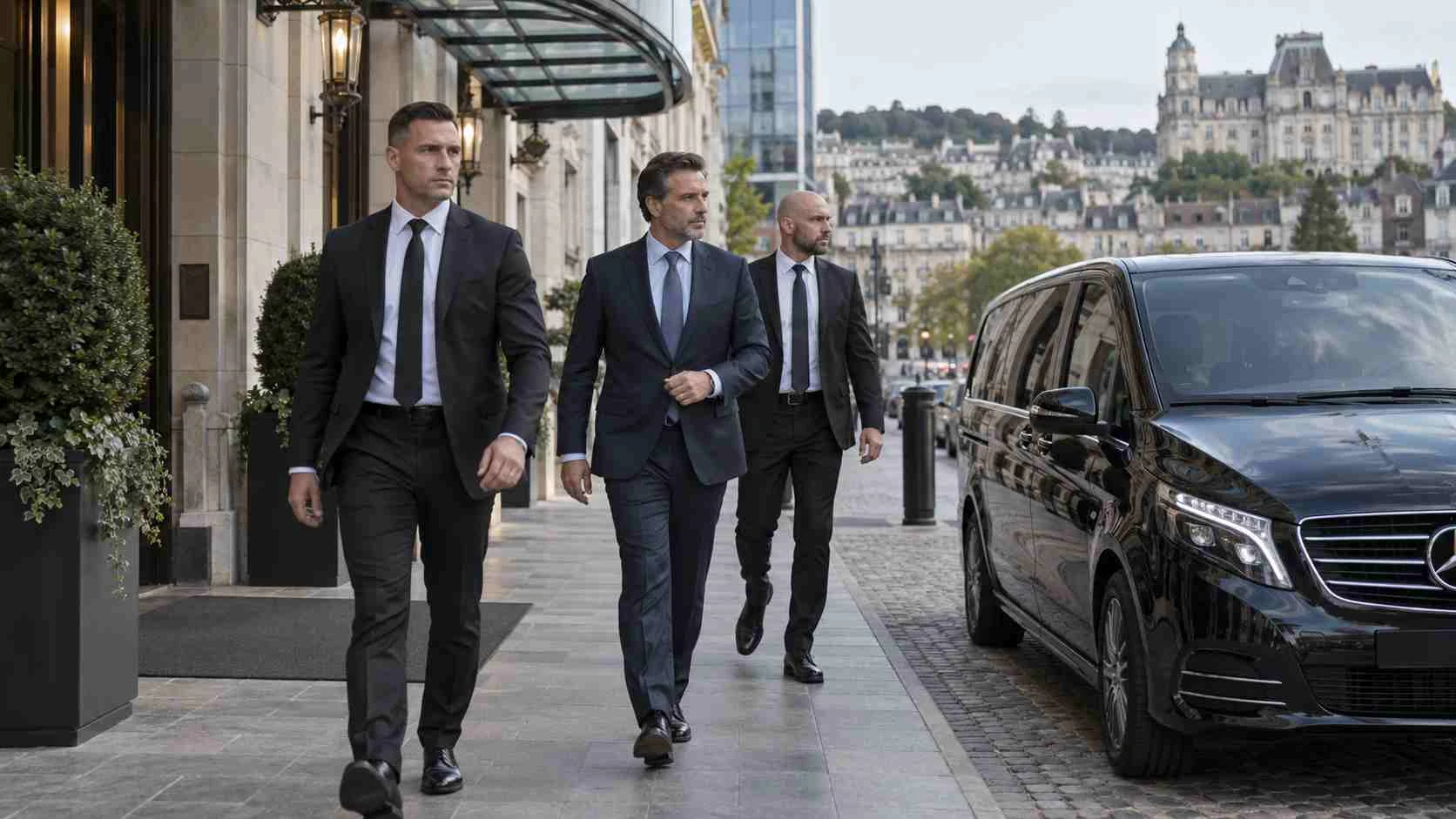
BELGIUM · EXECUTIVE · FAMILY · PRIVATE PROTECTION
Bodyguard Services in Belgium for Executive, VIP & Family Protection
R&H Global Protection coordinates bodyguard services, executive protection and secure transportation throughout Belgium for international business leaders, private families and visiting delegations. Assignments can combine Brussels institutional or corporate meetings, confidential Antwerp commercial appointments and Ghent university or conference programmes, with airport and rail receiving where required. We retain one clear client brief across the journey while arranging appropriately authorised local personnel, security drivers, discreet venue liaison and longer-term protection continuity between Belgian cities.
Part of R&H Global Protection’s international bodyguard services, connecting national assignments with worldwide protection capability.
Belgium Personal Protection at a Glance
Brussels Airport (BRU)European Executive and Institutional Protection
Low-profile protection for Brussels institutional and corporate appointments with confidential assistant coordination and clear responsibility for the principal through the planned working day.
Brussels Corporate and Formal Programmes
The detail can account for Antwerp luxury, diamond and port-sector business while keeping property, yacht, venue or family-split functions separately scoped when they require their own personnel.
Antwerp and Ghent Business Coverage
A receiving officer and dedicated driver can be coordinated around Brussels Airport (BRU) · Brussels-Midi · Antwerp (ANR); flights, luggage, passengers and the first protected address are confirmed before duty begins.
Airport, Rail and National Continuity
One management brief can connect Brussels EU Quarter, Antwerp Diamond District and Belgian intercity rail and roads, with any regional, cross-border or host-controlled stages reviewed for timing and locally authorised delivery.
Direct answer · hiring private protection in Belgium
Can You Hire a Private Bodyguard in Belgium?
Yes. R&H Global Protection coordinates bodyguard and executive protection in Belgium for private clients, family offices and international executives. Share the dates, Brussels Airport (BRU) · Brussels-Midi · Antwerp (ANR) arrival or other receiving point, protected people, main locations and any dedicated driver or residence need. The appropriate Belgium company and personnel authorisations are checked for each regulated duty before deployment.
R&H Global Protection · +972-55-9724475 · info@global-protection.net. The Belgium duty hours, vehicles, officer roles and onward stops are defined in the written brief; the displayed amount is an indicative officer-day range.
Bodyguard · Executive Protection · Close Protection in Belgium
What Does a Bodyguard in Belgium Cover?
A bodyguard in Belgium accompanies the named principal through the agreed business or private itinerary. In this setting, Brussels institutional and corporate appointments can connect with Antwerp luxury, diamond and port-sector business without turning every arrival into an obvious security event. The officer plans the next handoff with the authorised client representative and adapts proximity to the setting: a private appointment, public street, hotel, yacht, university or industrial host can each have different access rules.
The assignment does not automatically include chauffeur driving, venue-wide guarding, vessel operations, lifeguarding, port gate security, staff screening or a fixed residence post. These are distinct responsibilities. The driver maintains the vehicle, host teams control their premises and a separately staffed property team remains at the residence if continuous static coverage is required. One officer cannot simultaneously protect two independent family or executive routes.
Belgium Protection Planning
Executive Protection in Belgium Across Business and Institutional Travel
R&H structures Belgium executive protection around Brussels institutions, Antwerp commercial business, Ghent academic programmes and Belgian road/rail continuity.
Clear responsibility.
Start by confirming who needs protection, who controls schedule changes and which Belgium activities create different responsibilities.
Brussels meeting and host protocols
When the principal arrives for Brussels institutional and corporate appointments, the first step is to identify the private commitments that cannot shift, the assistant authorised to amend them and the information that should remain restricted.
Antwerp private-sector and commercial duties
The operating environment changes between Brussels EU Quarter and Avenue Louise and Sablon. A building, property, public street or controlled commercial venue may impose entirely different reception procedures.
Ghent rail-to-pedestrian programme
Transport must work with the protection officer instead of competing with that role. For Antwerp luxury, diamond and port-sector business, the driver handles readiness, waiting and repositioning while the CPO focuses on the named principal.
National road and rail handoffs
For Ghent university and academic delegations and the next stage toward Belgian intercity rail and roads, carry the client preferences forward without treating every day as identical. The coordinator reviews relief, lodging, confirmed host permissions and the legal delivery structure when the programme changes.
Belgium Close Protection Services
Close Protection in Belgium: Personal and Supporting Services
From Brussels institutional and corporate appointments to BRU, rail and same-day Belgian city changes, the services below show how a personal officer can be supported by drivers, private-property coverage and advance preparation.
Executive Protection in Belgium
R&H coordinates a principal-focused detail for Brussels institutional and corporate appointments and Ghent university and academic delegations. The officer can liaise with the executive assistant, driver and named host while using the confirmed itinerary to prepare each stage.
Private Bodyguard and VIP Protection in Belgium
Discreet personal security for founders, international executives, public figures and private visitors around Brussels EU Quarter and Avenue Louise and Sablon. Close proximity is adjusted to the setting and client profile.
Family and UHNW Protection in Belgium
Family security supports parents, children, household staff and private guests during Antwerp luxury, diamond and port-sector business. The officer learns the household’s routine while limiting unnecessary exposure of addresses, children’s schedules and visitor information.
Female Bodyguard Requests in Belgium
Female protection professionals can be requested for family privacy, particular client preference or an executive requirement. The proposal confirms professional fit, preferred language, working duties, availability and the authorisations needed in Belgium.
Airport and Rail Receiving in Belgium
Receiving can start through Brussels Airport (BRU) · Brussels-Midi · Antwerp (ANR) or another confirmed gateway. Share the flight or train details, passenger group, baggage, first destination and vehicle plan; the principal’s escort and the transport supplier then use one accepted handoff.
Bodyguard, Security Driver and Executive Vehicle in Belgium
An independently assigned driver manages the vehicle, navigation, waiting and repositioning between Brussels EU Quarter and Antwerp Diamond District. The protection professional can remain with the principal when a building or pedestrian segment takes the party away from the car.
Residential and Private-Property Security in Belgium
Extended stays may need independently staffed security for a villa, hotel base, chalet, residence or other private property. The mobile personal officer is not counted as a property post while accompanying the principal elsewhere.
European Corporate and Institutional Programme Protection in Belgium
This is a specific reason clients enquire about protection in Belgium: Brussels institutions, Antwerp commercial business, Ghent academic programmes and Belgian road/rail continuity. The detail should be built around actual venue and transport interfaces, not an invented generic protection package. For example, Ghent university and academic delegations may need a different host contact, timing buffer and officer placement from Brussels institutional and corporate appointments.
Protective Assessment and Advance Planning in Belgium
Advance planning identifies the airport meeting point, Brussels EU Quarter hosts, transport stops, public exposure and the first arrival or departure constraint. It also checks whether BRU, rail and same-day Belgian city changes changes the needed personnel, driving or access structure.
Long-Term Close Protection in Belgium
A retained detail can establish officer fit, household and executive-assistant introductions, work patterns, relief and review points. In Belgium, a long engagement may include repeated Brussels institutional and corporate appointments, Antwerp luxury, diamond and port-sector business and onward travel.
Service boundariesA bodyguard supports the named principal in Belgium; a security driver, property post, venue team or marine/industrial operator performs a separate function. For Antwerp luxury, diamond and port-sector business, roles and host permissions are agreed before the client relies on the combined service.
Belgium Client Profiles
Who Hires Bodyguards and Executive Protection in Belgium?
Belgium clients do not all need the same type of officer. Brussels institutional and corporate appointments creates one working rhythm, while Antwerp luxury, diamond and port-sector business introduces different family, privacy, host or transport requirements.
European Business Executives
European Business Executives typically want private meetings and scheduled arrivals completed without adding management work. The protective officer should coordinate with the authorised assistant and vehicle team when Brussels institutional and corporate appointments moves toward Antwerp Diamond District.
International Corporate Directors
International Corporate Directors typically want private meetings and scheduled arrivals completed without adding management work. The protective officer should coordinate with the authorised assistant and vehicle team when Brussels institutional and corporate appointments moves toward Antwerp Diamond District.
Institutional Visitors
Institutional Visitors may combine Antwerp luxury, diamond and port-sector business with meals, airport receiving and quieter time at a residence or hotel. The personal officer needs household judgement and familiarity with the client's routine, not a conspicuous tactical presentation.
Private Families
Private Families may combine Antwerp luxury, diamond and port-sector business with meals, airport receiving and quieter time at a residence or hotel. The personal officer needs household judgement and familiarity with the client's routine, not a conspicuous tactical presentation.
Diamond and Luxury Clients
For diamond and luxury clients, confidentiality and site access can matter as much as time in the vehicle. A programme touching Brussels EU Quarter and Antwerp Diamond District should identify the commercial host, meeting purpose, appropriate entry route and whether the next phase is public or restricted.
Port and Logistics Executives
For port and logistics executives, confidentiality and site access can matter as much as time in the vehicle. A programme touching Brussels EU Quarter and Antwerp Diamond District should identify the commercial host, meeting purpose, appropriate entry route and whether the next phase is public or restricted.
Delegations and Advisers
Delegations and Advisers often work with formal hosts and an itinerary that changes between meetings, public entrances and private hospitality. Around Avenue Louise and Sablon and Antwerp Diamond District, R&H plans receptions with the appropriate organiser without treating invitations or accreditation as automatic.
Long-Term Business Residents
Long-Term Business Residents may combine Antwerp luxury, diamond and port-sector business with meals, airport receiving and quieter time at a residence or hotel. The personal officer needs household judgement and familiarity with the client's routine, not a conspicuous tactical presentation.
Discretion and information controlThe right detail is defined by the client profile, known schedule, next host, protected people and any additional family or project duties. For Belgium, private planning should separate a single-principal assignment from parallel movements rather than equating client seniority with a fixed team size.
Israeli-Led Protective Methodology
Protection Planning Adapted to Belgium
Belgium is geographically compact, yet a single programme can pass from Brussels institutions to Antwerp commercial meetings and Ghent academic engagements. R&H Global Protection keeps the principal brief consistent while confirming Belgian authorisation, transport mode, host access and timings for each stage. The receiving arrangement at BRU or Brussels-Midi, not a generic capital-city itinerary, determines the first protected movement. The methodology is designed around that distinct environment and the next legitimate access decision, not copied from a generic airport-and-hotel template.
R&H Global Protection applies an Israeli-led prevention and preparation approach with experienced personnel and suitable local professional delivery. In Belgium, attention is given to Brussels institutional and corporate appointments, Ghent university and academic delegations and the supporting driver or property arrangements.
Operating principle
Quiet preparation. Clear responsibility. Flexible execution.- AdvanceConfirm the first fixed time, gate or receiving contact for Brussels EU Quarter and the next agreed movement.
- DiscretionKeep Belgium client itineraries, private addresses and commercial details restricted to the people who actually need them.
- Separate rolesDistinguish the mobile CPO, dedicated driver, host-controlled security and any separately staffed property or facility post.
- AdaptabilityRecheck the operating picture when BRU, rail and same-day Belgian city changes changes the client's original day.
- ReviewFor extended Belgium stays, revisit relief, transportation, guest changes, regional travel and regulatory delivery with the designated client contact.
Long-term continuityA retained Belgium assignment should preserve compatible personnel and privacy preferences while reviewing what changes. Officer relief, driving hours, estate or office routines, new hosts and destinations toward the Netherlands can all alter the actual resource need. One stable client-management contact helps the detail evolve without interrupting the principal's normal day.
Belgium Local Operating Context
Where the Protection Plan Changes Across Belgium
Protection assignments across Belgium can involve Brussels institutional and corporate venues, Antwerp’s diamond and port-related business, Ghent’s university and historic centre, and airport or rail connections between cities. Each stage has distinct access, vehicle and host requirements rather than one standard city route.
Brussels EU Quarter and business districts
Brussels programmes may move between meetings in the EU Quarter, corporate appointments around Avenue Louise and private hospitality near Sablon. Each venue controls its own admission process, so the officer and driver confirm lawful receiving points, pedestrian transitions and timing without assuming official access.
Antwerp diamond and port economy
Antwerp’s Diamond District, including Hoveniersstraat and Pelikaanstraat, brings confidential meetings with luxury and diamond businesses, while port-related appointments require separate host arrangements. The plan distinguishes discreet city-centre executive protection from any controlled port or industrial-site access.
Ghent academic and historic-centre programme
Ghent programmes often connect Gent-Sint-Pieters with university or research appointments and the pedestrian-oriented historic centre. Plan public-space walking stages, legal vehicle rejoin points and host-controlled entry around academic meetings rather than expecting door-to-door car access throughout the centre.
BRU, Brussels-Midi and intercity journeys
Brussels Airport (BRU) and Brussels-Midi can connect appointments in Brussels, Antwerp and Ghent. The team checks actual rail or vehicle arrival points, luggage movements, realistic connection times and the limits of access to controlled areas, with the next local handover confirmed in advance.
Stage 1 of an illustrative Belgium programme: confirm the receiving contact, driver or pedestrian handoff, permitted access and agreed next move before the principal arrives at Brussels.
Stage 2 of an illustrative Belgium programme: confirm the receiving contact, driver or pedestrian handoff, permitted access and agreed next move before the principal arrives at Antwerp.
Stage 3 of an illustrative Belgium programme: confirm the receiving contact, driver or pedestrian handoff, permitted access and agreed next move before the principal arrives at Ghent.
Stage 4 of an illustrative Belgium programme: confirm the receiving contact, driver or pedestrian handoff, permitted access and agreed next move before the principal arrives at Brussels Airport and Brussels-Midi.
Stage 5 of an illustrative Belgium programme: confirm the receiving contact, driver or pedestrian handoff, permitted access and agreed next move before the principal arrives at Flanders and wider Belgium.
Planning note:Named areas in Belgium illustrate potential operating environments only. They are not R&H offices, endorsements, published routes or claims of previous assignments. The final itinerary and lawful access are confirmed privately.
Belgium Assigned Team
Professional Standards for Your Belgium Detail
The people assigned for Brussels institutions, Antwerp commercial business, Ghent academic programmes and Belgian road/rail continuity should combine discretion, reliable communication and a clear understanding of applicable Belgian private-security requirements.
Across Belgium, suitable personnel should handle Brussels formal appointments, Antwerp commercial confidentiality and Ghent academic programmes; each regulated role requires appropriate checks.
Check the delivering provider’s authorisation and each officer’s credentials against the exact personal-protection duties before deployment.
Officers should understand host-managed entry, formal meeting protocols and the unobtrusive presentation expected around Brussels corporate and institutional venues.
Plan authorised public meeting points at airports and stations, then coordinate rail schedules, luggage, driver handovers and onward city transfers.
For Antwerp appointments, restrict circulation of commercially sensitive locations, counterparties and meeting times to the relevant client-approved contacts.
Prepare walkable city-centre movements and realistic vehicle rejoin points around Ghent, taking local access restrictions into account.
A multi-week Belgian assignment needs planned officer relief, consistent briefings and periodic adjustments as Brussels, Antwerp and Ghent appointments evolve.
Hiring a Bodyguard in Belgium
How to Arrange Close Protection in Belgium
Begin with the protected people, dates and full Belgium itinerary. A clear first enquiry identifies the gateway, major commitments, parallel routines, regional stops and any driver or property requirement without revealing confidential addresses or sensitive threat evidence in an open message.
Define the protection requirement in Belgium
Give the approximate dates or duration, principal profile, protected-person count and main priority: Brussels institutional and corporate appointments.
Confirm Brussels Airport (BRU) or another arrival
State the actual flight, terminal or train, passengers, baggage and first protected address.
Map the fixed programme and hosts
List Antwerp luxury, diamond and port-sector business and other appointments with hard times.
Identify parallel principals and family movements
Explain if colleagues, spouses, children or guests will split off around Avenue Louise and Sablon.
Declare property, vehicle and regional stages
Confirm the driver, vehicle class, residence or facility post and any onward phase toward the Netherlands.
Confirm authorised delivery and written quotation
R&H reviews suitable professional personnel, the regulated delivery model applicable in Belgium, work periods, transport, host limits and committed logistics.
Belgium Service Models
Choose the Right Protection Model in Belgium
An accepted Belgium protection model should match the actual people, geography and duties—not the idea that one standard bodyguard package fits everyone.
Choose the staffing pattern for Brussels institutions, Antwerp commercial business, Ghent academic programmes and Belgian road/rail continuity.
- Belgium executive detailA named officer accompanies the principal through Brussels institutional and corporate appointments, confirmed hospitality, approved venues and the accepted start and finish of duty.
- Personal officer plus security driverSeparate CPO and driver roles around Brussels Airport (BRU) · Brussels-Midi · Antwerp (ANR) and Avenue Louise and Sablon, with agreed waiting and next pickup arrangements.
- Family or delegation with parallel needsAdditional personnel can support spouses, children, delegation members or executives taking separate Belgium routes at the same time.
- Retained or multi-week client programmeContinuity with officer matching, regular review and relief for Ghent university and academic delegations rather than a new ad-hoc team for each movement.
- Residence and mobile protectionDistinct static personnel remain at a property when it needs coverage while the mobile detail travels with the client.
- Belgium plus onward regional travelOne confidential brief continues toward the Netherlands or other declared locations while local staffing, transport, credentials and cross-border duties are checked independently.
Belgium Bodyguard Cost · Written Quotations
How Much Does a Bodyguard in Belgium Cost?
R&H Global Protection’s current indicative Belgium officer-day planning range is €700–€1,400 per bodyguard per day.
Receiving through Brussels Airport (BRU) · Brussels-Midi · Antwerp (ANR), the accepted appointments, hospitality and final handover define the duty.
If parents, executives, children or visiting colleagues follow independent schedules between Brussels EU Quarter and Avenue Louise and Sablon, allocate the extra resources needed rather than stretching one officer across both.
Brussels institutional and corporate appointments and Ghent university and academic delegations can require liaison with property, terminal, institution, conference, marina or office hosts.
Vehicle category, passenger capacity, mileage, parking, waiting, driver hours and the specific Antwerp Diamond District handoff are listed independently from the CPO daily rate.
If a Belgian programme adds residential guarding, event staff or another regulated specialist role, identify the responsible provider and quote that separate service explicitly.
Additional stages toward the Netherlands, accommodation where necessary, flights, taxes, site-specific requirements and committed expenses are set out individually in the written quotation.
Team Configurations for Belgium Protection
These are staffing models, not fixed all-inclusive packages. The proposed Belgium quote identifies each officer, driver, vehicle, duty window, property resource and applicable local authorisation.
Single principal / defined duty
One officer can cover one principal's clear sequence through Brussels EU Quarter and other booked appointments when no separate parallel duty is required.
Officer and dedicated driver
A driver handles arrival, waiting and rejoin points while the personal officer remains with the principal at Avenue Louise and Sablon and other hosts.
Executive and family split team
Additional bodyguards cover spouses, children or executives whose Belgium itineraries happen simultaneously in different areas.
Belgium retained detail
A continuing arrangement allows suitable officer continuity, planned relief and reviews as Ghent university and academic delegations or regional travel evolves.
€700–€1,400 per officer / day · indicative planning range. Vehicles, drivers, extra CPOs, separately staffed properties, travel, accommodation, taxes and regulated supporting functions must be confirmed in the actual written scope.
A contained assignment for Brussels institutional and corporate appointments differs from a complex programme involving Antwerp luxury, diamond and port-sector business, extended working hours, separate family routes or regional travel toward the Netherlands.
Request an Itemised Belgium ProposalThe planning range does not include unlimited 24-hour active officer coverage. Final mobilisation, payments, cancellations, specialist staffing and logistics are agreed in writing.
Local context without overexposureReferences to Brussels EU Quarter, Avenue Louise and Sablon, Antwerp Diamond District, Ghent / Gent-Sint-Pieters explain potential Belgium environments only; they are not R&H offices, verified past client engagements, official partnerships or published routes. The actual client plan remains confidential and subject to current host information.
Belgium Geographic Coverage & Compliance
Personal Security in Belgium and Your Onward Itinerary
The Belgium coverage plan connects Brussels EU Quarter, Avenue Louise and Sablon, the actual gateway and the final onward point.
Belgium
Belgian private-security law regulates personal-protection and guarding activities. The proposed delivering business, professional qualifications and actual scope must comply with the relevant Belgian authorisations; executive accompaniment does not confer police or institutional access powers.
Protection can be scoped around Brussels when it forms part of the confirmed Belgium itinerary.
Protection can be scoped around Antwerp when it forms part of the confirmed Belgium itinerary.
Protection can be scoped around Ghent when it forms part of the confirmed Belgium itinerary.
Protection can be scoped around Brussels Airport and Brussels-Midi when it forms part of the confirmed Belgium itinerary.
Protection can be scoped around Flanders and wider Belgium when it forms part of the confirmed Belgium itinerary.
Official sources describe the applicable Belgium framework; they do not certify an individual proposed provider or officer. Confirm current licences and the actual activity before the Belgium assignment begins.
Why R&H Global Protection
Why Choose R&H Global Protection in Belgium?
R&H Global Protection is best suited to a client in Belgium who needs Brussels institutions, Antwerp commercial business, Ghent academic programmes and Belgian road/rail continuity coordinated with clarity, discretion and locally lawful delivery.
Belgian Regulatory Coordination
A Belgium detail must fit the national private-security framework, including the authorisation and qualification requirements applicable to protection of persons.
European Business Programme Understanding
Brussels institutional meetings differ from Antwerp commercial appointments and Ghent university visits.
Brussels, Antwerp and Ghent Continuity
One client programme can carry through Brussels, Antwerp and Ghent without passing sensitive briefing material through multiple unrelated chains.
Road, Rail and Airport Integration
Belgian rail and road connections create choices: BRU arrival, Brussels-Midi, Antwerp-Central and Gent-Sint-Pieters may not be best served by one continuous car.
Executive and Institutional Discretion
Company directors and visiting delegates need a discreet officer who understands when a host is formal and when the setting is private.
Retained Family and Business Support
Over a six-week assignment, repetition should improve service instead of hiding fatigue. R&H reviews authorised personnel, duty windows, relief, rail changes and personal preferences as the national business programme evolves.
“I was based in Belgium for six weeks while managing a European business project that required regular meetings in Brussels, Antwerp and other parts of the country. The programme included corporate appointments, government-related meetings, dinners and frequent rail and airport movements. R&H Global Protection provided consistent executive protection throughout the assignment and worked closely with my assistant and local transportation team. The officer understood how to remain discreet in formal business environments while still maintaining good awareness during travel and public movements. After several weeks, the security arrangements became completely integrated into my schedule and required very little input from me.”
International Protection Continuity
Connect Your Belgium Assignment to Onward Travel
The next stage of a Belgium itinerary may have a different operating rhythm from Brussels institutional and corporate appointments. R&H can preserve the principal's confidentiality preferences and management contact while confirming the receiving officer, local company and personnel authority, driver, accommodation and host-access conditions for onward travel. An international itinerary is a planning framework, not a security licence that transfers between countries.
Relevant onward pages: Brussels · Antwerp · Ghent · Netherlands · France · London · Amsterdam · Dubai · Paris · Monaco · Madrid · New York · Singapore
Explore International Bodyguard ServicesBelgium · Confidential Protection Enquiry
Hire a Bodyguard in Belgium
For a Belgium protection enquiry, share the dates, number of people, Brussels Airport (BRU) · Brussels-Midi · Antwerp (ANR) arrival or other receiving point, main business or family programme, and whether you require a dedicated driver, vehicle, residence or onward stage toward the Netherlands. R&H will review the confidential brief and the appropriate Belgium regulated delivery arrangement. Please reserve passports, precise private addresses and detailed threat evidence for a secure direct channel.
WhatsApp opens a draft for you to review and send. Opening a draft does not book protection. Prefer a web form? Use our contact page.
Belgium Bodyguard Questions
Frequently Asked Questions About Protection in Belgium
Direct answers about Belgium hiring, €700–€1,400 planning, locally authorised delivery, Brussels Airport (BRU) · Brussels-Midi · Antwerp (ANR) receiving, drivers, families, Antwerp luxury, diamond and port-sector business, residences and retained protection.
How much does a bodyguard in Belgium cost?
R&H Global Protection’s indicative Belgium planning range is €700–€1,400 per bodyguard per day. The written quotation defines personnel, the actual duty window, drivers, vehicles, supporting teams, regional movement, accommodation and any applicable taxes or deployment costs.
Can I hire a private bodyguard in Belgium?
Yes. Share dates, number of protected people, Brussels Airport (BRU) · Brussels-Midi · Antwerp (ANR) arrival if relevant, the principal’s schedule and any vehicle or residence requirement. R&H can review the brief and arrange the appropriate locally authorised personal-protection delivery structure in Belgium.
What security authorisations apply in Belgium?
Belgian private-security law regulates personal-protection and guarding activities. The proposed delivering business, professional qualifications and actual scope must comply with the relevant Belgian authorisations; executive accompaniment does not confer police or institutional access powers. Personnel credentials and regulated activities are checked for the assignment before deployment.
Can protection begin at Brussels Airport (BRU) · Brussels-Midi · Antwerp (ANR)?
Yes, at an agreed lawful meeting point where the relevant gateway supports receiving. Confirm the arrival, passenger group, baggage, executive vehicle and first destination. Airside, immigration, restricted rail or specialist terminal access are not included unless separately authorised.
Can I request a female or English-speaking bodyguard in Belgium?
Yes. Share the preferred professional profile, language and privacy requirements in advance. Availability, qualifications, dates and locally required authorisations must be confirmed before any officer is committed.
Can a bodyguard in Belgium work with a dedicated security driver?
Yes. The dedicated driver manages vehicle readiness, waiting and repositioning while the personal officer accompanies the principal. Vehicle class, luggage, mileage and working hours are itemised separately from the CPO’s duties.
Can one executive-protection programme cover Brussels, Antwerp and Ghent?
Yes. A national itinerary can connect the three cities through one confidential management brief. Each institutional, commercial, academic, airport or rail stop still needs its own access, timing and driver handoff plan.
Can you protect my family while I attend separate meetings in Belgium?
Yes, when the protection brief provides appropriate additional resources for simultaneous movements. One officer accompanying the executive cannot also cover relatives following a different Belgium schedule elsewhere. A coordinated plan can cover both without conflating staffing.
Can residential or other separately staffed security be added in Belgium?
Yes, when it is separately scoped and locally authorised. The property post remains at the residence, hotel, villa, chalet or project base while the mobile officer travels with the principal. The quote distinguishes personnel and work periods.
How does long-term close protection in Belgium work?
A retained engagement begins with officer selection, introductions, privacy preferences, working hours, relief, driver arrangements and an authorised management contact. The plan is periodically reviewed when Brussels institutional and corporate appointments, family routines or onward travel changes materially.