
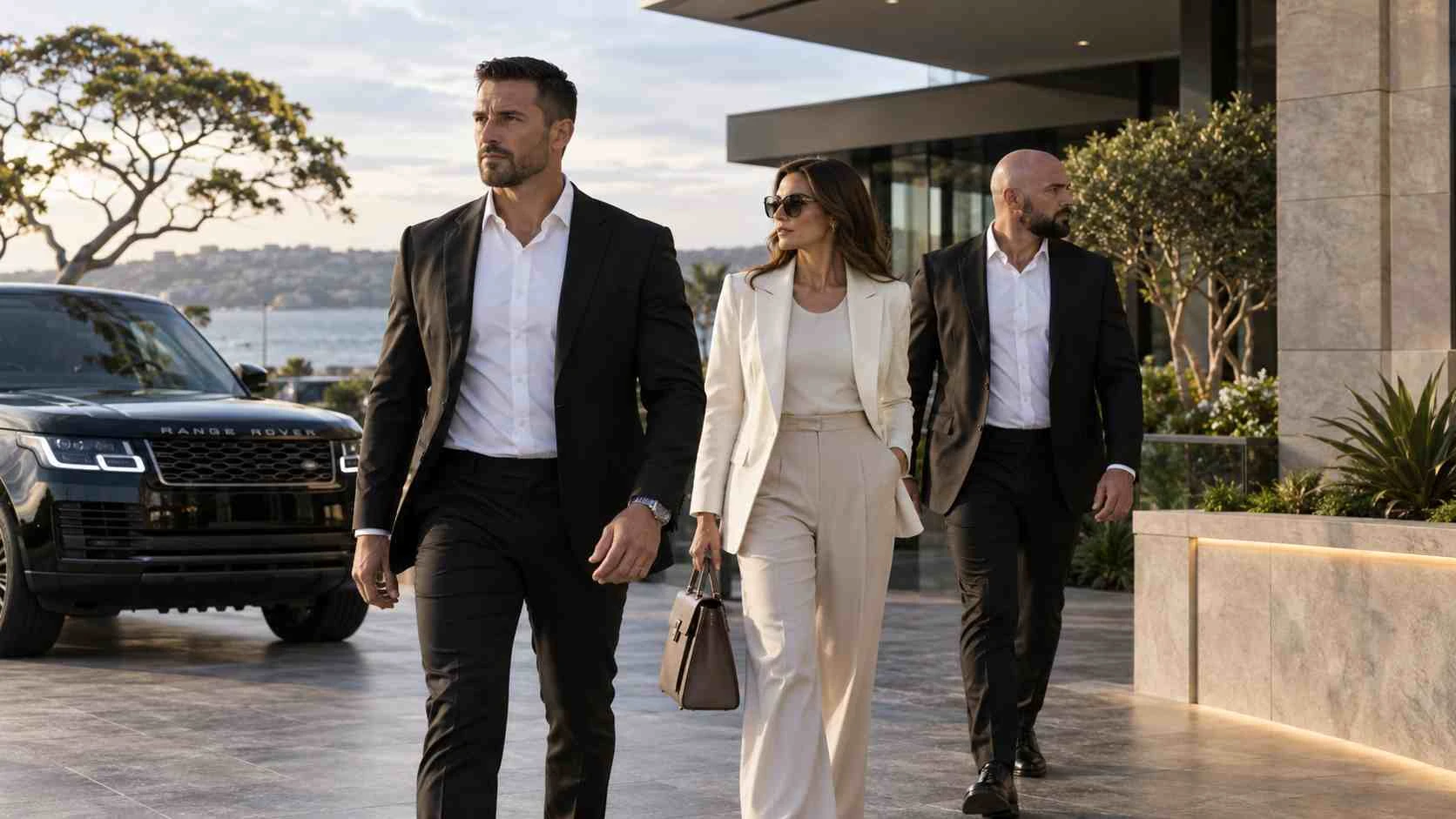
Australia · MULTI-CITY EXECUTIVE AND FAMILY PROTECTION · PRIVATE EXECUTIVE PROTECTION
Bodyguard Services in Australia for Executives and Private Families
R&H Global Protection coordinates discreet bodyguard services in Australia for international business owners, board members, resources-sector executives and private families. Protection plans link airport arrivals and corporate appointments in Sydney and Melbourne with Western Australia resources visits and private family travel. Licensing, host-site access, suitable transport and officer handovers are reviewed for each state or territory before deployment.
For wider coverage, explore R&H Global Protection’s international bodyguard services and connected destinations.
Australia Bodyguard Services at a Glance
SYD, MEL, BNE, PER, ADL and CBR · major airports across Australia · Sydney CBD, Barangaroo and the harbour · Brisbane business, Gold Coast and Queensland movementsExecutive & Private Visits
Coordinate discreet protection around Sydney CBD, Barangaroo and confirmed client appointments.
Host Access & Permissions
Secure receiving and entry approval from venues or project hosts; local site rules remain in force.
Domestic Airport Receiving
Confirm flight, passenger count, public receiving point, driver and the first booked destination.
Regional & Onward Travel
Advance route changes, longer road sectors, overnight plans and relief before the journey extends.
Direct answer · hiring personal protection in Australia
Can You Hire a Private Bodyguard in Australia?
Yes. R&H Global Protection coordinates bodyguard services and executive protection across Australia for corporate leaders, resources executives and private families. The agreed itinerary may cover Sydney and Melbourne, Perth and Canberra and airport receiving, with a separate chauffeur when required. Indicative rates are AUD 1,000–2,200 per officer per day for the agreed duty window. Regulated duties are subject to state and territory licence requirements; venue owners control restricted access. Vehicles, regional travel and extra security shifts are quoted separately.
R&H Global Protection · +972-55-9724475 · info@global-protection.net. The written Australia brief defines protected people, lawful personnel, duty hours and transport.
Bodyguard · Executive Protection · Close Protection in Australia
What Does a Bodyguard in Australia Cover?
A bodyguard accompanies the named principal on agreed business or family movements in Sydney, Melbourne, Perth, Canberra and other planned destinations. Professional driving, residential guarding and site security are separately scoped.
Protection duties are subject to state and territory licence checks. State-licensed providers and each venue retain responsibility for admission, restricted areas and specialist safety.
Australia Protective Planning
Executive Protection for Multi-City Business and Family Travel in Australia
R&H prepares executive and private protection across Australia for appointments at Sydney and Melbourne, Perth and Canberra and confirmed onward travel. The plan assigns lawful staff, receiving contacts and transport. A Sydney or Melbourne business day can be followed by an interstate flight to Perth or formal meetings in Canberra. Receiving, officer eligibility and vehicle allocation are checked for each state or territory rather than assumed to transfer automatically.
Clear responsibility.
Confirm the principal, assistant, first appointment and driver before arrival at major Australian airports. Host admission and onward plans are checked separately.
Protection Planning for Australia Executive and Private Clients
Arrange agreed meetings between Sydney and Melbourne and Perth and Canberra, with clear receiving contacts and realistic transfer time.
Venue Permissions and Responsible Host Security
State-licensed providers and each venue control admissions and venue-specific safety; principal protection stays separate.
Domestic Airport and Chauffeur Handoffs
Agree the terminal, luggage, pickup and onward vehicle at major Australian airports.
Locally Authorised Protection and Programme Continuity
Confirm state and territory licence checks before regulated escort work begins.
Australia Close Protection Services
Close Protection in Australia: Personal and Supporting Services
These ten capabilities distinguish a principal-focused bodyguard from driving, fixed property guarding and specialist venue teams across Australia.
Executive Protection in Australia
A locally eligible officer supports corporate, resources and family programmes at Sydney and Melbourne, with an agreed working window and discreet movements.
Private Bodyguard and VIP Protection in Australia
Discreet VIP accompaniment across Sydney and Melbourne and Perth and Canberra, including planned arrival and departure points.
Family and Child Protection in Australia
Family movements protect privacy; separate officers are needed when adults and children travel different routes.
Female Bodyguard Requests in Australia
Female protection professionals or language skills can be requested, subject to local credentials and availability.
Airport Receiving and Secure Transfers in Australia
Airport pickup at major Australian airports requires a confirmed flight, collection point, vehicle and receiving contact.
Bodyguard and Security Driver in Australia
A separate chauffeur and suitable executive vehicle may connect Sydney and Melbourne, Perth and Canberra and the client's accommodation.
Residential and Private Property Coordination in Australia
Hotel, lodge and private-home arrivals may be coordinated; fixed overnight guarding requires a separate team.
Venue Security and Specialist Operator Responsibilities
State-licensed providers and each venue control their facilities. A private officer does not replace site guards or specialist operators.
Protective Advance Planning in Australia
Review major Australian airports, Sydney and Melbourne and Perth and Canberra for movement timing, entry approvals and suitable transport.
Long-Term Close Protection in Australia
Long-term assignments benefit from one confidential brief, documented shifts, authorised personnel and reliable relief.
Australia Client Profiles
Who Hires Bodyguards and Executive Protection in Australia?
Protection requests from corporate, resources and family programmes across Australia vary by exposure, schedule and family requirements; each team is assigned to its actual role.
Multinational board chairs
For multinational board chairs, movements around Sydney and Melbourne should name a local receiving contact before travel.
Resources and infrastructure investors
For resources and infrastructure investors, movements around Perth and Canberra should agree privacy rules and site entry.
Family offices and international families
For family offices and international families, movements around Sydney and Melbourne should distinguish escorting from host security.
Delegations and official visitors
For delegations and official visitors, movements around Perth and Canberra should confirm reliable transfers and relief.
Technology and corporate founders
For technology and corporate founders, movements around Sydney and Melbourne should plan arrivals around the actual venue.
Premium hospitality visitors
For premium hospitality visitors, movements around Perth and Canberra should separate corporate and family schedules.
Industrial project leadership
For industrial project leadership, movements around Sydney and Melbourne should coordinate the next driver pickup.
Multi-city executive travellers
For multi-city executive travellers, movements around Perth and Canberra should refresh permissions after route changes.
Israeli-led Protective Methodology
Protection Planning Adapted to Australia
The Australia operating brief links Sydney and Melbourne with Perth and Canberra, allowing for domestic flights, interstate licensing and regional drives. Receiving and staffing are reviewed before key movements.
R&H coordinates locally eligible personnel, a driver and the accountable client contact. Required permissions include state and territory licence checks.
Operating principle
Quiet preparation. Clear responsibility. Flexible execution.- AdvanceConfirm the arrival terminal, the first authorised host, site-entry restrictions and practical movement margins between Sydney CBD, Barangaroo and the harbour and Brisbane business, Gold Coast and Queensland movements.
- DiscretionShare board papers, travel schedules and family residence details only with the accountable assistant and professionals who need the information for their assigned work.
- Separate rolesThe bodyguard remains principal-focused. Queensland business travel may continue by road to the Gold Coast, changing driver duty, traffic margin and family receiving plans.
- AdaptabilityWhen plans change because of domestic-air connections, long regional driving, state licensing changes and split family movements, reconfirm the client’s approval, lawful staff assignment, pickup point and available duty window.
- ReviewFor extended programmes in Australia, confirm officer relief, verified local eligibility, driver availability, overnight location and a practical incident/continuity plan.
When appointments change, the assistant, officer and driver agree revised arrival times and host permissions.
Australia Operating Context
Where Australian Executive Protection Changes by State and City
Four distinct settings shape Australia protection: Sydney and Melbourne, Perth and Canberra, airport receiving and host-controlled appointments. A continuous client brief can cross state borders, but each assignment still requires locally eligible officers and confirmed receiving arrangements. Domestic flights, flight delays and time-zone changes can affect business and family movements between Sydney, Perth and Canberra. A consistent programme brief allows different locally eligible personnel to follow the same client preferences. It also records who takes over at an airport, hotel or event venue, reducing ambiguity when the principal changes cities.
Sydney CBD, Barangaroo and the harbour
Sydney and Melbourne require distinct airport, office and hotel receiving plans; CBD access cannot be transferred unexamined between major cities.
Melbourne CBD, Southbank and executive venues
Queensland business travel may continue by road to the Gold Coast, changing driver duty, traffic margin and family receiving plans.
Brisbane business, Gold Coast and Queensland movements
Western Australia resources schedules can add charter flights, remote sites, mine-owner access rules and substantial onward distances.
Perth resources, Adelaide industry and Canberra official appointments
Canberra, Adelaide and other stages introduce government, defence, manufacturing or event hosts whose access procedures remain their own.
Confirm the arrival, public exit, luggage and driver at major Australian airports.
Check the next meeting and host entry near Sydney and Melbourne CBDs.
Stay with the principal through Perth resources and Canberra meetings; venue security remains the operator’s duty.
Reconfirm vehicle collection and timing before the next stop near Perth resources and Canberra meetings.
Plan final release around domestic flights, interstate licensing and regional drives and lawful rest or relief.
Named sites illustrate possible itineraries, not partnerships or guaranteed access. Real hosts and routes are confirmed before mobilisation.
Australia Assigned Team
Professional Standards for Protection in Australia
R&H plans locally eligible protection teams across Australia, with discreet conduct, clear responsibilities and a confirmed working schedule.
One accountable client brief links the principal, driver and locally eligible protection personnel for corporate, resources and family programmes.
Select personnel accustomed to Sydney and Melbourne CBDs and Perth resources and Canberra meetings, with practical communication and low-profile positioning.
Check state and territory licence checks; locally regulated duties cannot be performed on foreign experience alone.
Share board papers and family travel plans only with authorised client and protection contacts.
The receiving officer and driver agree the terminal, first destination and return before arrival at major Australian airports.
Plans account for domestic flights, interstate licensing and regional drives and realistic officer and chauffeur working hours.
Long assignments require relief, days off and separately staffed night or parallel family coverage.
Australia / Hiring Process
How to Arrange Close Protection in Australia
Send dates, protected people, principal movements and vehicle requirements for Australia. R&H reviews eligibility and returns a written scope.
Confidential Principal Brief
Specify the principal, dates, assistant and planned appointments near Sydney and Melbourne or Perth and Canberra.
Airport and Executive Vehicle Receiving
Provide the flight, terminal, luggage and first appointment at major Australian airports; specify any separate chauffeur.
Venue, Host and Itinerary Checks
Identify the responsible hosts at Sydney and Melbourne and Perth and Canberra, plus any restricted entry requirements.
Officer Roles, Relief and Local Authorisation
Agree officer numbers, driver responsibilities, working hours and any necessary relief.
Route Changes and Onward Handoffs
Confirm onward receivers and transport changes involving domestic flights, interstate licensing and regional drives.
Compliance Review and Written Proposal
Agree the written scope, price and transport only after confirming state and territory licence checks.
Australia Service Models
Choose the Right Protection Model in Australia
Choose a single officer for a stable schedule across Australia, or add drivers, relief and separate coverage when domestic flights, interstate licensing and regional drives complicate the programme.
The officer stays with the principal; chauffeurs, venue operators and residence staff retain their own responsibilities.
- Executive and VIP Protection in AustraliaOne locally eligible officer accompanies the principal around Sydney and Melbourne during the agreed duty window.
- Protection Officer Plus Security DriverAdd an independent chauffeur and vehicle for major Australian airports and Perth and Canberra.
- Hosted Meetings and Controlled PremisesConfirm site access and receiving contacts with state-licensed providers and each venue before arrival.
- Venue, Site and Operator ResponsibilitiesOperators retain access, property security and safety duties; personal protection is separately scoped.
- Family, Delegation and Residence ExtensionsSplit family itineraries, residence posts and overnight duties need additional trained personnel.
- Australia Regional and Onward TransfersOnward legs involving domestic flights, interstate licensing and regional drives require new receivers and planned relief.
Australia / Transparent Pricing
How Much Does a Bodyguard in Australia Cost?
Indicative bodyguard services across Australia cost AUD 1,000–2,200 per officer per day for an agreed duty window. Vehicles, travel, relief and specialist services are quoted separately.
The daily fee covers a named principal during written duty hours; overnight and extended cover need separate staffing.
Parallel family or executive movements may need additional eligible officers and vehicles.
A chauffeur and executive vehicle are additional resources, including receiving at major Australian airports.
The rate excludes site security, regional charter flights and separate residential posts; those duties require separately approved providers.
Domestic flights, interstate licensing and regional drives may alter early starts, receiving or overnight logistics.
Long engagements may require officer travel, accommodation, rostered rest and relief personnel.
Team Configurations for Australia Protection
One locally eligible officer accompanies the named principal on agreed movements across Australia.
A separate chauffeur and suitable vehicle handle arrivals at major Australian airports and onward meetings.
Split family, delegation or residence coverage requires explicitly staffed additional shifts.
Extra eligible officers can support longer travel or multiple meetings involving Perth resources and Canberra meetings.
The written proposal confirms duties, locally eligible staffing, hours, travel, vehicles and separately costed resources.
Australia Coverage and Compliance
Executive Protection Across Australia’s Business and Private Travel Regions
Accepted itineraries can connect Sydney and Melbourne, Perth and Canberra and airport transfers. Hosts retain control of restricted facilities and specialised operations. Regional travel adds flight schedules, time-zone differences and long road sectors. Family movements, rest periods and the final destination should be considered before committing to a multi-state itinerary.
Australia
Assignments across Australia are planned around state and territory licence checks, verified travel connections and host-controlled access.
Sydney and Melbourne require distinct airport, office and hotel receiving plans; CBD access cannot be transferred unexamined between major cities.
Queensland business travel may continue by road to the Gold Coast, changing driver duty, traffic margin and family receiving plans.
Western Australia resources schedules can add charter flights, remote sites, mine-owner access rules and substantial onward distances.
Canberra, Adelaide and other stages introduce government, defence, manufacturing or event hosts whose access procedures remain their own.
For onward movement toward Sydney, Melbourne, Brisbane, Perth, Adelaide, Gold Coast and Canberra, R&H reconfirms applicable legal permissions, staff duty periods, receiving vehicles, host arrangements and any overnight or domestic-flight changes.
Official legislation and regulator guidance inform this Australia service description. The sources do not verify that R&H Global Protection or any proposed local partner presently holds a particular security licence; actual eligibility must be confirmed for each assignment.
Australia / Why R&H Global Protection
Why Choose R&H Global Protection in Australia?
R&H coordinates movements between Sydney and Melbourne and Perth and Canberra with clear staffing, client communication and transport responsibilities.
Planning for Australia Executive and Private Movements
Officer positioning changes between Sydney and Melbourne and Perth and Canberra rather than following a rigid routine.
Respect for Host and Specialist Security
State-licensed providers and each venue retain site and venue duties; the escort stays responsible for the principal.
Discreet Client Information Handling
Board papers and family travel plans are restricted to the people whose roles require them.
Domestic Airport and Driver Coordination
Arrival at major Australian airports is confirmed with the driver and the next appointment before travel.
Programme Changes Without Improvised Access
New plans involving domestic flights, interstate licensing and regional drives trigger updated receiving and duty-hour checks.
Locally Eligible Protection and Accountability
Regulated duties are allocated only after confirming state and territory licence checks.
“I spent approximately three months travelling through Australia while combining business commitments with private family travel. The programme included executive meetings in Sydney and Melbourne, resources-sector appointments in Western Australia, several days in Brisbane and private time with my family along the coast. R&H Global Protection provided continuity throughout the assignment and coordinated closely with our assistants, drivers and accommodation teams. The security approach changed naturally between board meetings, domestic flights, industrial visits and family activities. Having one team familiar with our wider Australian itinerary made a complex multi-city programme significantly easier to manage.”
International Protection Continuity
Connect Your Australia Assignment to Onward Travel
For onward travel beyond Australia, R&H reconfirms each new receiver, applicable local permissions and vehicle arrangements before mobilisation.
Related destinations: Sydney · Melbourne · Brisbane · Perth · Adelaide · Gold Coast · Canberra · Singapore · London · New York · Paris
Explore International Bodyguard ServicesAustralia · Confidential Protection Enquiry
Hire a Bodyguard in Australia
To discuss bodyguard services in Australia, share the dates, duration, protected people, arrival through an agreed Australian airport, relevant board meetings, domestic flights, regional industrial visits and family travel, hotel or residence, security-driver needs and anticipated travel toward Sydney, Melbourne, Brisbane, Perth, Adelaide, Gold Coast and Canberra.
Opening WhatsApp drafts an enquiry; it does not confirm a reservation, accepted assignment or payment obligation.
Australia Bodyguard Questions
Frequently Asked Questions About Bodyguard Services in Australia
Ten direct answers about AUD 1,000–2,200 officer pricing, local security licences, major airports across Australia, board meetings, domestic flights, regional industrial visits and family travel, confidential drivers and regional travel. Final officer availability and specialist access require specific verification.
How much do bodyguard services in Australia cost?
R&H Global Protection uses an indicative AUD 1,000–2,200 per officer per day for bodyguard services in Australia, covering an agreed duty window. Vehicles, security drivers, relief personnel, flights and accommodation are quoted separately. Final pricing depends on duration, legal staffing and the actual itinerary.
Can I arrange executive protection in Australia?
Yes. R&H Global Protection can review a protection programme for international business owners, board members, resources-sector executives and private families. Any deployment depends on appropriate local authorisation, an agreed schedule and suitable resources. Long-term assignments take priority; shorter visits are assessed individually without guaranteed availability.
Are bodyguards in Australia armed or unarmed?
Low-profile unarmed protection is the normal proposed service in Australia. Any armed arrangement requires separately verified local firearms and security permissions, and may not be available. International military experience alone cannot grant local authority to carry weapons.
What licence is needed for a bodyguard in Australia?
Security-provider and individual bodyguard licensing is assessed state by state. A suitable locally licensed provider and eligible officer must be confirmed for each jurisdiction; foreign military experience is not an Australian security licence. An officer’s overseas experience does not replace required permissions.
Can a bodyguard meet me at a major Australian airport?
Airport receiving can be included subject to lawful staffing and the airport operator’s public-access rules. Supply flight and terminal details, passengers, bags and the first destination. An independent chauffeur and suitable vehicle are scoped separately; restricted airport areas are not automatically accessible.
Can close protection support multi-city executive and family protection in Australia?
Yes, an accepted brief can cover board meetings, domestic flights, regional industrial visits and family travel. The bodyguard protects the principal and coordinates arrivals and departures. Facility, resort, government or activity operators remain responsible for their premises, access controls and specialist safety functions.
Can I combine a bodyguard and security driver in Australia?
Yes. A dedicated driver and executive vehicle can be priced alongside the eligible protection officer for major airports across Australia, business appointments and private movements. The quote specifies passenger capacity, standby, working hours and onward transfers rather than assuming transport is included.
Can one executive protection programme cover several Australian states?
An agreed protective detail can support the principal around Sydney CBD, Barangaroo and the harbour and Brisbane business, Gold Coast and Queensland movements. Venue, industrial or activity access must be authorised by the responsible host; specialist operators keep their own safety and facility-security responsibilities.
Can protection extend beyond Australia?
Yes, a longer programme can include Sydney, Melbourne, Brisbane, Perth, Adelaide, Gold Coast and Canberra, subject to staffing, relevant regional permissions and receiving arrangements. Domestic flights, overnight accommodation, private vehicles and relief coverage are planned before the movement rather than assumed in the basic officer rate.
How do I request a bodyguard quotation in Australia?
Send R&H Global Protection the dates, duration, protected people, main venues and arrival details, plus driver or residence needs. Identify domestic-air connections, long regional driving, state licensing changes and split family movements. R&H then reviews lawful staffing, duty hours, host permissions and separately quoted resources before providing a written proposal.