
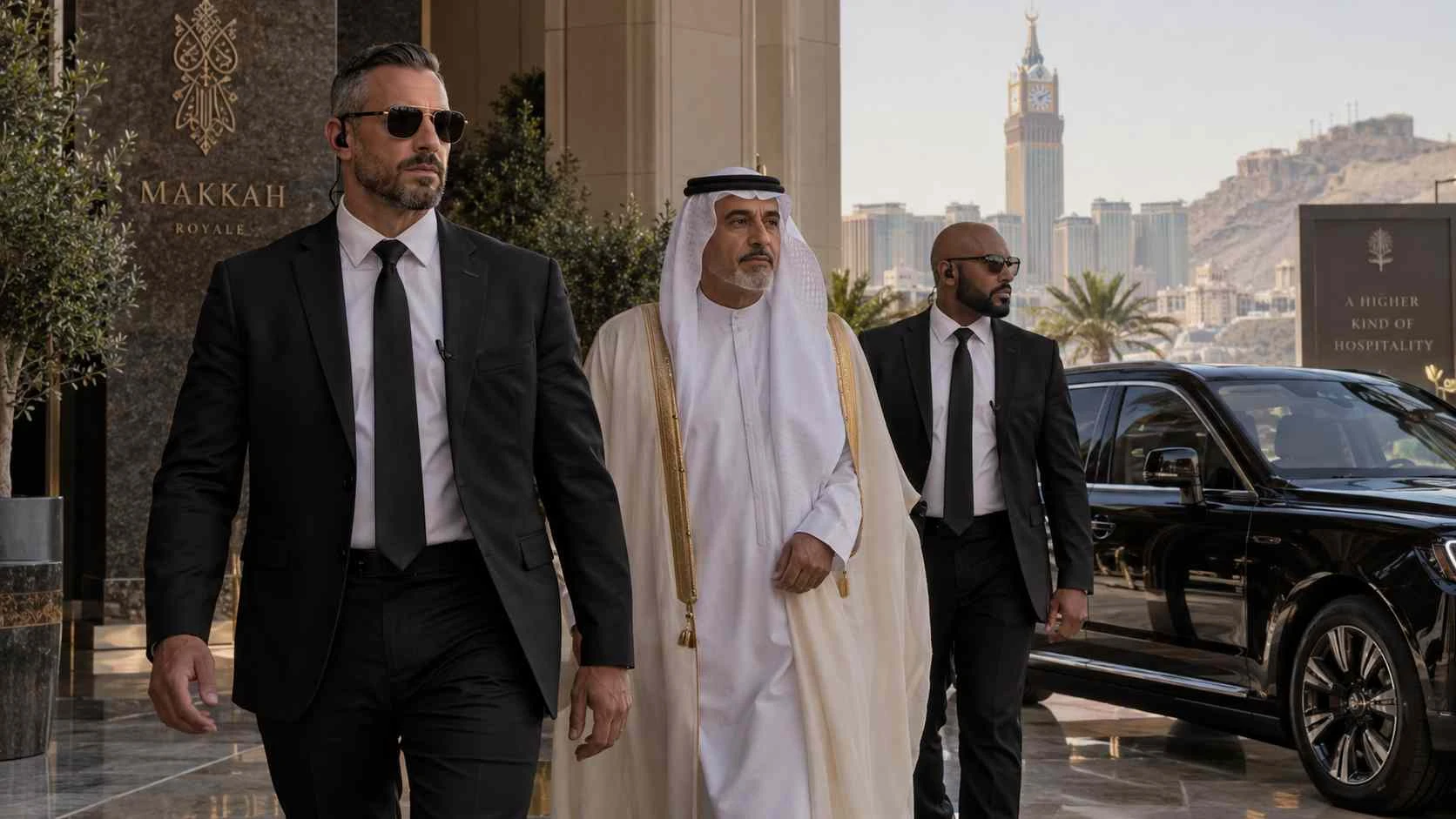
Mecca · FAMILY PROTECTION DURING UMRAH · PRIVATE CLIENT PROTECTION
Bodyguard Services in Mecca for Umrah and Private Family Visits
R&H Global Protection coordinates discreet bodyguard services in Mecca for Muslim private families, elderly pilgrims, children and eligible VIP visitors. Executive protection can cover Umrah-related family travel, hotel departures, approved road or rail transfers and permitted private appointments, with planned receiving through King Abdulaziz International Airport (JED) and Haramain High Speed Railway. Each programme defines locally eligible protective personnel, responsible hosts, separate chauffeur duties and the client’s confidential onward itinerary.
Part of R&H Global Protection’s bodyguard services in Saudi Arabia and coordinated private protection planning.
Mecca Bodyguard Services at a Glance
JED / Haramain receiving · Jeddah airport and Haramain arrivals · Mecca hotel and authorised vehicle handoffsExecutive & Private Visits
Discreet accompaniment for Muslim private families, elderly pilgrims, children and eligible VIP visitors at confirmed meetings and private appointments, with carefully agreed duty windows.
Host Access & Permissions
Confirm host approval for Muslim-only entry, Umrah permission, Hajj-season restrictions, Saudi-national personnel and official mosque control; local staff follow visitor screening, official access and site safety rules.
JED & Haramain Receiving
Agree King Abdulaziz International Airport (JED) and Haramain High Speed Railway, passengers, baggage, public collection point, driver contact and the first scheduled destination.
Regional & Onward Travel
Coordinate onward routes toward Jeddah and Medina via permitted road and Haramain rail connections; recheck drivers, licensing, receiving staff and overnight requirements before travel.
Direct answer · hiring personal protection in Mecca
Can You Hire a Private Bodyguard in Mecca?
Yes. R&H Global Protection coordinates bodyguard services and executive protection in Mecca for Muslim private families, elderly pilgrims, children and eligible VIP visitors. The detail may cover permitted family, hotel and Umrah transport movements, with arrival via King Abdulaziz International Airport (JED) and Haramain High Speed Railway. Indicative officer pricing is USD 700–1,500 per day; vehicles and additional staff are quoted separately. Regulated guard duties require an appropriately licensed Saudi provider and eligible Saudi-national security personnel, checked before confirmation. Non-Muslims cannot enter the city of Mecca; official pilgrimage and mosque access controls always apply.
R&H Global Protection · +972-55-9724475 · info@global-protection.net. Each Mecca assignment confirms the principal, eligible local staffing, duty window, host permissions and transport handoff.
Bodyguard · Executive Protection · Close Protection in Mecca
What Does a Bodyguard in Mecca Cover?
A professional close-protection officer in Mecca accompanies the named principal through the accepted private or corporate programme, including receiving, transitions and appropriate public-facing activity.
Regulated guard duties require an appropriately licensed Saudi provider and eligible Saudi-national security personnel, checked before confirmation. The protected person still follows local host access and professional duty requirements.
Mecca Protective Planning
Discreet Family Protection and Travel Coordination During Umrah in Mecca
R&H begins with the real protected person, decision-making assistant and itinerary. Umrah-related family travel, hotel departures, approved road or rail transfers and permitted private appointments may involve different venue rules, exposure and transport demands, so the detail is planned around the principal rather than an assumed all-access security role.
Clear responsibility.
Confirm King Abdulaziz International Airport (JED) and Haramain High Speed Railway, the named receiving contact, baggage and the first vehicle before arranging meetings, hospitality or a second protected family movement.
Protection Planning for Mecca Executive and Private Clients
The assignment can connect Jeddah airport and Haramain arrivals with Mecca hotel and authorised vehicle handoffs, while the client’s assistant shares only the practical itinerary and responsible host details needed for safe arrivals.
Venue Permissions and Responsible Host Security
Hotel receiving and the family loading point can be coordinated away from unnecessary crowd exposure, subject to local access controls. Each host controls credentials, visitor procedures and any required supervision; the bodyguard retains responsibility for the named principal within permitted areas.
JED / Haramain and Chauffeur Handoffs
At King Abdulaziz International Airport (JED) and Haramain High Speed Railway, confirm the public meeting point, passengers, baggage, vehicle capacity and next host, allowing for travel delays.
Locally Eligible Protection and Programme Continuity
Regulated guard duties require an appropriately licensed Saudi provider and eligible Saudi-national security personnel, checked before confirmation. Recheck the provider, officer and host contacts when the assignment moves or the team changes.
Mecca Close Protection Services
Close Protection in Mecca: Personal and Supporting Services
Ten service capabilities distinguish direct personal protection from separately staffed driving, property, venue and specialist roles.
Executive Protection in Mecca
R&H can plan principal-focused protection for Muslim private families, elderly pilgrims, children and eligible VIP visitors, covering Umrah-related family travel, hotel departures, approved road or rail transfers and permitted private appointments through appropriately eligible local staff and confirmed hosts.
Private Bodyguard and VIP Protection in Mecca
Discreet VIP accompaniment can begin at King Abdulaziz International Airport (JED) and Haramain High Speed Railway or a booked property. Official screening and host credentials are handled by the responsible authority.
Family and Child Protection in Mecca
Families may require child-aware scheduling, separate cars and a clear regrouping plan. The same officer should not be assumed to cover multiple simultaneous family movements without proper staffing.
Female Bodyguard Requests in Mecca
Requests for a suitable female officer or language capability in Mecca are assessed against local eligibility, actual availability and lawful duties.
Airport Receiving and Secure Transfers in Mecca
At King Abdulaziz International Airport (JED) and Haramain High Speed Railway, confirm passengers, bags, permitted exit and driver identity. A bodyguard cannot bypass restricted terminal screening.
Bodyguard and Security Driver in Mecca
A separately contracted professional driver and executive vehicle may connect Jeddah airport and Haramain arrivals to Family, elderly and child travel requirements. Officer and driver duties, rest and costs are defined independently.
Residential and Private Property Coordination in Mecca
The bodyguard coordinates movements at a hotel or private property. Fixed posts and overnight residential coverage require separate eligible staff.
Venue Security and Specialist Operator Responsibilities
Hotel receiving and the family loading point can be coordinated away from unnecessary crowd exposure, subject to local access controls. Responsibility for technical safety, crowd management, official access and property-wide security stays with the relevant licensed operator or authority.
Protective Advance Planning in Mecca
Advance planning checks JED / Haramain receiving, permitted site entries, Family, elderly and child travel requirements and the final collection. Changes to Muslim-only entry, Umrah permission, Hajj-season restrictions, Saudi-national personnel and official mosque control trigger refreshed driver and host instructions.
Long-Term Close Protection in Mecca
Long-term respectful, permit-sensitive Umrah and family movement benefits from a consistent client brief, staff rest, suitable relief and lawful handoffs.
Mecca Client Profiles
Who Hires Bodyguards and Executive Protection in Mecca?
Professional requests in Mecca commonly involve Muslim private families, elderly pilgrims, children and eligible VIP visitors, but the protection plan is always based on an actual named principal and itinerary.
Muslim family principals
For muslim family principals, discreet arrival and meeting transitions around Jeddah airport and Haramain arrivals can be more important than visible security.
Elderly pilgrimage visitors
The scope for elderly pilgrimage visitors may combine Umrah-related family travel, hotel departures, approved road or rail transfers and permitted private appointments; host registration and a named assistant keep changes manageable.
Parents with children
When parents with children travel with staff or family, the brief should separate parallel movements from one officer’s agreed duty.
VIP Umrah travellers
VIP Umrah travellers can receive a tailored plan for Grand Mosque boundaries and Umrah permits, including transport, confidentiality and the next confirmed host.
Extended family groups
For extended family groups, discreet arrival and meeting transitions around Jeddah airport and Haramain arrivals can be more important than visible security.
Private religious visitors
The scope for private religious visitors may combine Umrah-related family travel, hotel departures, approved road or rail transfers and permitted private appointments; host registration and a named assistant keep changes manageable.
Mobility-sensitive groups
When mobility-sensitive groups travel with staff or family, the brief should separate parallel movements from one officer’s agreed duty.
Long-stay Muslim families
Long-stay Muslim families can receive a tailored plan for Grand Mosque boundaries and Umrah permits, including transport, confidentiality and the next confirmed host.
Israeli-led Protective Methodology
Protection Planning Adapted to Mecca
In Mecca, protection changes as the principal moves between Jeddah airport and Haramain arrivals, Mecca hotel and authorised vehicle handoffs and Grand Mosque boundaries and Umrah permits. Those settings differ in access rights, exposure, meeting privacy and transport arrangements.
One confidential client brief connects the named assistant, locally authorised provider, responsible hosts and separate chauffeurs.
Operating principle
Quiet preparation. Clear responsibility. Flexible execution.- Advance Confirm King Abdulaziz International Airport (JED) and Haramain High Speed Railway, actual collection point, arrival party and host permission before the first movement.
- Discretion Limit distribution of religious travel dates, family mobility needs and hotel movements to the named assistant and personnel with a specific operating reason.
- Separate roles Facility managers and authorised officials keep control of Muslim-only entry, Umrah permission, Hajj-season restrictions, Saudi-national personnel and official mosque control; private officers remain focused on the principal.
- Adaptability Recheck the vehicle, host contact and duty period if Umrah-related family travel, hotel departures, approved road or rail transfers and permitted private appointments changes at short notice.
- Review Longer programmes use realistic work periods, documented handoffs and eligible relief where necessary.
Assignment continuity: when the Mecca itinerary changes, R&H reconfirms licensed duty, the responsible host, vehicle receiving and realistic staff hours before the next movement.
Mecca Operating Context
Where Mecca Family Protection Meets Official Pilgrimage Controls
The destination combines Umrah-related family travel, hotel departures, approved road or rail transfers and permitted private appointments, with distinct host, driving and confidentiality requirements.
Jeddah airport and Haramain arrivals
Confirm passports, passenger count, baggage and the approved onward transport plan; no private guard can bypass border or pilgrimage screening.
Mecca hotel and authorised vehicle handoffs
Hotel receiving and the family loading point can be coordinated away from unnecessary crowd exposure, subject to local access controls.
Family, elderly and child travel requirements
Group movement planning should accommodate mobility, changing prayer schedules and realistic separation points without claiming official crowd control.
Grand Mosque boundaries and Umrah permits
The Holy Mosque and pilgrimage access systems are administered by authorities; private security cannot promise entry, reserved routes or crowd privileges.
Reconfirm the actual arrival through King Abdulaziz International Airport (JED) and Haramain High Speed Railway, travellers, baggage, public exit, suitable vehicle and the first named contact.
Coordinate Jeddah airport and Haramain arrivals with the principal’s assistant, confirming guest registration, driver collection and any next protected movement.
Support the named principal through Umrah-related family travel, hotel departures, approved road or rail transfers and permitted private appointments, without taking over the host’s separate venue, operational or government obligations.
Allow time for Family, elderly and child travel requirements, visitor procedures, the next appointment and driver repositioning if plans change.
At the final leg, confirm onward travel toward Jeddah and Medina via permitted road and Haramain rail connections, driver work periods, relief needs and the next receiving team.
Planning note: areas, airports, hosts and landmarks in Mecca illustrate possible itineraries—not specific partnerships, guaranteed access, confirmed local provider licences or the availability of particular officers.
Mecca Assigned Team
Professional Standards for Protection in Mecca
Family Protection During Umrah needs clear distinctions between locally authorised guards, professional drivers and each host’s own security responsibilities.
One accountable client brief, clear lawful roles and documented receiving permissions for Mecca.
Protective personnel should understand Umrah-related family travel, hotel departures, approved road or rail transfers and permitted private appointments and remain unobtrusive when the principal is in a private meeting.
Regulated guard duties require an appropriately licensed Saudi provider and eligible Saudi-national security personnel, checked before confirmation. Separate host and specialist responsibilities must also be respected.
Protect religious travel dates, family mobility needs and hotel movements through named client representatives, minimum-necessary distribution and appropriately secure communications.
Confirm King Abdulaziz International Airport (JED) and Haramain High Speed Railway, passenger details, permitted waiting points, bags and a viable vehicle plan before the arrival.
Account for Muslim-only entry, Umrah permission, Hajj-season restrictions, Saudi-national personnel and official mosque control, scheduling changes, host permissions and the real finish time.
Extended programmes require realistic duty windows, planned rest, qualified relief personnel and lawful handoffs for each location.
Mecca / Hiring Process
How to Arrange Close Protection in Mecca
Provide a confidential brief with protected people, dates, arriving transport through King Abdulaziz International Airport (JED) and Haramain High Speed Railway, intended Umrah-related family travel, hotel departures, approved road or rail transfers and permitted private appointments and any private family requirements.
Confidential Principal Brief
Provide dates, duration, protected people, a named decision-making assistant and any relevant privacy concerns.
Airport and Executive Vehicle Receiving
Identify King Abdulaziz International Airport (JED) and Haramain High Speed Railway, arrival time, passenger count, baggage and the permitted receiving point.
Venue, Host and Itinerary Checks
List responsible hosts for Jeddah airport and Haramain arrivals, Mecca hotel and authorised vehicle handoffs and each restricted or specialist venue.
Officer Roles, Relief and Local Authorisation
Clarify which principals move together, whether family members split and what driver, fixed-post or relief staffing is needed.
Route Changes and Onward Handoffs
Build realistic schedules for Muslim-only entry, Umrah permission, Hajj-season restrictions, Saudi-national personnel and official mosque control and onward movements toward Jeddah and Medina via permitted road and Haramain rail connections.
Compliance Review and Written Proposal
Confirm locally lawful staffing and permissions before issuing the scope and quote. Regulated guard duties require an appropriately licensed Saudi provider and eligible Saudi-national security personnel, checked before confirmation.
Mecca Service Models
Choose the Right Protection Model in Mecca
The right team depends on the real principal, respectful, permit-sensitive Umrah and family movement, local provider eligibility and the working day. Complex visits, family splits or regional travel may require a second officer or independent chauffeur.
An eligible officer accompanies the named principal through Umrah-related family travel, hotel departures, approved road or rail transfers and permitted private appointments. Drivers, hotels, venues, religious sites and specialist operators retain their own separate responsibilities.
- Executive and VIP Protection in MeccaA suitably authorised officer accompanies the protected person through Jeddah airport and Haramain arrivals during a defined duty window.
- Bodyguard With Independent Security DriverA separate executive chauffeur and appropriate vehicle connect King Abdulaziz International Airport (JED) and Haramain High Speed Railway with confirmed appointments and onward receiving points.
- Hosted Business and Specialist AppointmentsHost-controlled venues such as Mecca hotel and authorised vehicle handoffs require prior admission approval, appropriate credentials and a clear protective scope.
- Venue, Official and Operator ResponsibilitiesMuslim-only entry, umrah permission, hajj-season restrictions, saudi-national personnel and official mosque control remain under the responsible private operator, venue or authority rather than the travelling bodyguard.
- Family, Delegation and Residential ExtensionsParallel family, delegation and residence coverage is separately staffed; a single officer cannot perform multiple simultaneous duties.
- Regional and Onward Travel From MeccaBefore continuing toward Jeddah and Medina via permitted road and Haramain rail connections, reconfirm lawful officer roles, vehicles, rest, relevant permissions and the next receiving contact.
Mecca / Transparent Pricing
How Much Does a Bodyguard in Mecca Cost?
Bodyguard services in Mecca use an indicative flat daily officer planning range of USD 700–1,500 for the agreed duty window. Written pricing reflects the real itinerary and locally eligible staffing.
The officer fee covers the named principal’s confirmed Mecca movements during the agreed period; it is not a universal hourly tariff.
Independent family appointments or parallel executives may require separate officers, vehicles or defined shifts.
Transport planning includes King Abdulaziz International Airport (JED) and Haramain High Speed Railway, passenger count, luggage, permitted vehicle waiting and the final collection.
Host admission and specialist duties covering Muslim-only entry, Umrah permission, Hajj-season restrictions, Saudi-national personnel and official mosque control are not automatically included in a personal-protection fee.
Changes in Umrah-related family travel, hotel departures, approved road or rail transfers and permitted private appointments may affect the driver, early receiving, overtime arrangements, regional travel and accommodation.
Longer programmes may need flights, accommodation, rotation, days off, relief and separate locally authorised personnel.
Team Configurations for Mecca Protection
One locally eligible officer accompanies the principal through the accepted Mecca itinerary.
A separate chauffeur and vehicle provide transfers between King Abdulaziz International Airport (JED) and Haramain High Speed Railway and the booked programme.
Family members or a larger delegation may receive parallel coverage when expressly staffed and agreed.
Additional qualified personnel or vehicles can support travel toward Jeddah and Medina via permitted road and Haramain rail connections, subject to applicable permissions.
Indicative USD rate per officer per day for an agreed duty window; vehicles and extra resources are separate.
Mecca Coverage and Compliance
Bodyguard Coverage Across Mecca and Regional Routes
Coverage follows the accepted Mecca itinerary, not unrestricted entry to airports, private sites, factories, ports, academic facilities, mosques or official venues.
Mecca
Regulated guard duties require an appropriately licensed Saudi provider and eligible Saudi-national security personnel, checked before confirmation. Actual transport and specialist-site access are confirmed separately.
At Jeddah airport and Haramain arrivals, confirm the appointment time, principal’s contact and discreet vehicle receiving without assuming facility-wide security rights.
Visits to Mecca hotel and authorised vehicle handoffs need the host’s admission procedure and a confirmed permitted route for the principal.
For Family, elderly and child travel requirements, adapt visibility, privacy and driver collection to the actual activity and group size.
Travel toward Grand Mosque boundaries and Umrah permits needs road or rail coordination, realistic duty hours and receiving confirmation.
Onward travel toward Jeddah and Medina via permitted road and Haramain rail connections requires a fresh check of provider eligibility, drivers, host permission and any accommodation.
Official legislation and regulatory guidance inform this Mecca description. Those sources do not establish that R&H or a proposed local provider already holds assignment-specific licences, access permits or available personnel; those must be verified before confirmation.
Mecca / Why R&H Global Protection
Why Choose R&H Global Protection in Mecca?
An executive or family in Mecca may move between Jeddah airport and Haramain arrivals, Family, elderly and child travel requirements and Grand Mosque boundaries and Umrah permits, requiring accurate instructions rather than visible or intrusive security.
Planning for Executive and Private Movements
The protective position that works for a private meeting may differ from a public arrival, hosted technical visit or family day.
Respect for Host and Specialist Security
R&H separates the principal’s escort from official screening, technical safety and facility-wide host security; it never assumes those powers.
Discreet Client Information Handling
Religious travel dates, family mobility needs and hotel movements should be shared only with the named assistant and staff with an agreed practical task.
JED / Haramain and Driver Coordination
Confirm King Abdulaziz International Airport (JED) and Haramain High Speed Railway, passengers, permitted meeting points, luggage and a suitable vehicle before the principal arrives.
Programme Changes Without Improvised Access
Changes to Muslim-only entry, Umrah permission, Hajj-season restrictions, Saudi-national personnel and official mosque control require revised receiving, officer hours and host permission.
Locally Eligible Protection and Accountability
Regulated guard duties require an appropriately licensed Saudi provider and eligible Saudi-national security personnel, checked before confirmation. The written scope identifies the provider, personnel and defined operational roles.
“Our family travelled to Mecca for Umrah and wanted professional support that would help us manage the journey safely and discreetly, particularly while travelling with elderly relatives and children. R&H Global Protection coordinated closely with our transportation and accommodation arrangements and helped keep movements organised during very busy periods. The officer understood that the religious purpose of the visit had to remain the priority and maintained a respectful, unobtrusive presence throughout. Hotel departures, family movements and transfers were handled calmly, allowing us to concentrate on the pilgrimage rather than the surrounding logistics.”
International Protection Continuity
Connect Your Mecca Assignment to Onward Travel
From Mecca, a client may continue toward Jeddah and Medina via permitted road and Haramain rail connections. Each new arrival, driver, eligible officer and hosted venue must be confirmed against the actual itinerary and local legal requirements.
Related destinations: Saudi Arabia · Riyadh · Jeddah · Medina · Dubai · London
Explore International Bodyguard ServicesMecca · Confidential Protection Enquiry
Hire a Bodyguard in Mecca
For bodyguard services in Mecca, send dates, protected people, arrival through King Abdulaziz International Airport (JED) and Haramain High Speed Railway, key appointments and any required vehicles. Include Muslim-only entry, Umrah permission, Hajj-season restrictions, Saudi-national personnel and official mosque control where applicable so R&H can assess lawful staffing, separate host responsibilities and realistic pricing.
Opening WhatsApp drafts an enquiry; it does not confirm a reservation, accepted assignment or payment obligation.
Mecca Bodyguard Questions
Frequently Asked Questions About Bodyguard Services in Mecca
Ten concise answers about USD 700–1,500 daily officer pricing, local authorisation, King Abdulaziz International Airport (JED) and Haramain High Speed Railway, respectful, permit-sensitive Umrah and family movement, drivers, restricted hosts and onward travel.
How much does a bodyguard in Mecca cost?
R&H Global Protection uses an indicative USD 700–1,500 per officer per day in Mecca for the agreed duty window. Separate vehicles, security drivers, extra officers, relief, personnel travel and accommodation are quoted as needed. Final pricing reflects actual assignments and lawful staffing.
Can R&H arrange executive protection in Mecca?
R&H can review a discreet programme for Muslim private families, elderly pilgrims, children and eligible VIP visitors. Regulated local guard duties require the appropriate provider and eligible officers, verified before confirmation. Longer assignments take priority; shorter visits depend on actual resources and acceptance.
Are bodyguards in Mecca armed?
Unarmed, prevention-led protection is the normal proposed service in Mecca. Armed assignments are not automatically available or included. Any firearms role would require separate legally authorised personnel, permissions and a specific written scope; international military experience is not sufficient.
What licences apply to bodyguard services in Mecca?
Saudi private-security rules require the appropriately licensed local company and Saudi-national security employees and guards. International advisory participation is a separate legal matter, not a substitute for an eligible guard. Actual provider status, personnel authorisation and relevant access must be checked before assignment confirmation.
Can protection begin at King Abdulaziz International Airport (JED)?
Airport or rail receiving can be planned at a permitted public collection point once the arrival, travellers, luggage and vehicle details are confirmed. A private guard cannot bypass screening, immigration, transport operator rules or controlled areas. A separate chauffeur is quoted as required.
Can protection cover respectful, permit-sensitive Umrah and family movement in Mecca?
Yes, subject to a confirmed client programme, lawful local staffing and each host’s approval. The bodyguard focuses on the protected person through Umrah-related family travel, hotel departures, approved road or rail transfers and permitted private appointments; companies, venues, transport operators and official authorities retain their own security and access duties.
Can I combine a bodyguard and an executive driver in Mecca?
Yes. R&H can review a separate chauffeur and suitable vehicle alongside the locally eligible officer. The written scope specifies collection points, passenger count, agreed duty windows, additional vehicles and any regional handoffs. Transport costs are separate from the officer planning range.
Can a private bodyguard escort us anywhere inside the Grand Mosque?
No. Official authorities control Grand Mosque access, security and crowd movements; private guards cannot override those rules. Non-Muslims are not permitted to enter the city of Mecca, not just the mosque precinct. Eligible Muslim travellers must follow current Hajj or Umrah permits, seasonal restrictions and approved security arrangements.
Can protection continue from Mecca to Medina or Jeddah?
A lawful itinerary may connect Mecca, Jeddah and Medina by permitted road or Haramain rail travel. Confirm current permits, Saudi-eligible staffing, passengers, mobility needs and receiving contacts. The security team cannot provide special religious-site access or immunity from seasonal restrictions.
How can I request a bodyguard quotation in Mecca?
Send dates, duration, protected people, arrival details, key appointments, vehicle needs and any family or residence support. Explain Muslim-only entry, Umrah permission, Hajj-season restrictions, Saudi-national personnel and official mosque control if relevant. R&H can then assess lawful resources, duty periods, host responsibilities and separately priced logistics before issuing a proposal.