Skip to content
Tokyo, Japan

Bodyguard Services in Tokyo — Israeli Security Experts in Japan

R&H Global Protection provides bodyguard services in Tokyo and VIP security across Japan for executives, diplomats, entertainers, family offices, and high-net-worth clients. Our teams combine former Israeli intelligence and special-operations backgrounds with licensed local partners to deliver discreet, intelligence-led close protection, executive security, security drivers, residential coverage, and counter-surveillance throughout Japan.

Coverage spans Tokyo and nationwide deployments across Yokohama, Osaka, Kyoto, Nagoya, Fukuoka, Sapporo, and Okinawa, typically within 72 hours.

Former Israeli Special ForcesShin Bet Security Background24/7 Global Deployment20+ Years of Experience35+ Countries Operated
Tokyo Threat Profile

The Safest Megacity in the World Still Has a Threat Profile

Tokyo is, by almost any measure, the safest megacity on earth. Violent crime is statistically negligible. Public infrastructure is precise. Law enforcement is professional.

For executives and UHNWIs arriving from higher-crime international cities, the contrast can feel disorienting — the usual security triggers are absent.

That absence is exactly why serious protection here looks different.

The real threat profile facing executives, family offices, and visiting principals in Japan is not street crime. It is a combination of targeted surveillance by state-aligned actors, industrial espionage in semiconductor, biotech, and advanced-manufacturing sectors, privacy exposure through predictable movement patterns, nightlife-concentrated opportunistic crime in specific districts, and natural-disaster contingency in a seismically active zone.

Layered over this is a legal and cultural framework — the Firearm and Sword Possession Control Law, the Security Services Act, and rigid expectations around public behaviour — that makes Western-style visible protection ineffective at best, counterproductive at worst.

Bodyguard services in Tokyo are not about projecting force. They are about intelligence, access, cultural fluency, and disappearing into a city that values invisibility. R&H Global Protection delivers discreet, intelligence-led close protection across Japan, working through vetted partners holding current Security Services Act certification.

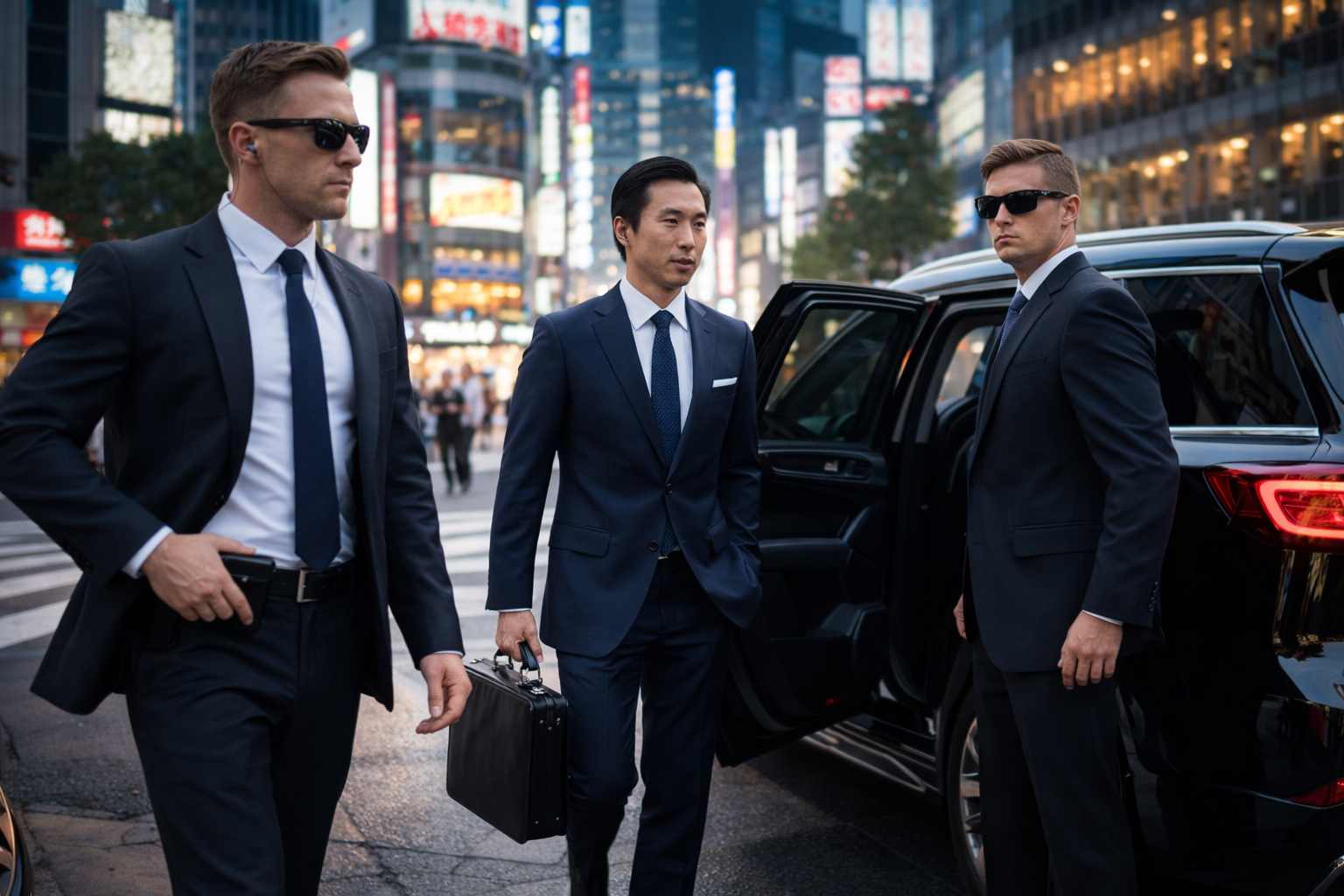
Why Imported Templates Fail

Why Standard Protection Models Fail in Tokyo

Most international firms export one template and apply it globally. In Japan, that template breaks.

Firearms are out of the equation

Under the 1958 Firearm and Sword Possession Control Law, civilian handgun possession is prohibited outside narrow, specific exceptions. Private security operators do not carry firearms. Any plan built around armed response is structurally incompatible with Japanese law.

The Security Services Act governs who can operate

The Keibigyōhō (警備業法) requires any commercial security provider to be certified by the Prefectural Public Safety Commission, with named training supervisors and registered offices. Unlicensed protection work — including work performed by visiting foreign operators without a licensed local partner — is unlawful. Credible protection here runs through a licensed Japanese operator or is not credible at all.

Visibility creates risk instead of deterring it

A suited foreign detail walking two paces behind a principal through Marunouchi draws attention in a city that culturally disfavours it. That attention is documented — by pedestrians, by hotel staff, by CCTV, by anyone with a phone. The principal is then identifiable for the rest of the trip. Low-profile, single-operator or small-team movement with bilingual protocol fluency is the standard that actually works.

The real threats are informational, not physical

Japan ranks among the most targeted environments in APAC for advanced persistent threats, with ransomware leading its national threat list for over a decade. Japan's 2024 Active Cyber Defense legislation confirms how seriously the state itself treats this surface. Visiting executives face a risk profile dominated by digital compromise, counter-surveillance gaps in hotels and meeting rooms, and social-engineering attempts — not physical assault.

Effective bodyguard services in Tokyo start from that reality.

Intelligence-Led Approach

Close Protection in Tokyo — An Intelligence-Led Approach

R&H Global Protection was founded by former Israeli special-operations and intelligence operators, with senior advisors drawn from national-police VIP protection command — between them they have protected heads of state, ambassadors, and high-value commercial clients across both hostile and permissive environments.

What that background brings to Japan is not aggression. It is intelligence discipline.

Protective operations in this tradition treat the 48 to 72 hours before a client arrives as the most important part of the assignment. Route reconnaissance, venue walk-throughs, hotel floor assessment, driver vetting, counter-surveillance sweeps of meeting rooms and residences, liaison with local stakeholders — for any serious close-protection company operating here, all of this happens before the client lands at Haneda or Narita.

Japan-Specific Methodology

How Israeli Security Methodology Adapts to Japan

01

Seismic and Typhoon Contingency Planning

Every residential and hotel assignment includes pre-mapped evacuation routes and floor-by-floor structural notes for principal residences and primary hotels.

02

Bilingual Operator Coverage

Bilingual Japanese–English operators, or interpreter pairing where the engagement requires it, are assigned for every client-facing role.

03

Japanese Corporate Protocol Fluency

Teams are briefed on business-card exchange (meishi), seating hierarchies, and the unwritten rules of Keidanren-tier meetings.

04

Official Liaison Where Required

Where principal status requires it, coordination may involve Tokyo Metropolitan Police Department Security Police for diplomats, former heads of state, and designated VIPs.

05

Physical and Digital Perimeter Integration

Cyber hygiene and digital counter-surveillance are integrated into the protective brief, treating physical and digital exposure as a single problem.

06

Bilingual Briefs and Contracts

Bilingual contracts and operational briefs reduce ambiguity between the principal’s representatives, licensed Japanese partner, venue teams, and building managers.

Services in Tokyo

Executive Protection and VIP Security Services in Tokyo

Executive protection in Tokyo is a layered discipline that spans close protection, secure transportation, residential coverage, event security, and counter-surveillance. Below are the core executive security services we deliver across the city and the greater Kantō region.

Close Protection

Dedicated one-on-one or small-team coverage throughout the principal's time in Japan: Haneda or Narita arrival, hotel check-in at properties such as Aman Tokyo, The Peninsula Tokyo, Palace Hotel Tokyo, or Mandarin Oriental, boardroom movement around Marunouchi, Ōtemachi, and the Tokyo Stock Exchange district in Nihonbashi, government and diplomatic engagements near Kasumigaseki, Akasaka Palace, and the Imperial Palace district, and discreet Ginza or Azabu restaurant arrivals through to departure protocol.

Operators work low-profile — business attire, discreet earpieces, minimal visible equipment. The emphasis is on early threat detection, route control, and keeping the principal moving without friction or visibility.

Residential and Corporate Site Security

For principals with extended stays — residences in Hiroo, Moto-Azabu, Hanzōmon, Aoyama, or Roppongi Hills — we establish residential security protocols covering entry control, CCTV integration, visitor vetting, staff screening, and liaison with building management and concierge teams.

For corporate offices, embassies, or private family-office locations, the corporate security model extends to access control, delivery screening, meeting-room sweeps, and emergency response coordination.

Counter-Surveillance and Technical Security Sweeps

Meeting rooms, hotel suites, residences, and vehicles are swept for covert audio and video devices before and during the engagement. This is particularly relevant for executives in sectors exposed to industrial espionage — semiconductors, biotech, defence, advanced manufacturing — where Japan's role as a global innovation hub intersects with persistent state-aligned collection interest.

Transportation and Security Drivers

Secure transportation is built on pre-inspected vehicles, trained security drivers, and route planning that accounts for Shuto Expressway congestion, typhoon-season disruptions, and seismic evacuation contingencies.

Our security drivers in Tokyo are trained in protective driving, surveillance detection, route deconfliction, and discreet executive movement throughout the Kantō region. Every executive driver assigned to a Tokyo engagement is bilingual, background-checked, and integrated into the close-protection brief — not a standalone chauffeur service.

Vehicle options include executive sedans such as Lexus LS, Mercedes-Benz S-Class, Toyota Century where cultural fit matters, and MPVs such as Toyota Alphard or Mercedes V-Class for family movements.

Event and Meeting Security

High-stakes events — investor summits, IPO roadshows, board meetings at the Imperial Hotel or Tokyo International Forum, private dinners in Ginza, product launches in Odaiba, gallery openings at the Mori Art Museum — require specific protection planning. Event coverage includes pre-event venue sweeps, access control, principal movement choreography, media management, and contingency coordination with venue security and local police liaison.

Travel Risk Management

For principals moving between Tokyo, Osaka, Kyoto, Nagoya, Fukuoka, or Sapporo, we coordinate end-to-end travel risk management: advance intelligence for each destination, licensed local protection at each leg, secure Shinkansen or private-vehicle inter-city transportation, and continuous communications with a single team lead owning the movement from first leg to last.

Client Profile

Who We Work With — Bodyguard Services in Tokyo

We provide business travel security in Tokyo and longer-term VIP protection for a focused client profile.

Fortune 500 and FTSE 100 Executives

Board, partner, and government-liaison visits requiring discreet movement control.

Sovereign Wealth and Government Delegations

Protocol-correct coverage for discreet official and private movements.

Private Equity and Venture Capital Principals

Deal meetings, portfolio diligence, and Nikkei Asia Forum-type engagements.

Family Offices and UHNWI Clients

Residences in Hiroo, Moto-Azabu, Hanzōmon, Aoyama, Roppongi Hills, or Karuizawa.

Diplomatic Missions

Coordination with Japan's Security Police and the Ministry of Foreign Affairs where required.

Entertainment, Sports, and Cultural Talent

Tour and promotional movements around Tokyo Dome, Mori Art Museum, and the National Art Center.

Legal and Compliance Teams

Sensitive M&A, internal investigation, or litigation engagements where movement carries informational risk.

The common feature across every engagement is that visibility damages the client. Discretion is the service.

Risk Assessment

The Tokyo Threat Environment — A Realistic Assessment

Digital and Industrial Espionage

Japan sits near the top of APAC ransomware and advanced persistent threat target lists. State-aligned collection against foreign executives is persistent and documented. Hotel Wi-Fi, compromised conference networks, USB devices handed over at events, and coffee-shop working sessions all create collection opportunities. Cyber protection sits alongside the physical brief on every engagement we run.

Nightlife-Concentrated Opportunistic Crime

Roppongi, Kabukicho, Shibuya, and parts of Ikebukuro have a documented pattern of scams targeting foreign visitors — inflated bar bills, credit-card fraud, drink-spiking, and aggressive street promoters steering visitors into controlled venues. The risk is transactional, predictable, and preventable with pre-vetted venues and operator presence.

Privacy Exposure and Predictable Movement

Principals who post real-time locations, share itineraries widely, or maintain predictable routines between office, hotel, and restaurant become easily trackable. The 2024 killing of Brian Thompson is frequently referenced in executive protection circles as a working example of how visible movement patterns create vulnerability. The lesson applies here as much as anywhere else.

Natural Disasters and Movement Disruption

The capital sits in one of the world's most seismically active zones. Major earthquakes, tsunami risk along the Pacific coast, and annual typhoon season can disrupt transportation, communications, and evacuation routes. Protection planning that does not include seismic and typhoon contingencies is incomplete.

Lone-Actor Risk

The 2022 assassination of Shinzo Abe in Nara restructured how Japan's Security Police approaches principal protection. It also reinforced a point serious operators have long understood: even in a country with near-zero firearms circulation, determined hostile actors improvise. Threats here are rarer, not absent.

Pricing

How Much Do Bodyguard Services Cost in Tokyo?

Pricing Depends on the Operational Profile

Bodyguard service pricing in Tokyo depends on the principal’s threat profile, operational complexity, number of operators required, duration of the assignment, and the mix of services involved.

$700–$1,500 / day

Single-Operator Close Protection

Single-operator close protection for short business visits or low-profile executive movement typically ranges from $700 to $1,500 per day. A two-operator detail for family movement, multiple venues, or standard executive coverage generally ranges from $1,400 to $3,000 per day.

$3,500–$8,000+ / day

Complex or High-Profile Operations

For high-profile principals, multi-city travel, or complex itineraries requiring a security driver and larger operational footprint, multi-operator teams usually range between $3,500 and $7,000 per day. Full-scale deployments involving residential security, technical counter-surveillance sweeps, and dedicated coverage teams for family offices or extended stays typically begin from $8,000 per day and are priced according to scope.

Monthly and Extended-Stay Agreements

Longer engagements — including residential coverage, family-office retainers, and extended-stay protection — are usually structured on monthly or annual agreements with dedicated team continuity, which often provides better value than daily pricing. Short-notice deployments, nationwide movements across Japan, and technical-surveillance work are quoted separately based on operational requirements.

Written Proposal Before Deployment

We do not publish fixed hourly rates. Every assignment begins with a confidential risk assessment followed by a written proposal tailored to the client’s itinerary, exposure level, and security requirements. All pricing is confirmed in writing before deployment.

Indicative Daily Scope
From
$700–$1,500
single-operator close protection / per day
Japan Coverage

Geographic Coverage Across Japan

Our primary base of operations is in the capital, covering the 23 special wards and the greater Kantō region. We regularly support principals across Japan.

TYO

Tokyo

Marunouchi, Ōtemachi, Ginza, Roppongi, Shibuya, Shinjuku, Akasaka, Azabu, Hiroo, Aoyama, Daikanyama, Ebisu, Odaiba, and private-residence districts across the capital.

YOK

Yokohama and Kanagawa

Minato Mirai corporate district, Yamate residences, Zushi residences, and Hakone retreats.

OSA / KYO

Osaka, Kobe, and Kyoto

Osaka's Umeda business district, Kyoto's luxury-hotel belt, and Kobe harbour districts.

NGO

Nagoya

Sakae and Marunouchi business districts, with frequent automotive-sector visits.

FUK

Fukuoka

Hakata business centre, Tenjin, and regional executive engagements.

CTS

Sapporo and Hokkaido

Sapporo, winter residences, Niseko private estates, and ski-season principal movements.

OKA

Okinawa

Naha and the resort belt, with diplomatic and military-adjacent engagements.

JPN

Multi-City Continuity

Licensed local teams, Shinkansen or private-vehicle inter-city transportation, and a single team lead owning the movement end-to-end.

Why R&H

What Makes R&H Global Protection Different

Operator Background

Senior operators come from former special-operations and intelligence units with doctrine built around asymmetric threat environments, high-value principal protection, and intelligence-first operations. The methodology travels; we adapt it for Japanese legal and cultural reality.

Intelligence-Led Planning and Local Integration

Every assignment starts with a threat assessment specific to the principal, their sector, the venues, and the publicly available footprint around them. Advance teams deploy before the principal arrives. We work exclusively through licensed Japanese partners holding current Security Services Act certification — operators augment, they do not replace local licensing. Every detail is lawful, and every contract is executed bilingually.

Discretion as a Standard

Every operator assigned is briefed on cultural protocol, visible-presence minimisation, and the specific behaviours that damage a principal in Japanese corporate and social environments. The standard is active invisibility, not simply low profile.

Integrated Physical and Digital Protection

Given the threat profile, we treat the physical and digital perimeters as a single problem. Advisory includes device hygiene, network guidance, hotel-room and meeting-room technical sweeps, and coordination with the principal's existing cyber team.

Single Point of Accountability

One team lead owns the engagement from initial risk assessment through final departure. There is no handoff between country teams and no dilution of responsibility.

Request a Confidential Consultation

Bodyguard Services in Tokyo, Planned Around Your Actual Itinerary

Looking for bodyguard services in Tokyo? Whether you require close protection for a corporate visit, multi-city movement across Japan, an extended family stay, or a high-profile event, our team is ready to support you. Share your requirements and we will return a tailored proposal aligned with your schedule, risk profile, and operational needs. There is no obligation, and every consultation is handled with complete discretion and confidentiality from first contact.

+972-55-9724475 / WhatsAppinfo@global-protection.netAvailable 24/7 for principals worldwide

Helpful Details to Include

  • Travel dates or estimated duration
  • Number of people who need coverage
  • Hotel, residence, or venue locations
  • Whether you need vehicles and drivers

Operational Context

  • Multi-city plans — Osaka, Kyoto, Hakone, etc.
  • Any known risks or concerns
  • Events — conferences, premieres, summits
  • Family protection requirements
  • Preferred team size, or let us recommend
FAQ — Bodyguard Services in Tokyo

Questions Clients Ask Before Hiring Protection in Japan

Single-operator close protection typically runs $700 to $1,500 per day depending on threat profile, duration, and complexity. Multi-operator details and full residential or technical packages scale from there. Every engagement begins with a confidential risk assessment and a written proposal.

Yes. Commercial protection services are governed by the Security Services Act (Keibigyōhō) and must be delivered by operators certified by the Prefectural Public Safety Commission. R&H Global Protection works exclusively through licensed Japanese partners with current certification.

Effectively, no. The 1958 Firearm and Sword Possession Control Law prohibits civilian handgun possession with very narrow exceptions. Private security operators do not carry firearms. Protection here is built around intelligence, early threat detection, and physical intervention — not armed response.

Yes. Every client-facing role is staffed with bilingual Japanese–English operators, or interpreter-paired where the engagement requires it. Drivers, team leads, and advance personnel are briefed in both languages, and contracts are issued bilingually.

Standard engagements can be mobilised within 48 hours. Nationwide coverage across Japan is typically 72 hours. Short-notice and emergency deployments are handled case-by-case with a senior team lead contactable around the clock.

A full package typically includes close protection, secure ground transportation, airport transfers, hotel and residential coverage, venue advance work, counter-surveillance technical sweeps where required, and coordination with local police and venue security. Scope is tailored to the principal.

Yes. We cover board meetings, investor summits, product launches, private dinners, and cultural engagements across venues including the Imperial Hotel, Palace Hotel Tokyo, Tokyo International Forum, Mori Art Museum, and private residences. Advance site assessment is standard.

Yes. Every residential and hotel assignment includes seismic evacuation routing, typhoon-season movement planning, and coordination with building management on emergency protocols. The team lead maintains a contingency communications channel for the duration of the engagement.

Yes. For visiting diplomats, former heads of state, and designated VIPs whose status requires it, we coordinate through the appropriate channels with Tokyo Metropolitan Police Department's Security Police division and, where relevant, the Ministry of Foreign Affairs.

Yes. We cover the capital's primary residential districts — Hiroo, Moto-Azabu, Hanzōmon, Roppongi Hills, Aoyama — and private estates in Karuizawa, Hakone, and Niseko. Scope includes access control, CCTV integration, staff screening, and building-management liaison.

For business travel security in Tokyo and short-notice executive movements, R&H typically mobilises a single-operator detail within 24 to 48 hours of confirmed instruction. A senior team lead is reachable around the clock, and a written scope and proposal is returned within 24 hours of first contact. For multi-city movement across Japan, lead time is 72 hours.

Yes. Our security drivers in Tokyo are trained in protective driving, surveillance detection, and route deconfliction, and every executive driver is bilingual and integrated into the close-protection brief — not a standalone chauffeur. Vehicles include Lexus LS, Mercedes-Benz S-Class, Toyota Century, and Alphard / V-Class for family movement.