
January, late November, December outside ILTM
Low ambient threat. Protection is residential, low-profile, and oriented around privacy preservation for villa-resident HNW clients in Californie, Super Cannes, and Cap d'Antibes.
Our bodyguards in Cannes deliver low-profile, intelligence-led protection for clients whose presence on the Riviera attracts attention they would rather not have. Coverage runs across Cannes, Antibes, Cap d'Antibes and Saint-Tropez. Teams deploy within 72 hours for most assignments and faster during peak event windows when advance planning permits.
What this means operationally: protection planning here is event-state dependent, not city-dependent. A protective detail at the 79th Cannes Film Festival (12–23 May 2026, currently running, jury chaired by Park Chan-wook) requires fundamentally different posture from a quiet October villa stay in Super Cannes. Most security firms treat the city as a single problem. It is at least four.
Low ambient threat. Protection is residential, low-profile, and oriented around privacy preservation for villa-resident HNW clients in Californie, Super Cannes, and Cap d'Antibes.
Corporate delegate concentration. Risk shifts to competitor surveillance, social engineering, hotel-lobby exposure, and after-hours yacht-circuit movement. Threat is professional, not opportunistic.
Maximum global media presence. Crowd density at the Palais des Festivals, photographic exposure on the red carpet steps, fan and paparazzi pressure at the Carlton, Martinez, and Majestic, and compressed movement between villa, hotel, screening, and after-party.
The protective focus moves to Vieux Port and Port Canto, tender transitions, and shore-to-vessel transfers. Maritime intelligence and harbour-side access control become the operational centre of gravity.
A protection brief that ignores which of these states the client will be operating in is not a brief — it is a template.
Our protection here is built around four client profiles:
Primarily villa-resident or seasonal, often with assets in Californie, Super Cannes, Cap d'Antibes, or aboard yachts in the Riviera circuit. Protection priorities are privacy, residential security, family movement, and discretion.
Attending MIPIM, Cannes Lions, MIPCOM, MAPIC, TFWA, or private off-site programmes. Concerns include corporate espionage, competitor surveillance, secure transportation, and protected hospitality.
At the Film Festival, Cannes Lions, or attached private events. The operational problem is managing visibility — paparazzi proximity, fan interactions, crowd dynamics and protected hotel back-of-house movement.
Attending events at the Palais des Festivals, private negotiations, or operating in coordination with the local Police Nationale and Gendarmerie under the active Vigipirate plan.
The same five-star hotels appear in every itinerary. The same private clubs — Z Plage, Magnum, Baôli — see the same flow of recognisable guests. The same yacht agents and concierge staff handle the same VIP profiles year after year. Information about who is in town, where they are staying, and which yacht they are using leaks through commercial and social channels long before a principal arrives.
Effective protection here therefore starts before arrival. We conduct advance reconnaissance of the villa, yacht, and venues in the itinerary; coordinate with hotel security and house staff; map alternative routing around La Croisette during peak event traffic; and stress-test the digital footprint of the principal's planned movements. The protective detail on the ground is the visible layer — the planning underneath it is what determines whether the assignment runs cleanly.
Most Cannes-bound clients arrive through Nice Côte d'Azur Airport, roughly 30 minutes away via the A8. Others arrive through Cannes-Mandelieu Airport or helicopter transfers. Our teams manage meet-and-greet, terminal coordination, vehicle staging, and discreet onward movement.
We provide close protection at Cannes' primary luxury hotels, including the Carlton, Majestic, Martinez, and Five Seas Hotel. Operations include lobby and corridor management, discreet floor security, protected movement, and coordination with hotel security teams.
During the Film Festival, operations focus on red-carpet arrivals, private screenings, hotel security, and controlled movement between venues and after-parties. During MIPIM and Cannes Lions, the emphasis shifts to executive transfers, yacht-event security, and corporate hospitality protection.
Residential security for villas above Cannes and across Cap d'Antibes includes perimeter management, household staff coordination, CCTV and alarm review, and discreet on-site protection tailored to the client's exposure level.
Protection around Vieux Port and Port Canto covers shore-to-yacht transfers, harbour-side access control, low-profile onboard presence, and coordination with captains and crew — particularly important during the Cannes Yachting Festival.
La Croisette concentrates Cannes' highest exposure points — luxury boutiques, hotels, beach clubs, and heavy pedestrian traffic. Protective movement focuses on route variation, crowd management, and minimizing unnecessary public exposure.
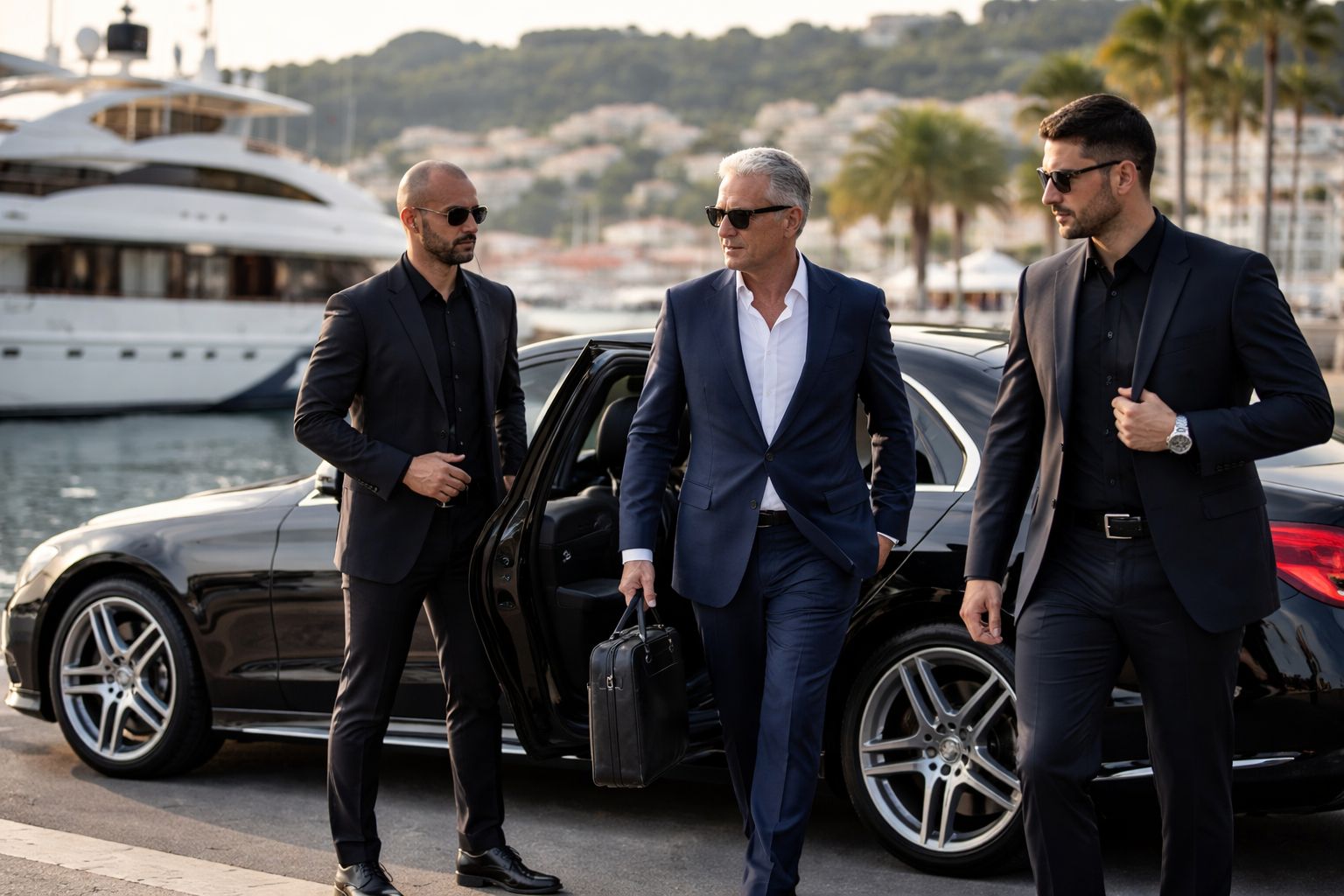
Single-agent or multi-agent details, built around the client's actual schedule rather than a standard template. Our agents dress to the setting — gala, conference, yacht club, beach — and the default posture is low-profile.
A professional bodyguard in Cannes should not be visible until the moment visibility matters. Effective personal protection Cannes work is a question of posture, spacing, and information control — not a question of headcount.
Cannes' street grid is narrow, one-way in many sections, and congested to near-standstill during festival and MIPIM dates. Route selection here is not theoretical — it decides whether a 12-minute transfer takes 12 minutes or 50.
Our security drivers are trained close protection operatives first and drivers second; they read environments, plan primary and alternate routes, and coordinate seamlessly with on-foot agents at the drop-off. Vehicles are vetted, unmarked, and sized to the profile — sedan for discreet transfers, SUV for family movements, armored when the threat profile requires it.
Full coordination with Nice Côte d'Azur Airport arrivals and helicopter transfers to/from Monaco Heliport. A trained security driver in Cannes is often the most operationally valuable asset in a detail — more than a second on-foot agent — because the client spends more time in the vehicle than anywhere else.
Villa burglary rings operating on the Riviera have been documented by the U.S. Embassy in Paris and by French police intelligence for over a decade. Villa security in Cannes is a specific discipline — it is not residential security adapted from elsewhere.
Our protocol starts with a pre-arrival site survey: access points, line-of-sight, neighbor assessment, staff vetting, panic-room positioning, and — critically — the integration between house technical security and the client's personal protection schedule.
For long-term villa engagements in Super Cannes, Cap d'Antibes, or Mougins, we integrate with existing household staff rather than replace them, coordinate with CCTV and alarm monitoring providers, and establish a rotation that covers the full 24-hour cycle without visible gaps.
Most yacht security failures happen within 30 meters of the vessel — during tender transfer, shore arrival, or the walk from the berth to a waiting car. Cannes yacht security done properly is not a dedicated marina team — it is the integration between onboard crew, shore-side close protection, and ground transport.
Our marina protocols for Vieux Port, Port Canto, and the wider Baie de Cannes cover the shore-side environment that onboard crew cannot. For guests moving between multiple yachts during festival afterparties, we coordinate agent handoff in real time.
The Cannes Film Festival's own accreditation security is designed to move 40,000 people in and out of a building on schedule. It is not designed to protect one specific person at a specific moment.
Our event protocols layer over festival security, not against it — covering the private journey into and out of the festival perimeter, the green room and backstage environment, gala dinners, yacht parties, and the moments between the official program that the festival does not cover.
For clients whose Cannes schedule is known two or more weeks in advance, we run full pre-travel advance: venue reconnaissance, route mapping, hotel room positioning, staff and vendor vetting, and threat briefings specific to announced appearances.
Most effective close protection in Cannes is decided before the client arrives, not after.
Short-format training for clients and household staff who want to understand the threat environment themselves — situational awareness on La Croisette, behavior in crowded festival venues, how to respond to an attempted watch grab, and household protocol briefings for live-in staff.
The goal is not to respond to a threat; the goal is to ensure the threat never develops into an event. Route unpredictability, schedule compartmentalization, and counter-surveillance discipline all support this approach.
Agents trained in the Israeli school are conditioned to notice deviations from baseline — the same person seen twice on separate transit routes, the car positioned incorrectly, or the photographer whose camera is not a camera. In a crowded festival environment where everyone appears to belong, this matters.
High-visibility close protection is useful in some environments. Cannes is not one of them. Discretion is not a preference here — it is operational doctrine. Our teams are trained to disappear into the scene while maintaining full control.
Our operatives combine this background with years of practical European deployment, fluent French and English working languages, and established relationships with local law enforcement and private security ecosystems across the French Riviera.
Firearms are tightly restricted. Private close protection operatives in France are unarmed in the overwhelming majority of cases. Armed protection requires specific authorisations that are difficult to obtain and limited in scope. Any provider promising routine armed cover here is misrepresenting French regulation.
International teams operate alongside licensed local agents. Our deployments in France follow this structure: international team leadership working in coordinated partnership with CNAPS-licensed French operatives. This is the legal and practical model.
The Vigipirate plan is currently in active force. Security screening at the Palais des Festivals, entry restrictions on the Festival perimeter, and a heightened public security posture across event venues are not optional — they apply to everyone, including principals and their protection.
Privacy and use-of-force law in France is restrictive. Protective intervention must remain proportionate; surveillance counter-measures and physical intervention are bounded by law. Operators must understand where these lines sit.
All R&H protection on the Riviera is structured to be legally clean, professionally credible, and operationally effective inside French regulatory constraints.
Bodyguard costs in Cannes vary by risk level, number of agents, vehicle requirements, and duration. Festival-period pricing sits above baseline due to accommodation and operational density.
Personal bodyguard / close protection for low-profile or focused assignments.
Executive protection team with 2–3 agents and secure transport.
Multi-agent cover with advance work, event density, yacht or complex movement requirements.
Villa detail and rotating cover quoted against location, hours, threat profile and staff integration.
Pricing factors include risk profile, number of protected persons, required vehicle standard (sedan / SUV / armored), hours of cover, advance-work requirements, and whether the assignment spans multiple Riviera locations or international travel.
We quote against actual requirements. There are no standard packages because there are no standard clients.
Protection here is rarely a single-city assignment. Our coverage extends across:
Le Cannet, Mougins, Mandelieu and the surrounding residential and event corridors.
Antibes, Juan-les-Pins, and Cap d'Antibes villa, yacht and private-residence assignments.
Nice and Nice Côte d'Azur Airport for arrival, transfer and onward-movement coordination.
Cross-border Riviera continuity for events, business, private travel and hotel protection.
Saint-Tropez, Saint-Jean-Cap-Ferrat, Villefranche-sur-Mer, and Beaulieu-sur-Mer.
The wider Provence-Alpes-Côte d'Azur region and multi-stop European itineraries.
Our operatives are trained in the methodology developed by Israeli security services — heavy on threat anticipation, environmental control, and preventive intelligence. Field execution is calibrated to the cultural and legal environment of the French Riviera, not imported wholesale.
Threat anticipation, advance reconnaissance, route variation, and exposure-window control. The principal should never need to feel the protection working.
No visible footprint, no social media presence, no public client roster. This is the only model that works for clients whose value is their privacy.
Many of our Riviera clients require continuous protection across Monaco, Milan, Paris, London, and beyond. We provide it under one operational standard rather than handing the principal off between unrelated local providers.
Compared to alternative providers on the Riviera, our specific differentiator is intelligence-led prevention executed with full local legal compliance — most local firms offer compliance without intelligence depth; most international firms offer intelligence without local compliance.
Helpful Details to Include
Assignment dates or estimated duration
Number of persons requiring protection
Villa, hotel, yacht, or venue locations
Whether you need vehicles and drivers
Any events — film festival, Grand Prix, galas
Family protection requirements
Risk profile (if known)
Single agent or full team required
WhatsApp: +972-55-9724475 · Email: info@global-protection.net
Send your Cannes or French Riviera itinerary, event schedule, villa, hotel, yacht, vehicle and protection requirements. Every enquiry is handled confidentially by a senior advisor.
WhatsApp: +972-55-9724475 · Email: info@global-protection.net
Most deployments are operational within 72 hours of confirmation. Urgent requests can sometimes be handled faster, though major event periods like the Cannes Film Festival and Cannes Lions significantly reduce operator availability.
Yes. We operate throughout the Film Festival, MIPIM, Cannes Lions, and other major Riviera events. Coverage includes red-carpet arrivals, hotel security, private screenings, executive transfers, and after-party protection.
Single-agent executive protection generally ranges from €700–€1,400 per day. Two-agent details with a security driver usually range from €2,500–€4,500, while larger event details scale higher depending on risk, hours, and logistics.
In most cases, no. Executive protection in France is primarily unarmed, with armed coverage requiring exceptional authorisation under strict legal conditions.
CNAPS is the French regulatory authority overseeing private security activity. Both companies and operatives must hold the appropriate authorisations to operate legally in France.
Yes. Female protective agents are available for family protection, discreet assignments, and environments where a female presence is operationally beneficial.
A security driver is trained in protective driving, route planning, and threat response as part of the protective detail. A chauffeur's role is transportation only.
Yes. We regularly accompany clients across Europe, the Middle East, the United States, and Asia while coordinating logistics and local support where required.
Yes. We provide yacht and marina security across Cannes, Monaco, Antibes, and Saint-Tropez, including tender transfers, access control, and onboard low-profile protection.
It means the operation is built around advance planning, threat assessment, and reconnaissance before the principal arrives — not simply visible security presence.
Yes. Many clients prefer a low-profile protective posture where the bodyguard blends naturally into the environment as a driver, assistant, or staff member.